.svg&w=384&q=75 "naujapitch logo")
USA vs Belgium: Tactical Analysis of the Round of 16 Defeat
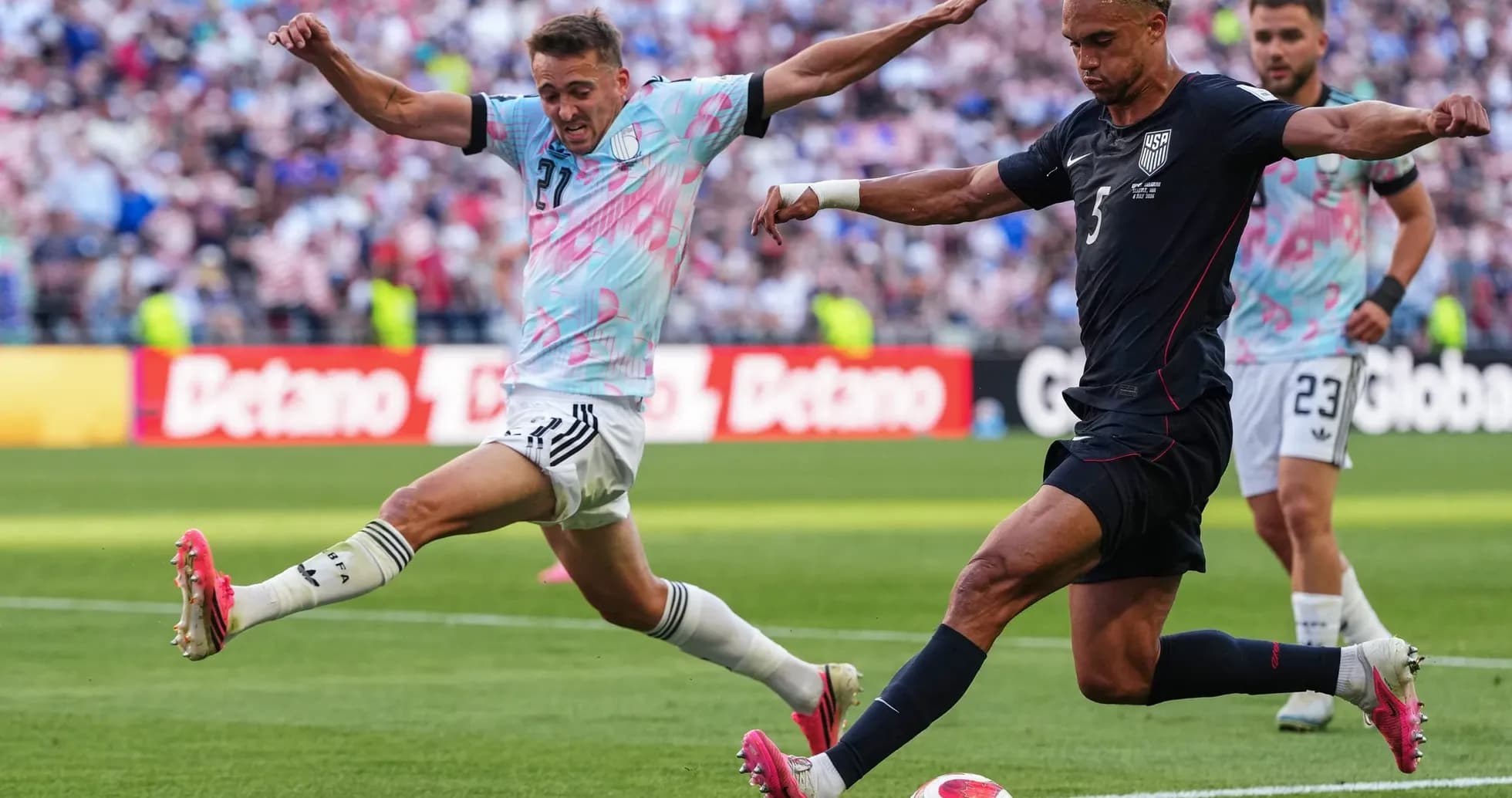
USA’s Round of 16 defeat to Belgium at Lumen Field was defined less by possession and structure, and more by the stark difference in penalty-box quality and individual execution. Mauricio Pochettino’s USA controlled 56% of the ball, built carefully from a 4-3-3 base, and completed 527 passes at 87% accuracy, yet were routed 1-4 by a Belgian side that turned 44% possession and a 4-2-3-1 shape into 15 total shots, 10 from inside the box, and four clinical goals.
USA's Structure
Structurally, USA’s 4-3-3 was orthodox: Matthew Freese in goal behind a back four of Alexander Freeman, Chris Richards, Tim Ream and Antonee Robinson. Tyler Adams anchored midfield with Weston McKennie and Malik Tillman as dual No.8s, while Sergiño Dest and Christian Pulišić flanked Folarin Balogun up front. On paper this offered numerical control in midfield and natural width; in practice, it left large defensive gaps when possession was lost.
Belgium's Structure
Belgium’s 4-2-3-1 under Rudi Garcia was compact and vertical. Thibaut Courtois sat behind a back four of Timothy Castagne, Nathan Ngoy, Brandon Mechele and Maxim De Cuyper. Amadou Onana and Nicolas Raskin formed the double pivot, with Dodi Lukebakio and Leandro Trossard wide, Youri Tielemans central, and Charles De Ketelaere as the nominal striker. The key pattern was Belgium’s willingness to sit off, then break quickly into the channels between USA’s full-backs and centre-backs.
Opening Goal
The opening goal at 9’ encapsulated the tactical mismatch. With USA’s full-backs high and the midfield line stretched, Belgium found Raskin between the lines. His assist into De Ketelaere exploited the space behind the USA back line, with no effective pressure on the ball-carrier and poor depth control from Richards and Ream. Belgium’s early 1-0 lead allowed them to lean even more into a transition-heavy plan.
USA's Equaliser
USA’s equaliser at 31’, finished by Tillman, came from their best structural phase: sustained possession, shorter combinations, and midfielders arriving in advanced pockets. It showed that when the USA three in midfield could rotate and pin Belgium’s double pivot, they could create central penetration. But the response just two minutes later at 33’—De Ketelaere again, this time assisted by Trossard—highlighted USA’s recurring issue: rest defence. With both full-backs again advanced, Belgium attacked quickly down the flank, Trossard delivering and De Ketelaere exploiting loose marking in the box. The 2-1 scoreline at half-time reflected Belgium’s superior box presence rather than territorial dominance.
USA's Pressing
Out of possession, USA’s pressing was sporadic rather than cohesive. Balogun led the line, but the wingers and No.8s often arrived a beat late, allowing Belgium to play through the first line and find Tielemans or the wide midfielders on the half-turn. Belgium’s 410 passes at 81% accuracy were not about sterile circulation; they were efficient connections into dangerous zones, particularly with 10 shots inside the box compared to USA’s 5.
Second Half Substitutions
The second half substitutions subtly altered the tactical picture. At 46’, Giovanni Reyna (IN) came on for Dest (OUT), suggesting Pochettino wanted more creativity between the lines and perhaps a shift in how the right flank operated. However, this also removed a natural wide runner and an additional defensive presence on that side, further exposing the full-back channel in transitions.
Belgium’s switch at 21’—Hans Vanaken (IN) for Onana (OUT)—was pivotal. Vanaken’s arrival added an extra line-breaking passer and late runner, and his influence was clear in the third goal at 57’. That goal, scored by Vanaken and assisted by De Ketelaere, stemmed from Belgium’s ability to overload central zones: Vanaken arriving from deep against a USA midfield that struggled to track his runs once play broke USA’s first line.
At 59’, Sebastian Berhalter (IN) replaced Pulišić (OUT), a move that tilted USA further towards central control but at the cost of their most direct individual threat. Later, at 72’, Ricardo Pepi (IN) came on for Adams (OUT), effectively sacrificing the screening No.6 to add another forward. While logical in chase mode, it further weakened USA’s defensive structure in front of the back four.
Belgium's Late Changes
Belgium’s 67’ double change—Jérémy Doku (IN) for Lukebakio (OUT) and Romelu Lukaku (IN) for De Ketelaere (OUT)—refreshed their vertical threat. Doku’s direct running pinned USA’s full-backs deeper, while Lukaku provided a more traditional reference point up front, occupying centre-backs and creating space for Vanaken and Tielemans to arrive from midfield. The late 89’ changes, Alexis Saelemaekers (IN) for Trossard (OUT) and Axel Witsel (IN) for Raskin (OUT), consolidated control and added fresh legs to close out the game.
Final Blow
The final blow at 90+3’, Lukaku scoring from a Vanaken assist, was the logical conclusion of these dynamics: a powerful striker attacking a tiring back line that no longer had a dedicated holding midfielder screening in front. USA’s defensive line was again exposed, and Belgium’s superior timing of runs and delivery into the box made the difference.
Goalkeeping Performance
In goal, Matthew Freese (USA) made 3 saves, but with Belgium generating 7 shots on target and 2.15 xG, the defensive unit in front of him was consistently overrun in high-value areas. Thibaut Courtois (Belgium), by contrast, faced only 2 shots on target and made 1 save, protected by a compact block that forced USA into lower-quality efforts; USA’s xG of 0.67 underlines how rarely they created clear chances despite their possession.
Statistical Summary
Statistically, the match tells a coherent tactical story. USA’s 56% possession and superior passing volume (527 passes to Belgium’s 410) did not translate into control of the penalty area. With only 7 total shots and 5 inside the box, they lacked both volume and quality in their finishing positions. Belgium’s 15 shots, 10 from inside the area, reflect a game plan built on targeted, high-impact attacks rather than long spells on the ball.
Discipline
Discipline also played a minor but telling role. USA committed 11 fouls to Belgium’s 9 and collected 2 yellow cards, both for “Tripping” (McKennie at 35’, Tillman at 69’), a sign of being half a step late in duels as Belgium broke through pressure. Belgium, with 0 yellow cards and 0 red cards recorded, managed their defensive actions more cleanly.
Broader Lens
From a broader lens, Belgium’s performance aligns with a high “Defensive Index”: low shots conceded on target (2), strong box protection (4 blocked shots), and the ability to turn limited possession into efficient, high-xG chances. USA’s overall form with the ball—good circulation, high pass accuracy—was undermined by structural issues in transition, insufficient rest defence, and an inability to convert territorial advantage into genuine threat. The 1-4 scoreline is a tactical reflection of Belgium’s ruthlessness in the spaces USA repeatedly left unprotected.