.svg&w=384&q=75 "naujapitch logo")
Paraguay vs France: Clash of Footballing Identities in the World Cup
Lincoln Financial Field staged a clash of contrasting footballing identities as Paraguay’s compact, counter‑punching unit met a France side that has treated this World Cup as an extended demonstration of attacking superiority. The Round of 16 backdrop sharpened every tactical choice: Paraguay arrived as Group D’s third-placed side with 4 points and a goal difference of -2, France as Group I winners, perfect with 9 points and a goal difference of 8. The 1–0 full-time score in France’s favour felt narrow, but it was the logical extension of their broader seasonal DNA.
I. The Big Picture – Structures and Seasonal Identities
Paraguay’s season numbers told the story of their game plan before a ball was kicked. Overall this campaign they had played 5 matches, winning 2, drawing 1 and losing 2. Their attacking output was modest: in total this campaign they had scored 4 goals, with an overall average of 0.8 goals per game. At home they had yet to score, averaging 0.0, and on their travels they averaged 1.3 goals. Defensively, they had conceded 6 goals overall, 1 at home and 5 away, for an overall average of 1.2 goals against (0.5 at home, 1.7 away). That balance – 4 scored, 6 conceded – underpinned a cautious, reactive outlook.
France, by contrast, arrived as a machine in full flow. Overall they had also played 5 matches but won all 5, with no draws or defeats. In total this campaign they had scored 14 goals, split as 9 at home and 5 away, for a prolific overall average of 2.8 goals per game (3.0 at home, 2.5 on their travels). Defensively, they had conceded just 2 in total, 1 at home and 1 away, for an overall average of 0.4 goals against (0.3 at home, 0.5 away). Their goal difference of 12 (14 scored, 2 conceded) framed them as the tournament’s apex predator.
Those numbers were mirrored in the lineups. Gustavo Alfaro’s choice of a 5‑4‑1 for Paraguay, with O. Gill behind a five‑man line of J. Alonso, O. Alderete, G. Gomez, G. Velazquez and J. Caceres, signalled a low block and heavy emphasis on protecting central spaces. In front, A. Cubas and D. Gomez were tasked with screening, while M. Galarza and M. Almiron were asked to shuttle wide and support the lone forward J. Enciso on the break.
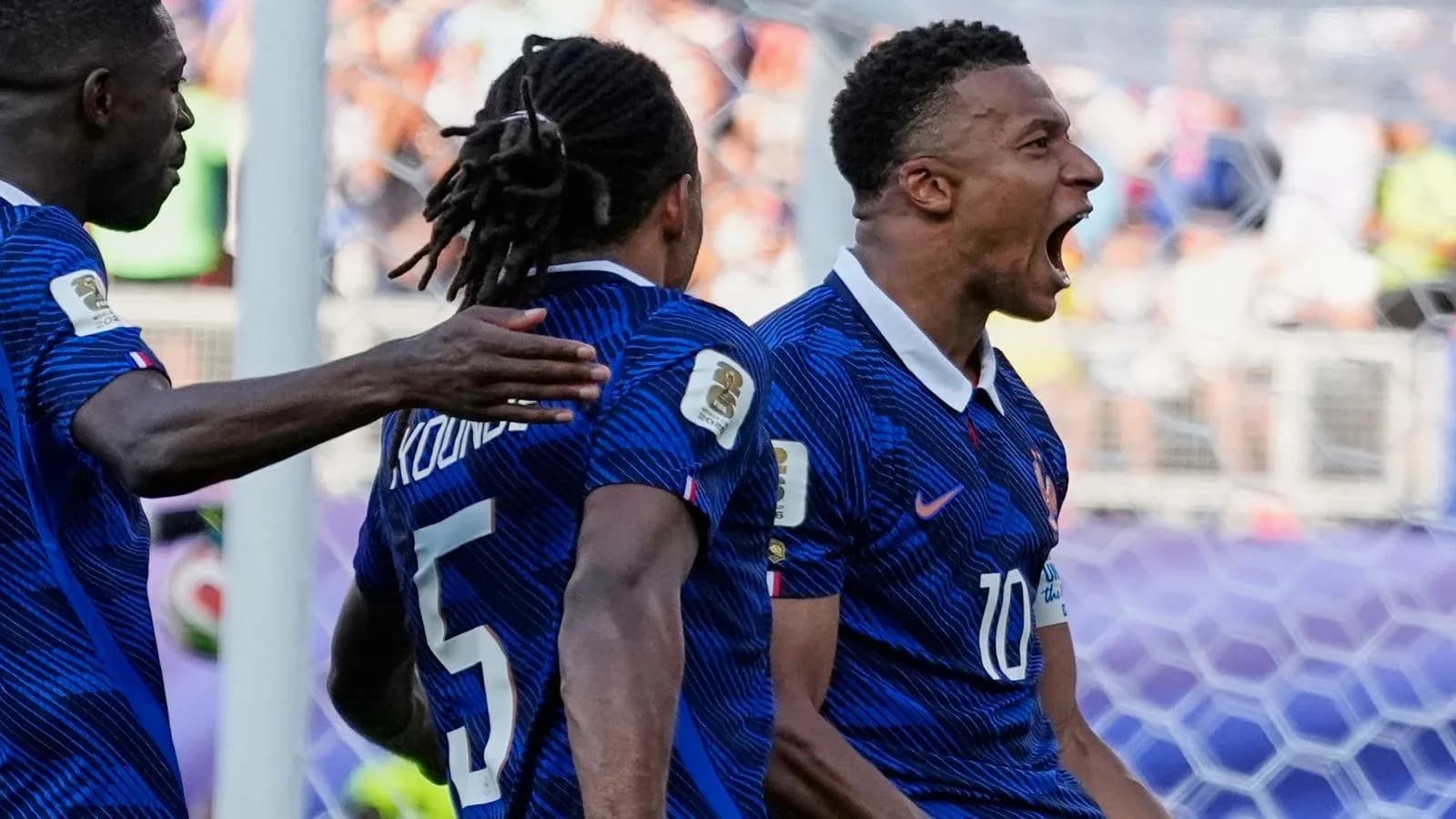
Didier Deschamps doubled down on France’s established identity with a 4‑2‑3‑1 that has been both ruthless and balanced. M. Maignan anchored a back four of L. Digne, W. Saliba, D. Upamecano and J. Kounde, with M. Kone and A. Rabiot forming the double pivot. Ahead of them, the trio of B. Barcola, M. Olise and O. Dembele provided width and creativity behind K. Mbappe, the tournament’s standout attacker with 7 goals and 2 assists across 5 appearances, at an average rating of 8.38.
II. Tactical Voids – Discipline, Risk and the Fine Line
Paraguay’s disciplinary profile framed one of the evening’s key tensions. Overall this campaign they had shown a willingness to live on the edge: their yellow cards peaked late, with 33.33% arriving between 76–90 minutes and 22.22% in the opening 15. Crucially, their only red card this season had come between 46–60 minutes – and the man at the centre of that statistic, M. Almiron, started again here. His record of 1 red and 1 yellow in 4 appearances underlined both his importance and volatility.
In midfield, D. Gomez and M. Galarza arrived as high-contact, high-card operators. D. Gomez had already collected 2 yellows, while M. Galarza had 2 yellows of his own, committing 10 fouls in 4 games. Their role was clear: disrupt France’s rhythm, even at the cost of bookings.
France, by contrast, had navigated the group with controlled aggression. Overall they had spread their yellow cards evenly, with 25.00% in each of the 16–30, 61–75, 76–90 and 91–105 minute bands, and no red cards. That discipline allowed Deschamps to maintain structural integrity late in games while still pressing high.
The absence list contained no data, meaning both coaches could lean fully on their core structures. For Paraguay, that meant no safety net if their already card-prone midfield slid into reckless territory against France’s relentless rotations between the lines.
III. Key Matchups – Hunter vs Shield, Engine Room vs Engine Room
The headline duel was always going to be K. Mbappe against Paraguay’s deep block. Mbappe’s tournament so far – 7 goals from 24 shots (17 on target) and 2 assists – has made him the purest expression of France’s firepower. Facing him was a Paraguay defence that, in total this campaign, had conceded 6 goals and kept 2 clean sheets, one at home and one away. Their biggest away defeat, 4–1, hinted at what happens when their line is forced to defend repeatedly in transition.
At the heart of that shield, G. Gomez and O. Alderete were tasked with stepping into Mbappe’s path, while wing‑backs J. Alonso and J. Caceres had to track the wide threats of Dembele and Barcola. Dembele, with 4 goals and 2 assists in 5 appearances, and Barcola’s direct running, ensured that Paraguay could not simply collapse centrally.
The creative axis tilted heavily towards France. M. Olise arrived as the competition’s leading assist provider with 5 assists in 5 games, underpinned by 270 passes at 88% accuracy and 10 successful dribbles from 17 attempts. His duel with Paraguay’s interior pair of Cubas and D. Gomez was the “engine room” battle: Olise drifting into half-spaces, D. Gomez (11 tackles, 2 blocked shots, 9 interceptions overall) trying to cut off his supply without succumbing to the rash challenge that has already produced 2 yellows and a conceded penalty this campaign.
For Paraguay, the counter‑punch was built around J. Enciso. With 1 goal and 2 assists in 5 appearances, plus 28 dribble attempts (13 successful), Enciso was their out‑ball and their chaos agent. His task was to isolate Saliba or Upamecano, force them into wide duels and buy breathing space for a side that had failed to score in 2 home matches and relied on away productivity to reach this stage.
IV. Statistical Prognosis – Why France’s Edge Was Always Likely
From a probabilistic lens, the matchup skewed heavily towards France. Overall, France’s attack at 2.8 goals per game against a Paraguay defence conceding 1.2 suggested that, even if Alfaro’s side executed their low block well, the French would generate enough volume to find at least one breakthrough. On the other side, Paraguay’s overall average of 0.8 goals for, set against a France defence allowing only 0.4 per match and boasting 3 clean sheets in 5 games, implied that any Paraguayan goal would be an outlier moment rather than an expectation.
Paraguay’s late‑game yellow‑card surge (33.33% between 76–90 minutes) intersected dangerously with France’s tendency to keep pushing deep into matches, as evidenced by their consistent yellow spread but zero reds. As the clock ticked, the likelihood of a decisive French chance – perhaps via Mbappe’s penalty threat (1 scored from 1 taken) or a late Olise delivery – only grew.
In the end, the 1–0 scoreline reflected the structural truth of these squads. Paraguay’s 5‑4‑1 and combative midfield gave them a fighting chance to drag the contest into a coin‑flip, but France’s blend of individual brilliance from Mbappe and Dembele, orchestration by Olise, and defensive calm from Saliba and Upamecano made them the more sustainable proposition over 90 minutes. Following this result, the numbers and the narrative remain aligned: France advance as a side whose underlying metrics still point towards a deep run, while Paraguay exit having stretched their defensive identity to its absolute limit against the tournament’s most complete squad.