.svg&w=384&q=75 "naujapitch logo")
Spain's Tactical Victory Over Portugal in World Cup Round of 16
Portugal’s 0-1 defeat to Spain at AT&T Stadium in this World Cup Round of 16 tie was decided on fine tactical margins, with Spain’s structural control and superior shot quality eventually breaking a disciplined but increasingly passive Portuguese block.
Spain’s approach was built around a clear possession hierarchy. With 55% of the ball and a passing profile of 531 passes, 467 accurate (88%), Luis de la Fuente’s side used Rodri as the central stabiliser, dropping between Pau Cubarsí and Aymeric Laporte to form a three-man first line. This allowed the full-backs Pedro Porro and Marc Cucurella to advance and pin Portugal’s wide players, while Pedri, Dani Olmo, Alex Baena and Lamine Yamal rotated between the lines to overload the half-spaces. The result was a steady stream of territorial pressure and a shot map tilted towards quality: 15 total shots, 6 on goal, and an xG of 1.77.
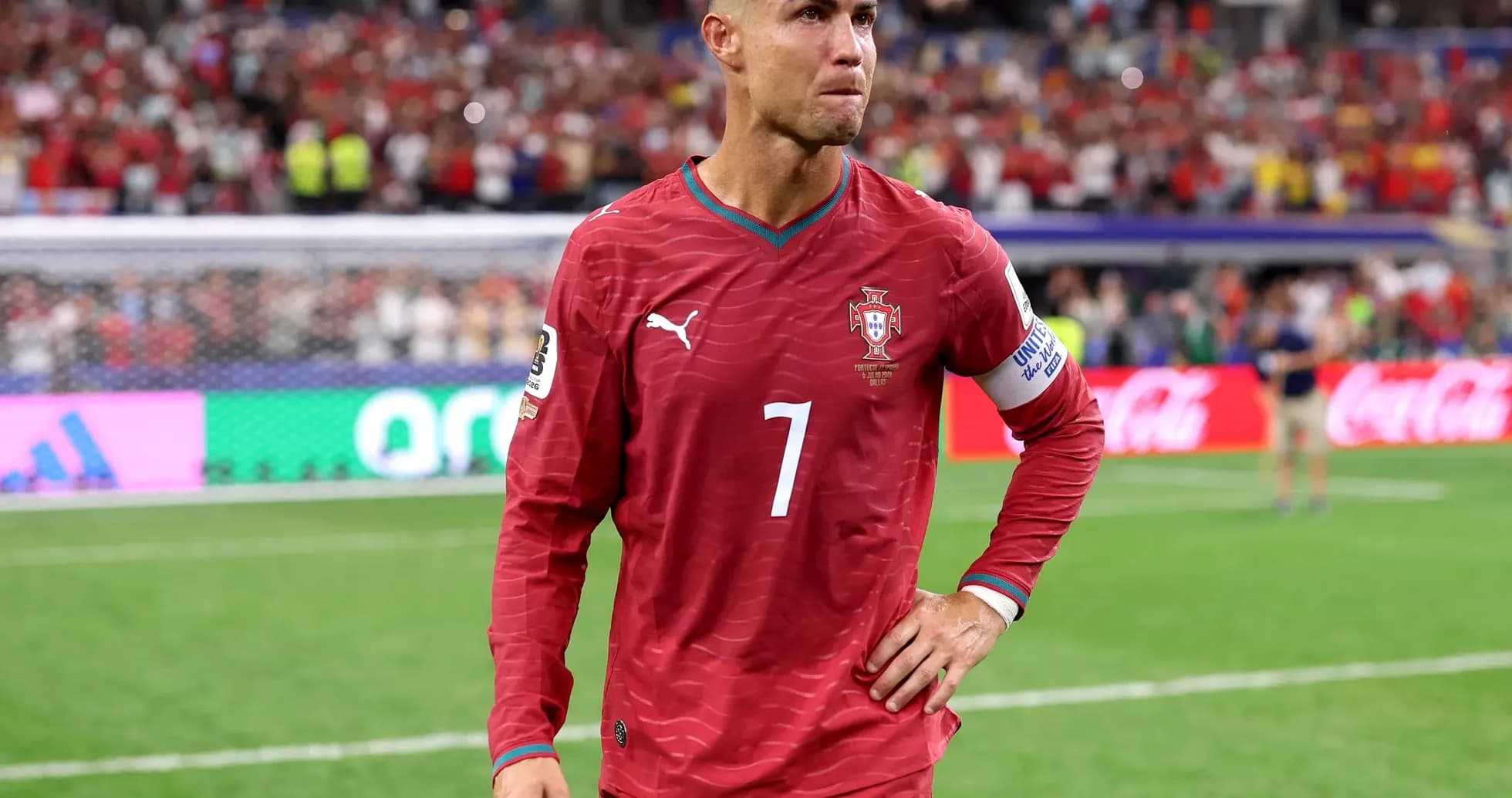
Portugal, by contrast, accepted a more reactive role. With 45% possession and 426 passes, 357 accurate (84%), Roberto Martinez’s team tried to compress central zones in front of Rúben Dias and Renato Veiga, using Vitinha and João Neves as screeners. The front line of Cristiano Ronaldo, João Félix and Pedro Neto initially looked geared to spring transitions, but the team finished with only 10 total shots and 2 on goal, for an xG of 0.58. The numbers underline the tactical story: Portugal’s block was reasonably solid, but they struggled to convert regains into sustained attacks or high-quality chances.
Out of possession, Portugal set up in a mid-to-low block, with Bruno Fernandes often dropping to create a narrow midfield three, leaving Ronaldo higher to threaten depth. This compactness did limit clear central entries for Spain for long stretches, forcing De la Fuente’s side to circulate and probe patiently. However, Spain’s 7 corner kicks to Portugal’s 3 show how frequently they reached the final third and forced defensive set-pieces, a direct consequence of their territorial dominance and ability to keep Portugal pinned back.
The key adjustments came through substitutions. For Portugal, the 56' change saw Nélson Semedo (IN) come on for Nuno Mendes (OUT), subtly reshaping the right side and adding a more conservative full-back profile, hinting at a desire to protect against Spain’s wide threats rather than chase the game. At 71', Diogo Dalot (IN) for João Cancelo (OUT) and Rafael Leão (IN) for João Félix (OUT) signalled a late attempt to inject verticality and direct dribbling threat, particularly through Leão. Later, at 83', Bernardo Silva (IN) for Vitinha (OUT) and Francisco Conceição (IN) for Pedro Neto (OUT) added technical quality and one-v-one ability, but these changes came against a backdrop of deepening Spanish control and did not translate into a meaningful increase in shot volume or xG.
Spain’s bench was more directly tied to the decisive moment. At 75', Ferran Torres (IN) replaced Alex Baena (OUT), adding a more vertical, penalty-box-oriented presence. Then, at 85', Mikel Merino (IN) came on for Dani Olmo (OUT) and Fabián Ruiz (IN) for Pedri (OUT), injecting fresh legs and aerial presence in midfield. The winning goal at 90+1' by Mikel Merino, assisted by Ferran Torres, was the purest expression of this bench impact: a late-arriving midfielder attacking space created by a forward’s movement, capitalising on a Portugal block that had finally started to crack under sustained pressure.
Discipline and game management also reflected the tactical battle. Spain committed 13 fouls to Portugal’s 9, an indicator of how often they were prepared to disrupt potential transitions once possession was lost. Ferran Torres’ late yellow card for “Foul” at 90+9' came in a phase where Spain were protecting their lead, using tactical fouls to slow Portugal’s final pushes. For Portugal, Bernardo Silva and Renato Veiga both received yellows for “Foul” in the closing minutes (89' and 90+4'), symptomatic of a side forced into riskier challenges as their defensive structure stretched in search of an equaliser.
In goal, Diogo Costa (Portugal) and Unai Simón (Spain) underlined the difference in shot quality and pressure. Diogo Costa (Portugal) made 5 saves and, crucially, his goals prevented figure of 0.87 suggests he performed above expectation relative to the xG he faced (1.77 for Spain). He kept Portugal in the contest deep into stoppage time, particularly as Spain’s shot volume and centrality increased. Unai Simón (Spain), by contrast, registered 2 saves with the same goals prevented value of 0.87, a sign that while Portugal generated fewer on-target attempts, the quality of those few chances was non-trivial. Spain’s defensive structure in front of him, anchored by Rodri and the centre-backs, limited Portugal mostly to lower-probability efforts, reflected in their 0.58 xG.
The blocked shots tally — 3 for each side — shows that both teams defended their boxes with commitment, but Spain’s superior number of shots inside the box (8 to Portugal’s 7) and their higher total attempts underline a more consistent ability to work the ball into dangerous zones. Portugal’s attacking pattern was more sporadic: occasional flurries, often reliant on individual quality rather than a repeatable mechanism for breaking Spain’s press and mid-block.
In statistical terms, Spain’s victory was aligned with the underlying metrics. They outshot Portugal 15-10, led 6-2 in shots on goal, held the possession edge at 55-45, and generated triple the xG. Portugal’s defensive game plan nearly forced extra time, thanks in large part to Diogo Costa (Portugal) and a compact central block, but their inability to turn regains and late attacking substitutions into sustained pressure left them vulnerable to exactly the kind of late, bench-driven winner that Mikel Merino delivered.