.svg&w=384&q=75 "naujapitch logo")
Mexico vs England: Tactical Analysis of 3-2 Defeat at Estadio Azteca
Mexico’s 3-2 defeat to England at Estadio Azteca was a study in contrasting game models: Mexico’s territorial, possession-heavy 4-3-3 against England’s ruthlessly vertical 4-2-3-1 that maximised efficiency before digging in with ten men. Across 90 minutes, Mexico controlled the ball and the territory, but England controlled the scoreboard and key transition moments in this Round of 16 tie.
Mexico's 4-3-3 Structure
Javier Aguirre’s 4-3-3 was built on a clear idea: long, sustained spells in England’s half. Mexico completed 420 of 455 passes (92%) and held 67% possession, reflecting a structure where Erik Lira sat as the pivot, with Gilberto Mora and Luis Romo initially as the shuttlers ahead of him. Full-backs Jorge Sánchez and Jesús Gallardo pushed high and wide to pin England’s wingers, while Roberto Alvarado and Julián Quiñones tucked inside off the flanks to support Raúl Jiménez between the lines.
In settled play, Mexico often resembled a 2-3-5 in attack. César Montes and Johan Vásquez stayed on halfway, Lira dropped between them or alongside to form the first line of circulation, and both full-backs advanced into the second line. This allowed Mexico to generate volume: 20 total shots, with 12 inside the box and 7 blocked, indicating that England’s low block spent long periods defending their own area. However, the shot profile showed a lack of clear separation: only 5 shots on goal from those 20 attempts, broadly aligned with an xG of 1.87.
England's Tactical Approach
England, under Thomas Tuchel, accepted a back-foot role from the outset. The 4-2-3-1 was compact and narrow, with Declan Rice and Elliot Anderson screening the central lanes in front of Ezri Konsa and Marc Guéhi. With only 244 passes (80% accuracy) and 33% possession, England’s plan was not to compete for the ball but to win the moments. Their 6 total shots, 5 of them on target and 4 from inside the box, matched an xG of 1.55 and underlined just how clean their chances were when they did break through.
First Half Dynamics
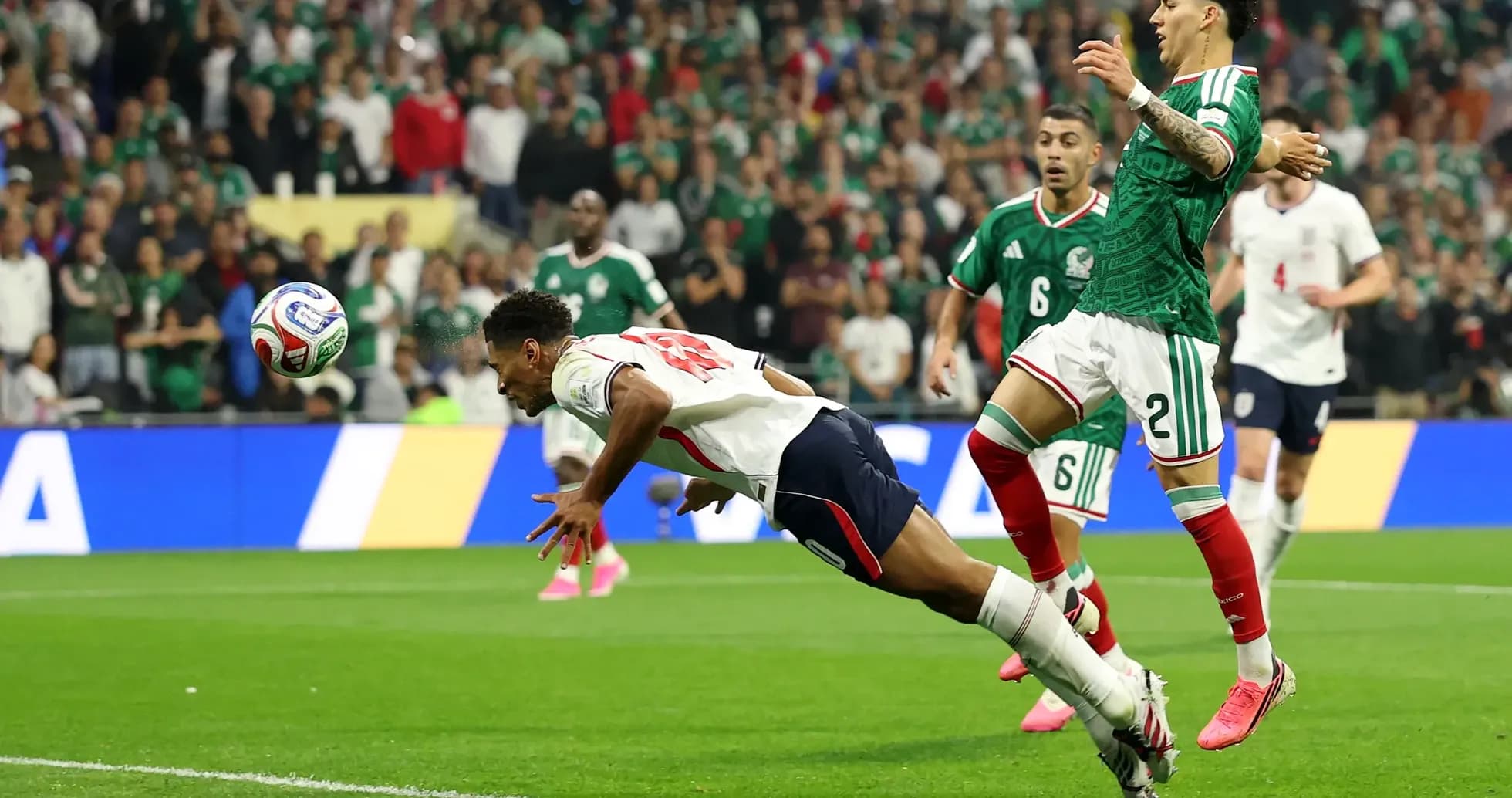
The first-half pattern was consistent: Mexico pushed, England struck. Jude Bellingham’s two goals, both in the 36th and 38th minutes, were classic examples of England’s verticality. Once they bypassed Mexico’s first press, the spaces around and behind Lira became exploitable, especially with Harry Kane dropping off the front line to connect play and Bukayo Saka and Anthony Gordon attacking the channels. Mexico’s midfield three struggled to control Bellingham’s late arrivals from the “10” space, and the centre-backs were reluctant to step out for fear of exposing the back line.
Quiñones’ goal on 42 minutes showed the other side of the tactical coin: Mexico’s ability to sustain pressure. With England’s block retreating deeper, Mexico could recycle possession around the box, forcing repeated defensive actions. England registered 0 blocked shots, highlighting that most Mexican attempts either missed the target or were saved or deflected by last-line interventions rather than being closed down at source. Mexico’s problem was not reaching shooting positions, but turning those into truly high-quality looks.
Second Half Changes
After half-time, the game state shifted dramatically with Jarell Quansah’s red card on 54 minutes for “Serious foul.” Tuchel reacted by reinforcing the back line and sacrificing some attacking width: Bukayo Saka (OUT) for John Stones (IN) at 57 minutes and later Nico O’Reilly (OUT) for Djed Spence (IN) at 74 minutes, Elliot Anderson (OUT) for Dan Burn (IN) at 75 minutes. England morphed into a deeper, more conservative structure, often a 5-3-1 or 4-4-1 depending on the phase, with Harry Kane acting as the lone outlet until his own substitution at 90 minutes for Morgan Rogers.
Remarkably, England still found a way to extend their lead with Kane’s penalty on 60 minutes. That moment was crucial tactically: it allowed England to fully commit to a low block with ten men, prioritising compactness in the box and aggressive protection of the central lane. From that point, Mexico’s dominance of the ball increased, but the quality of chances only marginally improved. Jiménez’s penalty at 69 minutes brought the score to 3-2 and intensified the siege, but England’s structural discipline held.
Defensive Struggles and Set-Pieces
Defensively, England’s back line was constantly under stress. With 12 Mexican corners to England’s 2, set-piece defending became a major phase of the game. Konsa and Guéhi, supported by Rice dropping between them, repeatedly attacked first balls, while the full-backs tucked in to protect the six-yard box. The fact that Mexico could not convert any of these situations into further goals underlines England’s aerial organisation and box defending, even with a man down.
Mexico's Tactical Adjustments
On the Mexican side, Aguirre’s in-game management was clearly aimed at adding more punch between the lines and in the box. At 46 minutes, Edson Álvarez (IN) came on for César Montes (OUT), effectively pushing Mexico into a more aggressive rest-defence shape, with Álvarez providing a more mobile presence in the first build-up line and freeing Lira to step higher. The double change at 61 minutes — Santiago Giménez (IN) for Gilberto Mora (OUT) and Brian Gutiérrez (IN) for Luis Romo (OUT) — turned the 4-3-3 into something closer to a 4-2-4/4-2-3-1 hybrid, with two central forwards and a more direct presence in the area.
Later, Jorge Sánchez (OUT) for Álvaro Fidalgo (IN) at 79 minutes and Julián Quiñones (OUT) for Guillermo Martínez (IN) at 81 minutes completed the shift to a full attacking posture. Gallardo effectively became a wing-back on the left, with Fidalgo operating as an extra midfielder/playmaker on the right and multiple forwards occupying the last line. This overload created volume but also left Mexico exposed to any potential English counters; England, however, were largely content to simply clear and reset.
Goalkeeper Performances
In goal, Raúl Rangel (Mexico) made 2 saves, a low number that reflects England’s limited but highly efficient shot volume rather than any lack of involvement. Jordan Pickford (England) made 3 saves, crucial in a context where Mexico were constantly probing around the box and forcing him to manage crosses, second balls, and the occasional clean look from inside the area. Both goalkeepers’ “goals prevented” figures sit at -0.15, indicating they conceded very close to the expected value of the chances they faced.
Discipline and Tactical Tone
Discipline also shaped the tactical tone. England committed only 7 fouls but took 4 yellow cards and 1 red, many of them for “Unsportsmanlike conduct” or “Roughing,” which speaks to the intensity of their defensive duels under pressure. Mexico, with 14 fouls and 2 yellow cards, used tactical fouling higher up the pitch to slow England’s transitions, but their inability to stop Bellingham’s early runs or to defend the penalty-box actions cleanly proved decisive.
Statistical Overview
Statistically, Mexico’s 1.87 xG versus England’s 1.55 xG supports the eye test: the hosts created slightly more and better chances over the full match. Yet England’s clinical edge — 5 shots on goal from 6 total shots and 3 goals scored — contrasted with Mexico’s less efficient finishing. Mexico’s passing dominance and territorial control did not translate into a sufficient number of clear, unpressured shots on target, while England’s entire attacking plan was geared towards ensuring that when they did shoot, it was from prime locations.
Conclusion
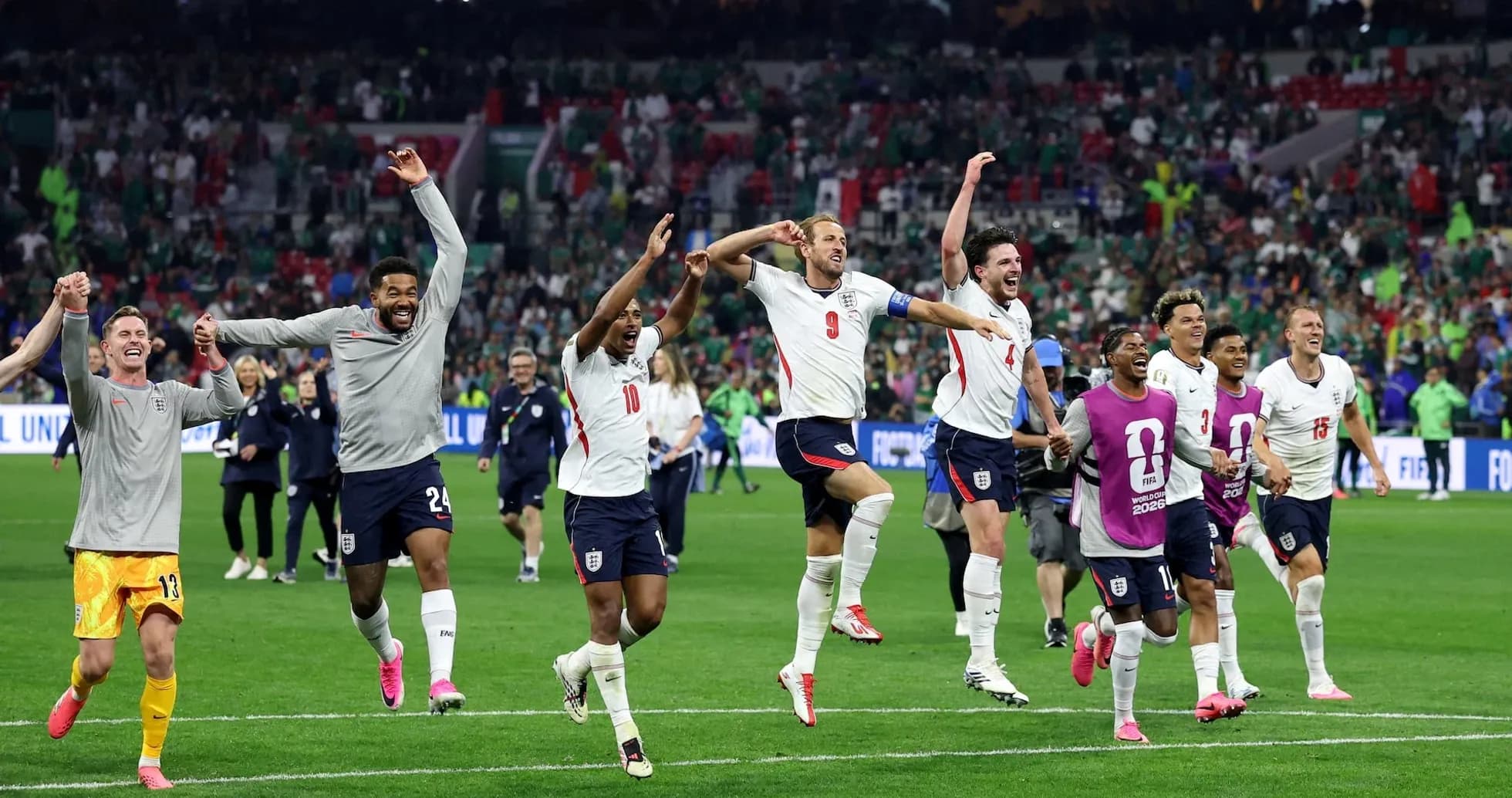
In tactical terms, this was a game where Mexico’s structure, possession, and late attacking waves were not quite enough to overcome England’s superior exploitation of transition moments and their disciplined, adaptable defensive block once reduced to ten men.