.svg&w=384&q=75 "naujapitch logo")
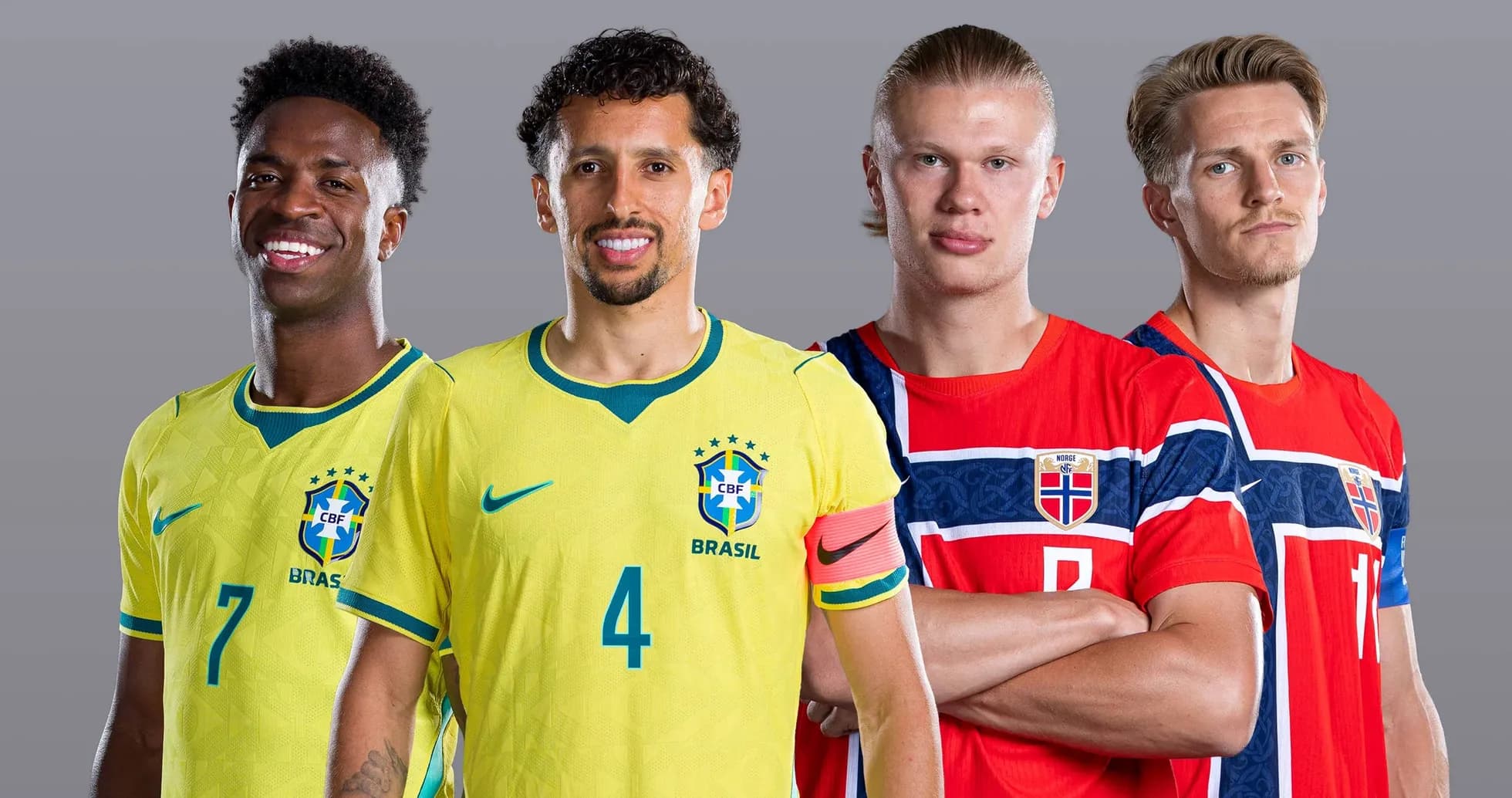
Brazil vs Norway: Tactical Clash in World Cup Round of 16
Brazil’s 2-1 defeat to Norway at MetLife Stadium in this World Cup Round of 16 tie was defined by a stark clash of styles: Brazil’s vertical, transition-heavy approach against Norway’s methodical, possession-based structure. Despite creating more shots and a far higher xG (2.73 to 0.84), Brazil were outmanoeuvred in key moments, while Norway’s control of the ball (66% possession) and efficiency in the final third, led by Erling Haaland, proved decisive.
Norway’s game plan was built around long, patient passing sequences and positional control. With 680 total passes and 617 accurate (91%), Stale Solbakken’s side used a three‑man midfield of Martin Ødegaard, Sander Berge and Patrick Berg to dominate central zones. They circulated the ball to stretch Brazil laterally, then looked to connect into Haaland, Alexander Sørloth and Antonio Nusa between and beyond Brazil’s centre-backs. The relatively low shot volume (9 total, 7 inside the box) underlines how selective Norway were: they worked attacks to high-value zones rather than shooting on sight.
Brazil, by contrast, played a much more direct, punchy game. Carlo Ancelotti’s team attempted 329 passes (279 accurate, 85%), less than half of Norway’s volume, leaning on vertical deliveries into Matheus Cunha and Vinícius Júnior and rapid wide combinations, particularly through Gabriel Martinelli and overlapping full-backs. The shot profile reflects this aggression: 14 total shots, 10 inside the box, and 4 blocked. Brazil consistently got into dangerous areas, but their finishing and decision-making under pressure were wasteful, epitomised by Bruno Guimarães’ missed penalty at 14'.
The penalty sequence early on showed both sides’ mental dynamics. VAR confirmed a spot-kick for Brazil at 12', giving them a golden chance to impose scoreboard pressure on a possession-dominant Norway. The miss kept the game level and allowed Norway to continue controlling tempo without having to chase the score. That single moment altered the tactical landscape: instead of being forced into riskier structures, Norway could maintain their measured build-up.
Second Half
In the second half, Solbakken’s substitutions sharpened Norway’s attacking mechanisms. At 46', Andreas Schjelderup (IN) came on for Antonio Nusa (OUT), and Oscar Bobb (IN) replaced Alexander Sørloth (OUT). Schjelderup immediately became a key connector, later assisting both of Haaland’s goals. His positioning between the lines and ability to receive under pressure gave Norway an extra playmaking link, especially as Brazil began to open up chasing the game. The 63' change, with Fredrik Aursnes (IN) for Julian Ryerson (OUT), further stabilised Norway’s left side, improving their rest defence and ball retention in wide areas.
Brazil’s substitutions were more reactive and individually oriented. At 58', Endrick (IN) came on for Matheus Cunha (OUT), adding fresh energy and depth running but not fundamentally altering the structure. The double change at 68' — Danilo Santos (IN) for Rayan (OUT) and Neymar (IN) for Gabriel Martinelli (OUT) — shifted Brazil towards a more creative, centralised attack. Neymar’s introduction eventually yielded the 90+9' penalty conversion, but it also coincided with Brazil’s shape becoming stretched, leaving more space for Norway’s counters and direct runs from Haaland.
Norway’s attacking efficiency hinged on their ability to isolate Haaland against Brazil’s central defenders. With only 9 shots but 5 on target, they forced Alisson (Brazil) into 3 saves, each arising from well-constructed moves rather than speculative efforts. Haaland’s brace — both assisted by Schjelderup — came from situations where Norway had successfully drawn Brazil’s midfield out of shape, then played quickly through the channels. Their 7 shots inside the box from 9 total underline how effectively they engineered clear looks rather than volume.
Defensively, Norway’s control of possession functioned as their primary protection. With 66% of the ball and just 6 fouls, they rarely had to resort to disruptive tactics or emergency defending. The back line, anchored by Kristoffer Ajer and Torbjørn Heggem, benefited from the midfield’s ability to slow Brazil’s transitions at source. Brazil did generate 4 shots on goal, but Ørjan Nyland (Norway) responded with 4 saves, matching that total and effectively neutralising Brazil’s xG advantage with high-quality goalkeeping and compact box defending.
Brazil’s defensive structure struggled more as the game wore on. With only 7 fouls and a single yellow card (Neymar for “Foul” at 90+6'), they did not impose enough physical or tactical disruption on Norway’s rhythm. The full-backs’ forward ambition, combined with midfielders stepping high to press Norway’s build-up, often left Marquinhos and Gabriel Magalhães exposed to direct balls into Haaland. Once Norway added Schjelderup and later Aursnes, they consistently found ways to progress through or around Brazil’s first line of pressure.
Set plays and wide restarts were relatively balanced, with both sides winning 5 corner kicks. However, neither team’s corner routines materially changed the game state; the decisive actions came in open play and from penalties. Offside lines were well managed on both sides (1 offside each), indicating disciplined defensive lines and timing in attacking runs.
The expected goals split — 2.73 for Brazil against 0.84 for Norway — encapsulates the tactical paradox. Brazil’s approach produced more and better chances in volume, but their lack of clinical edge and one critical early penalty miss undermined the plan. Norway, operating with far fewer opportunities, maximised their moments through structure, substitutions and the individual quality of Haaland and Schjelderup. In knockout football, their model of territorial and possession control, combined with ruthless exploitation of Brazil’s defensive imbalances, proved superior to Brazil’s more chaotic, transition-heavy blueprint.