.svg&w=384&q=75 "naujapitch logo")
Iran and New Zealand's Tactical Battle Ends in 2-2 Draw
Iran and New Zealand delivered a tactically nuanced 2-2 draw at SoFi Stadium, a match defined by contrasting structures and evolving control rather than chaos. Iran’s 4-4-2 under Amir Ghalenoei faced a New Zealand side in a 4-2-3-1 set by D. Bazeley, and across 90 minutes the shapes stayed broadly consistent even as roles within them shifted. The statistical balance – 48% possession and 17 shots for Iran versus 52% and 14 shots for New Zealand – mirrored a contest where each side had distinct phases of superiority, with New Zealand’s cleaner possession offset by Iran’s territorial pressure and volume of attempts.
New Zealand's Structure
New Zealand’s 4-2-3-1 was built around Chris Wood as a fixed reference point and a narrow band of three attacking midfielders underneath. Joe Bell and Marko Stamenic operated as the double pivot, giving structure in front of the back four and enabling early progression. The opening goal on 7 minutes, finished by Elijah Just and assisted by Wood, encapsulated their plan: Wood pinning the centre-backs, receiving early service, and combining into the half-spaces for the wide attacking midfielders to exploit. With 446 total passes and 377 accurate (85%), New Zealand showed a clear preference for controlled buildup and circulation through Bell and Stamenic before accessing the front four.
Iran's Approach
Iran’s 4-4-2, by contrast, was more direct and vertical, using the front pair of Shahriar Moghanlou and Mehdi Taremi as dual targets and Saman Ghoddos and Saeid Ezatolahi as key connectors from central midfield. The wide midfielders, Mohammad Mohebi on one flank and Aria Yousefi on the other, played high and aggressively, often flattening the line of four into a front five in possession as full-backs Ramin Rezaeian and Milad Mohammadi advanced. Iran’s 405 total passes with 312 accurate (77%) underscored a slightly more risk-prone approach: quicker vertical balls, more entries into the box (10 shots inside the box, matching New Zealand’s 10), and a willingness to accept turnovers in exchange for territory.
Tactical Battlegrounds
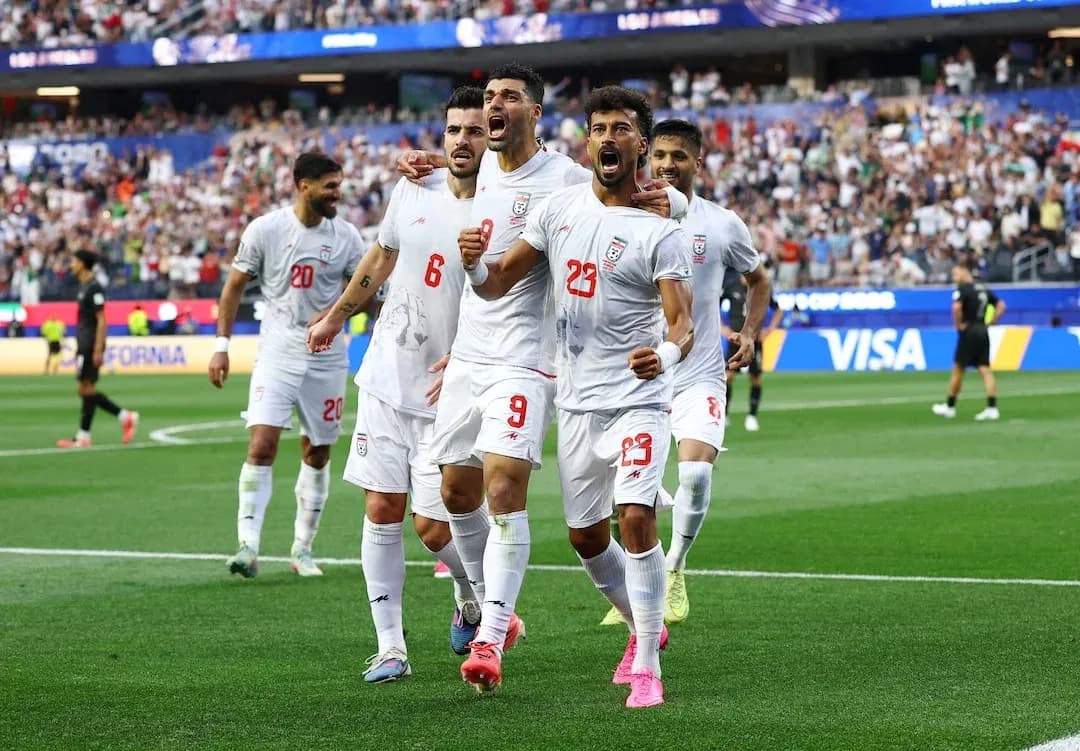
The flanks became the primary tactical battleground. On Iran’s right, Rezaeian pushed very high, frequently overlapping beyond Yousefi and later combining with Mohebi, which both created and solved problems. Offensively, his advanced positioning paid off with Iran’s first-half equaliser at 32 minutes, a goal he finished himself after arriving from deep. Later, at 64 minutes, his delivery and timing in the final third were decisive again, as he provided the assist for Mohebi’s goal that brought Iran back to 2-2. Defensively, however, his aggressive starting positions invited New Zealand to attack the space behind him, particularly in transitions through Just and Sarpreet Singh drifting into the left half-space.
On the opposite flank, Mohammadi had to balance overlapping runs with containing Tim Payne and Callum McCowatt. New Zealand’s full-backs, Payne and Liberato Cacace, were more conservative than their Iranian counterparts, stepping forward selectively rather than constantly. This allowed New Zealand to maintain a stable back line of four against Iran’s two strikers plus one wide midfielder stepping inside, which was crucial in limiting clear one-v-one situations in central zones despite Iran’s 17 total shots and 5 blocked shots.
Central Play and Adjustments
In central areas, Ezatolahi’s role as Iran’s single true holding midfielder in front of Shoja Khalilzadeh and Ali Nemati was pivotal. Against New Zealand’s double pivot, he often found himself outnumbered when Bell dropped deep and Stamenic pushed slightly higher. Iran compensated by having one of the wide midfielders, usually Ghoddos drifting inside from his nominal slot, narrow up to help create a temporary 4-3-3 structure in the defensive phase. This adjustment improved Iran’s access to New Zealand’s build-up lanes but came at the cost of leaving the full-backs more exposed in wide isolation, a trade-off that New Zealand exploited on their second goal, again through Just assisted by Wood at 54 minutes.
Substitution Patterns
The substitution patterns reflected the coaches’ attempts to tilt those dynamics. At 46 minutes, Mahdi Ghayedi (IN) came on for Yousefi (OUT), shifting Iran’s left side from a more balanced wide midfielder to a pure attacking profile. This change made Iran’s left flank more incisive in one-v-one situations and increased their ability to carry the ball into the final third, but it also further reduced their defensive cover in front of Mohammadi. At 53 minutes, Ali Alipour (IN) replaced Moghanlou (OUT), injecting more mobility and depth running into the front line. These moves collectively transformed Iran’s 4-4-2 into something closer to a 4-2-4 in attack, with both wide players high and both strikers looking to attack the box.
New Zealand’s substitutions were more about energy management and preserving structure. At 68 minutes, Benjamin Old (IN) came on for Cacace (OUT), and Ryan Thomas (IN) replaced McCowatt (OUT), refreshing both the left-back and one of the attacking midfield roles without altering the 4-2-3-1 shape. Later, at 78 minutes, Callan Elliot (IN) took over from Payne (OUT) at right-back, again a like-for-like change. In stoppage time, Jesse Randall (IN) replaced Singh (OUT) and Tyler Bindon (IN) came on for Stamenic (OUT), moves that suggested a late tilt towards shoring up the central lane and adding fresh legs in wide transition rather than chasing an all-out winner.
Defensive Strategies
Defensively, Iran’s back four had to cope with both aerial and ground threats from Wood. Khalilzadeh and Nemati focused on winning first contact and compressing the space in front of the box, while Ezatolahi screened passes into Wood’s feet as much as possible. The fact that New Zealand produced 8 shots on goal from 14 total attempts indicates that, when they did break through Iran’s first and second lines, they were able to generate relatively high-quality chances. Conversely, Iran’s 4 shots on goal from 17 attempts suggest that New Zealand’s block, anchored by Michael Boxall and Finn Surman, did a better job of forcing shots from suboptimal angles or distances, reflected in Iran’s 5 blocked shots versus New Zealand’s 2.
Goalkeeping Performances
The goalkeeping performances, while not individually quantified by name in the data, are indirectly illuminated by the team statistics. The Iran goalkeeper made 6 saves, a high workload that aligns with New Zealand’s 8 shots on target and underlines how often the 4-4-2’s aggressive full-backs left the central defenders exposed to direct or diagonal entries. On the other side, the New Zealand goalkeeper faced 4 shots on target and made 2 saves, conceding twice in situations where Iran’s overloads in wide areas and second-phase pressure created clear openings inside the box.
Discipline and Game Management
Discipline and game management also played a subtle tactical role. Iran committed 10 fouls to New Zealand’s 8, and the only card of the match came at 89 minutes: Ehsan Hajsafi (Iran) — Tripping. Introduced earlier as a substitute for Ghoddos, Hajsafi’s booking reflected Iran’s increasingly urgent attempts to disrupt New Zealand’s late transitions and prevent counters into open space as they committed numbers forward.
Statistical Overview
From a statistical perspective, the xG values – 1.5 for Iran and 1.24 for New Zealand – confirm the impression of a finely balanced contest, with Iran creating slightly more in terms of chance quality but New Zealand producing more shots on target and more efficient use of possession. Iran’s 4 corner kicks to New Zealand’s 1 also highlight the home side’s territorial pressure and repeated entries into the final third, even if that pressure did not translate into a decisive winning goal.
Ultimately, the 2-2 scoreline is a fair reflection of two coherent game plans colliding. New Zealand’s structured 4-2-3-1, focused on clean buildup and leveraging Wood as a central fulcrum, repeatedly found ways to access the half-spaces and generate clear attempts. Iran’s more vertical 4-4-2, with aggressive full-backs and high wide midfielders, responded with volume, sustained pressure, and critical contributions from Rezaeian and Mohebi. Neither side fully solved the other’s strengths, and the draw leaves both with a tactical template that is clearly functional but still exposed in transition and wide defensive coverage.