.svg&w=384&q=75 "naujapitch logo")
Saudi Arabia vs Uruguay: Tactical Analysis of the 1-1 Draw
Saudi Arabia’s 1-1 draw with Uruguay at Hard Rock Stadium was a classic clash of volume versus control. Uruguay, in a 4-2-3-1 under Marcelo Bielsa, dominated territory and tempo with 67% possession and a huge 27-shot output, but needed an 80th-minute strike from Maximiliano Araújo to rescue a point after Abdulelah Al-Amri’s first-half opener. Georgios Donis’ Saudi Arabia, set up in a compact 4-4-2, accepted long defensive phases and leaned on transitions, set-pieces and an outstanding display from Mohammed Al-Owais in goal to survive Uruguay’s sustained pressure.
First Half
The first half followed a clear pattern: Uruguay built patiently through Manuel Ugarte and Rodrigo Bentancur, but Saudi Arabia’s 4-4-2 block was narrow and disciplined, funnelling play wide and protecting the central lane. The Saudi back four held a relatively deep line, with both full-backs, Saud Abdulhamid and Moteb Al-Harbi, staying conservative to avoid exposing the channels to Darwin Núñez’s runs. In possession, Saudi Arabia were direct and vertical, using Firas Al-Buraikan and Musab Al Juwayr as outlets to stretch Uruguay’s centre-backs and create space for Salem Al-Dawsari to drive inside from the left.
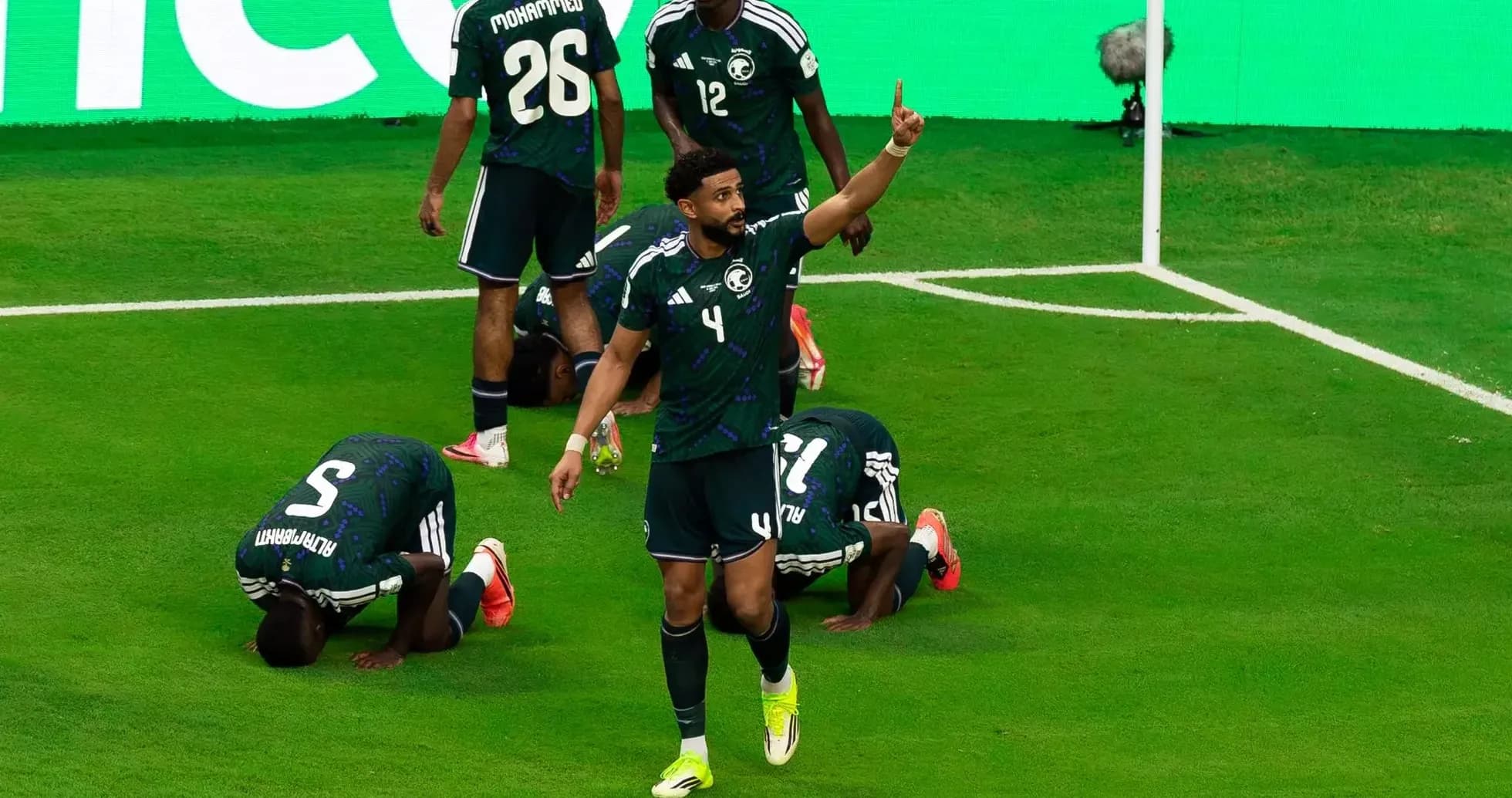
The breakthrough on 41 minutes, scored by centre-back Abdulelah Al-Amri, underlined Saudi Arabia’s set-piece and penalty-box focus. With only 33% of the ball and just seven total shots, they maximised rare attacking moments by committing key aerial threats forward. Al-Amri’s involvement at both ends was emblematic: a decisive contribution in the opposition box, then a yellow card three minutes later for “Foul” as he aggressively defended his area. That caution reflected Saudi Arabia’s readiness to disrupt Uruguay’s rhythm whenever the South Americans approached the danger zone.
Uruguay's Attacking Structure
Uruguay’s attacking structure was high and expansive. Full-backs Guillermo Varela and Matías Viña pushed on to pin Saudi wingers, while Federico Valverde and Maximiliano Araújo attacked half-spaces around the lone striker Núñez. The 16 shots inside the box show how often Uruguay managed to penetrate the Saudi block, but the finishing and Saudi’s emergency defending were inconsistent with the volume of chances. Seven blocked shots indicate how frequently Saudi defenders stepped out at the last moment to close down shooting angles, especially from the edge of the area.
Goalkeeping Performances
In goal, Mohammed Al-Owais (Saudi Arabia) was central to the result. He faced 10 shots on target and made nine saves, a workload that matches the pattern of prolonged Uruguay pressure, especially after the interval. His shot-stopping underlined Saudi Arabia’s low-block strategy: concede territory but rely on the goalkeeper to handle the inevitable onslaught. The goals prevented metric at -0.35 suggests he conceded slightly more than the model expected from the chances faced, but in practical terms, nine saves in a World Cup group opener is a heavy and influential shift.
At the other end, Fernando Muslera (Uruguay) had a quieter evening. Saudi Arabia produced only three shots on goal, and Muslera made two saves. Uruguay’s high line and strong counter-press meant Saudi Arabia rarely progressed into dangerous central zones; instead, they were pushed into lower-probability efforts or forced turnovers before reaching the final third. The xG numbers – 0.66 for Saudi Arabia and 1.72 for Uruguay – mirror this strategic split: Saudi Arabia were opportunistic, Uruguay were systematic but somewhat wasteful.
In-Game Adjustments
Bielsa’s in-game adjustments were aggressive and early. At 46', Agustín Canobbio (IN) came on for Darwin Núñez (OUT), signalling a shift towards more mobility and pressing from the front rather than a classic penalty-box striker. Simultaneously, Juan Sanabria (IN) replaced Matías Viña (OUT), adding more attacking thrust and flexibility on the left. Later, at 72', Nicolás de la Cruz (IN) replaced Manuel Ugarte (OUT), tilting the midfield further towards creativity and vertical passing, and at 81' Brian Rodríguez (IN) came on for Maximiliano Araújo (OUT) to inject fresh pace after the equaliser. Finally, at 90', Rodrigo Aguirre (IN) replaced Federico Viñas (OUT), another forward-for-forward swap to maintain attacking presence until the end.
Donis, by contrast, used his bench to preserve structure and energy rather than to chase the game. At 63', Nasser Al-Dawsari (IN) came on for Musab Al Juwayr (OUT), reinforcing midfield legs and defensive coverage. After Uruguay’s equaliser, he rotated defensive and wide roles in quick succession: at 81', Nawaf Boushal (IN) replaced Mohammed Abu Al-Shamat (OUT); at 90', Ali Lajami (IN) came on for Saud Abdulhamid (OUT), Ala'a Al-Hejji (IN) replaced Firas Al-Buraikan (OUT), and Abdullah Al-Hamdan (IN) entered for Moteb Al-Harbi (OUT). These late changes suggest a priority on fresh defenders and ball-carriers to see out the point rather than re-opening the game.
Statistical Overview
Statistically, Uruguay’s dominance was clear. They completed 612 passes to Saudi Arabia’s 322, with Uruguay hitting 540 accurate passes at 88%, compared to Saudi Arabia’s 236 accurate at 73%. This passing superiority allowed Uruguay to recycle attacks, pin Saudi Arabia deep and generate 14 corners to 4. The six offsides against Uruguay also reflect their persistent attempts to break Saudi Arabia’s line with runs in behind, a natural by-product of a team camping in the opposition half.
Defensively, Saudi Arabia’s 11 fouls to Uruguay’s 6, plus their single yellow card, show a willingness to break play up when necessary without descending into ill-discipline. Uruguay, despite chasing the game for almost 40 minutes, avoided bookings and maintained structural control rather than resorting to tactical fouling. Both teams recorded identical goals prevented figures of -0.35, hinting that the 1-1 scoreline slightly under-delivered Uruguay’s attacking potential while giving Saudi Arabia maximum return from a minimalist offensive plan.
Tactical Implications
In tactical terms, the draw can be read as a validation of Saudi Arabia’s compact 4-4-2 and Al-Owais’ resilience, and a warning for Uruguay that territorial and statistical dominance must be converted more ruthlessly if they are to fully capitalise on Bielsa’s high-possession, high-shot blueprint in the rest of the group stage.