.svg&w=384&q=75 "naujapitch logo")
Ivory Coast Defeats Ecuador 1-0 in World Cup Opener
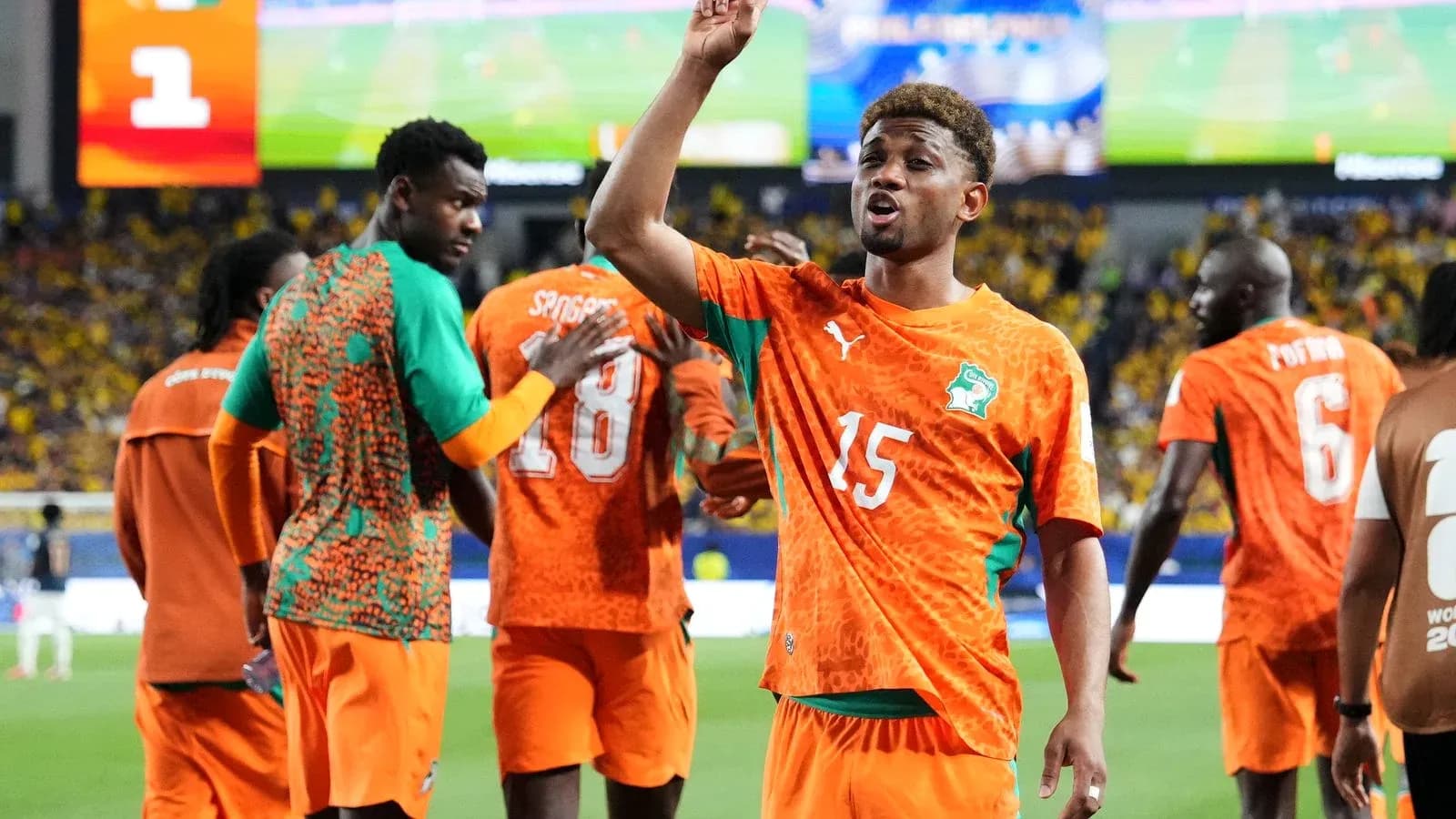
Lincoln Financial Field under the lights, Group E opening night, and two 4‑4‑2s staring each other down. Following this result, Ivory Coast walk away with a 1‑0 victory over Ecuador, three points that immediately reshape the group’s geometry: Ivory Coast sit 2nd with 3 points and a goal difference of +1 (1 goal for, 0 against), while Ecuador are 3rd with 0 points and a goal difference of -1 (0 goals for, 1 against). The scoreline is narrow; the tactical statement is not.
I. The Big Picture – Two 4‑4‑2s, Different Personalities
On paper, the mirror systems suggest symmetry. In practice, Emerse Fae’s Ivory Coast used their 4‑4‑2 as a platform for control, while Sebastian Beccacece’s Ecuador leaned on compactness and transition.
Ivory Coast’s season profile in this World Cup is now defined by clarity: in total this campaign they have played 1 match, winning it 1‑0. At home they have played 1, won 1, with 1.0 goals scored on average and 0.0 conceded. The clean sheet is no accident; their defensive record in total is 0 goals against, and the structure in front of Y. Fofana looked rehearsed rather than improvised.
The back four of G. Konan, E. Agbadou, W. Singo and G. Doue was conservative in rest defence but aggressive stepping into midfield lines. Ahead of them, the double axis of F. Kessie and S. Fofana gave the side both ballast and progression, with Y. Diomande and B. Toure stretching Ecuador horizontally from the flanks. Up front, N. Pepe and E. Wahi were less a classic big‑small pairing and more two mobile forwards trading channels, trying to drag W. Pacho and J. Ordonez into uncomfortable spaces.
Ecuador, by contrast, arrive in the tournament with a more fragile statistical base. On their travels they have played 1, lost 1, scoring 0.0 goals on average and conceding 1.0. In total, it is the same picture: 1 match, 0 goals for, 1 against, no clean sheets, and a failed‑to‑score mark that already reads 1. The 4‑4‑2 of A. Franco, J. Ordonez, W. Pacho and P. Hincapie behind a midfield of J. Yeboah, M. Caicedo, P. Vite and A. Minda was built to compress the centre and spring G. Plata and E. Valencia into space. It rarely unfolded that way.
II. Tactical Voids – Discipline, Edges and the Cost of Aggression
If there was a crack in Ivory Coast’s otherwise controlled performance, it came in their disciplinary profile. In total this campaign, their yellow cards are front‑loaded: 33.33% between 16‑30 minutes and 66.67% between 31‑45. That means every caution they have received so far has arrived before half‑time, a clear early‑game spike in aggression. S. Fofana embodies that edge. In his 77 minutes, he committed 1 foul, picked up 1 yellow card, yet still found time to block 1 shot and make 2 interceptions. He is both metronome and disruptor, but his card profile underlines a risk: Ivory Coast’s midfield heartbeat walks a disciplinary tightrope early.
Ecuador’s own yellow‑card distribution tells a different story: 100.00% of their cautions so far have come between 61‑75 minutes. They start controlled, then chase. J. Porozo, who comes off the bench as a defender and immediately adds physicality, is the clearest symbol of this. In 28 minutes he commits 2 fouls and takes 1 yellow card, winning 0 of his 2 duels. Beccacece’s late‑game push for territory leans on defenders stepping high and hard; the numbers suggest that in this match it tipped into desperation more than dominance.
Crucially, there are no penalties taken or missed by either side in total this campaign; both teams sit at 0 penalties, 0 scored, 0 missed. The margin, then, had to come from open play and detail.
III. Key Matchups – Hunter vs Shield, Engine Room vs Enforcer
The “Hunter vs Shield” narrative for Ivory Coast is already being written by a substitute: A. Diallo. He is not in the starting XI here, but his broader tournament profile matters for the squad picture. In total he has 1 appearance, 34 minutes, and 1 goal from 2 shots on target, with an 8.2 rating. His dribble success – 5 completed from 6 attempts – gives Fae a different kind of hunter: one who can destabilise a low block on his own. With Ivory Coast scoring 1.0 goals on average at home, Diallo’s presence off the bench turns narrow leads into something more secure and stalemates into tilted pitches.
On the other side, Ecuador’s shield is more collective than individual. W. Pacho and P. Hincapie, flanked by A. Franco, form a line that, in total this campaign, has only conceded 1 goal away from home. The structure is sound; the problem is what happens in front of them. With Ecuador failing to score in their only match, the burden on G. Plata and E. Valencia becomes heavy. They must both stretch and finish, all while tracking the adventurous runs of Konan and Doue.
In the “Engine Room” duel, F. Kessie and S. Fofana face off conceptually against M. Caicedo. Kessie offers tempo and security, Fofana verticality and risk; Caicedo is asked to be both destroyer and distributor. The fact that Ivory Coast’s card surge arrives before half‑time, while Ecuador’s comes in the 61‑75 window, suggests Kessie and Fofana won the early territorial battle, forcing Ecuador to chase later and open up spaces between their lines.
IV. Statistical Prognosis – xG Shadow and Defensive Solidity
We do not have explicit xG numbers in this dataset, but the contours are clear enough to sketch their shadow. Ivory Coast’s in‑total record – 1 goal scored, 0 conceded, 1 clean sheet, 0 matches failed to score – points to a side whose underlying chance creation is at least matching their output. They are not wasteful yet, and their defensive platform is immaculate.
Ecuador, with 0 goals for and 1 against in total, no clean sheets and 1 match failed to score, project as a team whose xG is likely underperforming or simply low. The reliance on late aggression, embodied by Porozo’s cameo and the 61‑75 yellow‑card spike, hints at a side that struggles to generate high‑quality chances in settled play and instead leans on chaos in the final third of matches.
Following this result, the tactical verdict is stark. Ivory Coast look like a side whose 4‑4‑2 has a clear identity: a controlled back four, an assertive double pivot, and a bench weapon in A. Diallo that can twist tight games. Their defensive solidity – 0.0 goals conceded on average at home and in total – provides a platform that should keep their xG against consistently low.
Ecuador, meanwhile, must re‑engineer the link between their compact base and their forwards. Until G. Plata and E. Valencia receive more structured service and the midfield line of Yeboah, Caicedo, Vite and Minda can progress the ball with more conviction, their xG will remain modest and their margin for error razor thin. The numbers say they can defend; the story of this night in Philadelphia is that they could not threaten enough to make it matter.