.svg&w=384&q=75 "naujapitch logo")
Germany Dominates Curaçao in World Cup Opener
Under the closed roof of NRG Stadium in Houston, Germany’s World Cup campaign opened with the kind of statement that reverberates far beyond Group E. A 7–1 demolition of Curaçao, sealed in regular time under the watch of referee Jalal Jayed, did more than deliver three points. It sketched the tactical DNA of both sides heading into the rest of the group stage: Germany as a ruthless, structurally coherent powerhouse; Curaçao as a brave but overmatched debutant still searching for defensive balance.
I. The Big Picture – Structure, Scoreline, Stakes
This was Group Stage - 1, but it felt like a knockout in everything but name. Germany, now top of Group E with 3 points and a goal difference of 6, have already carved out a cushion. Overall this campaign they have played 1 match, winning 1, scoring 7 and conceding 1. On their home designation in this fixture, that translates into a home average of 7.0 goals for and 1.0 against.
Curaçao, by contrast, sit 4th in the group. Overall they have played 1 match, lost 1, scoring 1 and conceding 7. On their travels so far they average 1.0 goal for and 7.0 against. The same scoreline that propels Germany towards the “Round of 32” description on the standings leaves Curaçao with a goal difference of -6 and a steep climb ahead.
Julian Nagelsmann’s 4-2-3-1 looked every inch the modern, hyper-structured German machine. Dick Advocaat’s 4-3-1-2, with a narrow diamond and dual forwards, offered theoretical counter-punching potential but left his side exposed against Germany’s width and vertical rotations.
II. Tactical Voids – What Was Missing, What Was Exposed
There were no listed absences for either side, so this was close to full-strength in terms of available squads. That makes the tactical voids on display even more revealing.
For Germany, the only “absence” was conceptual: a clean sheet. Overall, they have yet to record one; their cleanSheet total stands at 0 from 1 match, despite total dominance. That lone goal conceded hints at a side still vulnerable to occasional lapses, even when the back four of J. Kimmich, J. Tah, N. Schlotterbeck and N. Brown largely controlled territory.
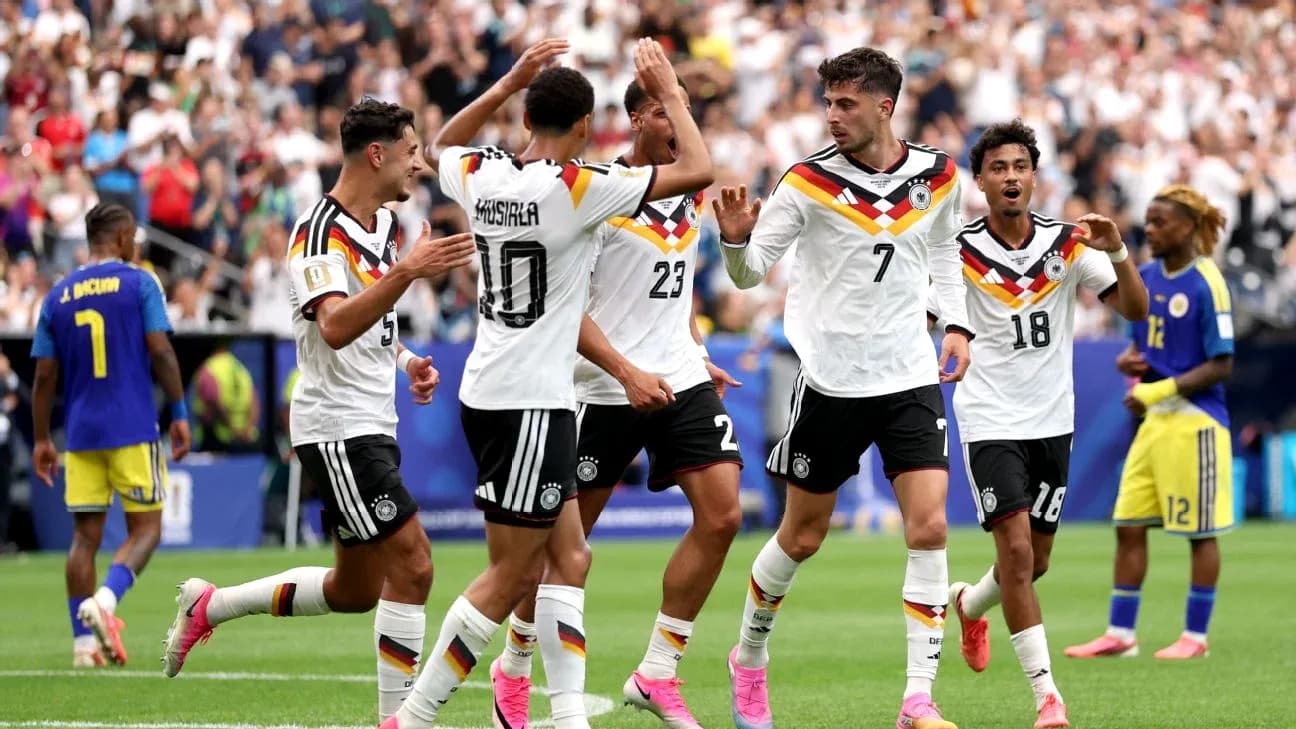
Curaçao’s void was structural. The 4-3-1-2 relied on L. Bacuna and J. Bacuna to shuttle and screen, with T. Chong as the link behind J. Locadia and S. Hansen. But the narrow midfield three could not cover the horizontal distances required against Germany’s line of three – L. Sane, J. Musiala and F. Wirtz – plus the adventurous full-back play of Kimmich and Brown. The consequence was persistent overloads on both flanks and a back four that was constantly forced into emergency defending.
Disciplinary data from the campaign so far shows no clear card pattern for either side; the card distribution entries are all null, suggesting that neither Germany nor Curaçao have yet been forced into major in-game tactical recalibrations by dismissals or early bookings. This match followed that script: tactical issues, not discipline, decided it.
III. Key Matchups – Hunter vs Shield, Engine Room vs Enforcer
Hunter vs Shield
The clearest “Hunter vs Shield” duel was conceptual: Germany’s attacking core, spearheaded by K. Havertz, against a Curaçao defence that had no prior World Cup reference point. Havertz has already emerged as one of the competition’s top scorers: overall he has 2 goals from 1 appearance, with 2 shots, both on target, and a penalty converted. His 41 passes at 92% accuracy underline how he functioned not just as a finisher, but as a connective nine, dropping into pockets that Curaçao’s centre-backs R. Bazoer and A. Obispo struggled to track.
Behind him, the late-game introduction of D. Undav added a different type of hunter. In just 26 minutes, Undav scored 1 goal and delivered 2 assists from 11 passes, with 3 key passes and 1 shot on target. His movement between the lines and into the right half-space punished a tiring Curaçao back line that had already absorbed wave after wave of pressure.
For Curaçao, the “shield” never truly formed. E. Room was left exposed by a line that had to defend wide spaces and constant underlaps from Brown and Kimmich. With Curaçao’s overall goalsAgainst total at 7 from 1 match, the shield is statistically as fragile as it looked on the pitch.
Engine Room – Playmaker vs Enforcer
Germany’s engine room was anchored by F. Nmecha and A. Pavlovic at the base, but the creative pulse came from J. Musiala, Wirtz and Kimmich. Musiala, operating as the nominal No. 10, combined 1 goal with 2 key passes and 4 successful dribbles from 5 attempts, while winning 9 of 14 duels. He was the press-breaker, the player who turned second balls into immediate threats.
Kimmich, listed as a defender but functioning as an inverted full-back, produced 73 passes at 89% accuracy, 5 key passes and 2 assists. His ability to step into midfield created a 3v2 overload against Curaçao’s central trio, repeatedly dragging L. Bacuna and J. Bacuna out of their zones and opening lanes for diagonal balls into Sane and Brown.
On the Curaçao side, L. Bacuna and J. Bacuna were forced into reactive roles. With no statistical record yet of tackles or interceptions in the campaign data, their impact was more about firefighting than control. The 4-3-1-2 never established a stable platform to release Chong or connect consistently with Locadia and Hansen.
IV. Statistical Prognosis – Where This Leaves Them
Following this result, the numbers are stark. Germany’s overall goalsFor average of 7.0 and goalsAgainst average of 1.0 are clearly inflated by a single match, but they signal a side that has already found rhythm in the final third. Their penalty record is spotless so far: 1 taken, 1 scored, 0 missed, a 100.00% conversion that adds another weapon to an already varied arsenal.
Curaçao’s overall averages – 1.0 goal scored and 7.0 conceded – point to a team that can threaten sporadically but is currently outgunned at this level. Their failure to keep a clean sheet and the absence of any penalty opportunities underline how rarely they were able to pin Germany back in dangerous zones.
In xG terms, a 7–1 scoreline typically reflects both sustained territorial dominance and a high-quality shot profile. Even without explicit xG figures, Germany’s shot efficiency (Havertz 2/2 on target, Undav 1/1, Brown 1/1, Musiala 1/1) suggests they translated chances into goals with ruthless precision. Defensively, conceding once while allowing Curaçao just a handful of meaningful moments indicates solid, if not yet flawless, control.
The tactical verdict is clear. Germany emerge as early Group E pacesetters, their 4-2-3-1 already humming with synchronized rotations and multiple goal threats. Curaçao, courageous but stretched, must now decide whether to double down on their 4-3-1-2 and refine the spacing, or pivot to a more conservative block to stem the flow of chances against higher-tier opposition. The story of their World Cup will be written in how quickly they can learn from this brutal opening lesson.