.svg&w=384&q=75 "naujapitch logo")
Erling Haaland: The Most Viral Footballer of the World Cup
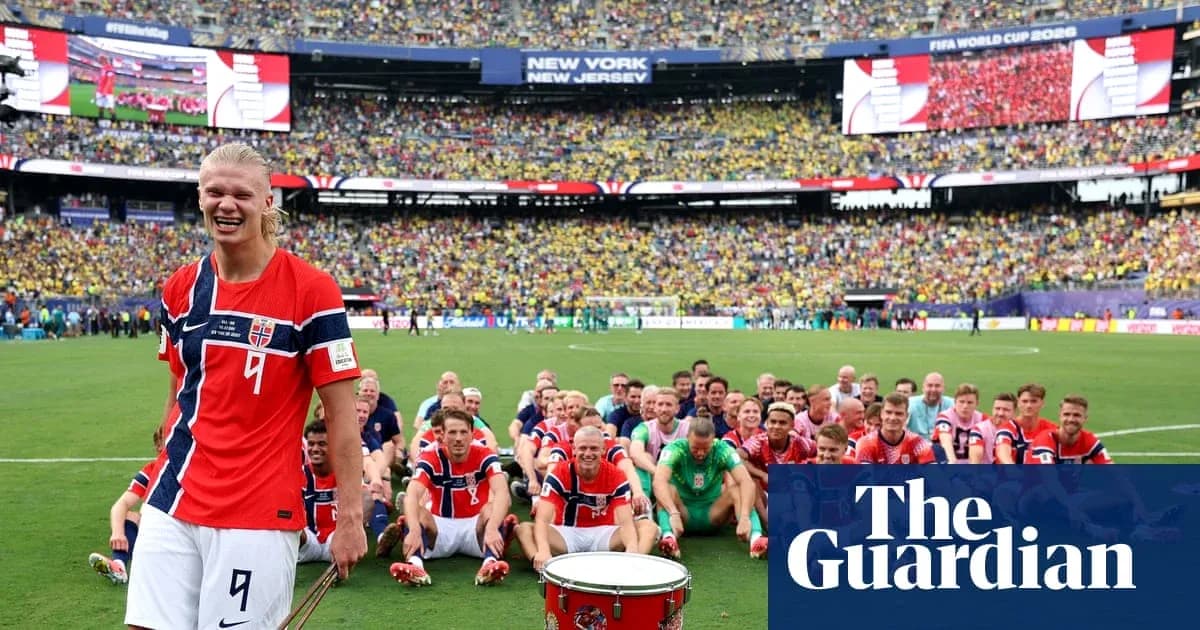
Erling Haaland is chasing the Golden Boot. He may yet leave this World Cup as its top scorer. But he has already run away with another title: the most viral footballer on the planet.
This is a striker who arrived at the tournament with a ready-made cult. In Norway, he is the poster boy of a generation. In Manchester, at least on the blue side, he is a phenomenon. In Leeds, where he was born while his father Alf-Inge Haaland played for the club, he is treated as one of their own, a Premier League superstar who once wore their colours in his dreams.
Now the rest of the world has caught up. Norway’s run to the quarter-finals has simply poured fuel on a fire that was already burning online. Haaland’s goals matter, of course. But his global explosion has been driven by something else: the relentless stream of content he spins out away from the pitch.
From goals to the “For You” page
At the start of July, “Haaland” crashed into the UK’s overall top 10 TikTok searches, a 300% week-on-week surge that made him the most searched World Cup player over that stretch. Clips tagged “Haaland best moments” rocketed by 1,300%. Since the tournament began, more than 14,000 posts have carried #Haaland or #ErlingHaaland, an increase of almost 500% month on month.
The numbers are dizzying. There are 1.4 million posts about him in total across the platform. Yet even that leaves him looking up at the long-established giants of the game: #Messi sits at 25 million posts, #Ronaldo at 22.3 million. Haaland is not at their level yet in the online arms race, but his rise has a different kind of momentum. It feels like the start of something, not the tail end of an era.
This is not a player stumbling into fame. He has been building this persona for years. Last Christmas he pulled on a Santa suit in Manchester, went undercover and handed out gifts to children in a video on his YouTube channel. His Instagram stories veer from surreal to self-deprecating. One that blew up showed him “raw dogging” a flight – no food, no water, no entertainment – and treating the ordeal as a joke.
During this World Cup, that blend of absurdity and accessibility has detonated across Instagram, TikTok and Snapchat. His Snapchat account alone has 4.7 million subscribers, drawn in by a feed that feels more like a friend’s chaotic story than a polished brand campaign.
Haaland hasn’t just sat back and watched. He has leaned into the chaos. When an Instagram user posted a picture of a green onion and asked, “Am I losing it or does this green onion look like Haaland?”, the striker replied with a meme of a dog hurriedly winding up a car window, the internet’s shorthand for hiding from embarrassment. The joke landed. So did the message: he is watching, and he is in on it.
Viking memes and Shrek selfies
The raw numbers on Instagram tell their own story. Haaland’s following has leapt from 40 million to 60 million during the tournament, making him the fastest-growing major player on the platform. His Reels have been viewed more than 683 million times since the World Cup kicked off.
Those views are fuelled by a stream of instantly shareable images. A mocked-up selfie with the cartoon ogre Shrek, captioned “Selfie with my twin.” A shot of him disguised as a tourist in New York, hidden under a baseball cap and sunglasses. Another of him trading his now-iconic Viking helmet for a cowboy hat while shopping in Texas.
Even Google has joined the act. Type his name into the search bar and an animation of rowers in Viking helmets glides across the screen. It is a rare nod from tech’s biggest player to football’s newest cultural force.
The clips that travel furthest, though, are often the quiet ones. A video of Haaland folding his jersey and handing it carefully to a kit man, while other players toss theirs on the floor, has raced around social media. It is a small gesture, but it cuts through. In an era of choreographed celebrations and branded celebrations, simple respect stands out.
The bromance era
His online pull is not just about him. Haaland’s friendship with Jude Bellingham, forged at Borussia Dortmund and renewed on the World Cup stage, has become one of the tournament’s most-watched subplots. Their interactions – on the pitch and on screen – have delighted fans to the point that some have compared them to the rival hockey players from HBO’s “Heated Rivalry”.
As Norway prepare to face England on Saturday, that storyline has only intensified. On TikTok there are 1.3 million posts about Bellingham, a figure that dwarfs the 277,600 attached to England captain Harry Kane. The England midfielder has his own star power, but there is no doubt Haaland’s orbit has pulled more eyes his way.
The reach stretches far beyond traditional football audiences. An 18-year-old TikTok creator from the Netherlands, who admits she only really follows the World Cup and the Euros when her own country plays, made a video about Haaland and Bellingham that has been shared more than 100,000 times. Before this tournament, she says, she “didn’t know Haaland”.
This time, the algorithm did the work. Haaland’s “funny moments” and Snapchat stories flooded her For You page. His “vibe”, as she puts it, hooked her in. The humour, the easy chemistry with Bellingham, the sense that these are elite athletes who still treat the game as fun – that was enough to turn a casual viewer into an active creator.
A lookalike and a mirror
The viral wave has swept up others too. Russian model Anastasia Kostromitina has found her own slice of World Cup fame after a video her mother posted went global. In it, she mimics Haaland’s poses, leaning into a resemblance that the internet had already spotted.
Long blond hair. Piercing blue eyes. Tall, athletic frame. The comparisons were inevitable. At first, she admits, she was confused by them. Then came the realisation: being compared to one of the world’s most formidable athletes is hardly an insult. She has called the likeness “not bad at all”, describing Haaland as “really humble” and, above all, “a great athlete”.
Her story underlines how far his image has travelled. This is not just about highlight reels and goal compilations. It is about a face, a haircut, a way of carrying himself that people recognise and want to play with.
“One of us” in Manchester
Back in Manchester, there is a different mood. For City supporters, this is not a discovery. It is confirmation. The rest of the world is finally seeing what they have been watching close up.
“He is a great asset for our club,” says Dante Friend from the 1894 fan group. The word “asset” here is doing heavy lifting. Haaland is not just a goalscorer. He is a bridge between the dressing room and the stands.
“He’s very active on social media, he follows the fan accounts, he’s in touch with some of the main fans behind the scenes, so we really feel he’s one of us.” That last phrase matters. For a club often accused of being corporate and distant, Haaland feels human, accessible, plugged into the supporter culture.
Kevin Parker, general secretary of the official Manchester City supporters club, goes further. He calls Haaland “an unbelievable footballer, right up there with the best strikers, goalscorers in the world”, but stresses that City fans have long seen him as “a different sort of footballer”.
Not different because of his finishing or his movement. Different because of his personality.
“He just seems a genuinely likable sort of guy,” Parker says, and he believes the World Cup has simply handed the rest of the world the same view City fans have enjoyed for three seasons. On the biggest stage, with the biggest audience, Haaland’s blend of ruthlessness on the pitch and playfulness off it has become impossible to ignore.
From his perspective, it is all upside. “I think he gives football such a positive vibe,” Parker says. In a tournament shadowed by criticism of Fifa and contentious decisions, Haaland’s presence has cut through the noise. “Everything that Erling does, it’s just positive, positive.”
Shedding the “quiet” label
Howard Cohen, chair of the Manchester City Disabled Supporters Association, remembers the early days after Haaland’s arrival in England. The public image, he says, was of a reserved, almost aloof figure.
“When he first came, there was a public image projected, certainly in some of the media, of him being quite quiet and reserved,” Cohen recalls. That perception did not last long. The real Haaland surfaced quickly – loud, playful, self-mocking.
“He’s really come out of his shell very quickly. He was clearly never that sort of quiet, reserved figure in reality, and he doesn’t take himself too seriously.” For Cohen, that trait is crucial. “I think that’s important for anybody in public life, but particularly for footballers,” he says. Fans, especially younger ones, want to see the person as well as the player.
That is what they get with Haaland. The Santa suit. The Viking memes. The folded shirts and the joking replies. The sense that he is happy to laugh with everyone, including at himself.
“He’s certainly picking up plenty of support around the world, and providing entertainment for people,” Cohen says. “And that’s what football should be about, after all.”
On the pitch, the Golden Boot remains in his sights. Off it, he has already reshaped what a World Cup star can look like in the age of TikTok and Snapchat. The question now is simple: is this just a World Cup fling with the internet – or the beginning of an era in which Erling Haaland defines not only how football is played, but how it is lived in public?