.svg&w=384&q=75 "naujapitch logo")

Aston Villa vs Liverpool: Premier League Showdown at Villa Park
On 15 May 2026, under the floodlights of Villa Park in Birmingham, Aston Villa and Liverpool walk out knowing that a single night could define their Premier League year. Two sides level on points, both officially sitting in the Champions League (League phase) places, collide with only goal difference and nerve separating them. The old ground crackles with tension: for Aston Villa, it is a chance to protect a place among Europe’s elite; for Liverpool, an opportunity to tighten their grip on the same prize and underline their status as the stronger force in this rivalry.
Season Context
Aston Villa arrive in fifth place with 59 points from 36 matches, built on 17 wins, 8 draws and 11 defeats. They have scored 50 goals and conceded 46, a positive but narrow goal difference that reflects a side capable of scoring but occasionally exposed at the back (goal difference +4). The reward for this work is clear in black and white: they are currently in the “Promotion - Champions League (League phase)” zone and must defend it.
Liverpool stand just ahead in fourth, also on 59 points from 36 games, but with a stronger goal difference (goal difference +12). Their 17 wins, 8 draws and 11 losses mirror Villa’s record in results, yet 60 goals scored against 48 conceded underline a slightly sharper attack and similar defensive record. Like Villa, Liverpool are officially in the “Promotion - Champions League (League phase)” positions, and this trip to Villa Park is about consolidating that status.
Form & Momentum
Aston Villa’s form line of DLLWD hints at a side stumbling at a delicate moment. One win in the last five matches (DLLWD) suggests inconsistency, and when set against 50 goals scored and 46 conceded over 36 games, it paints a picture of a team that can be entertaining but occasionally fragile (1.39 goals scored and 1.28 goals conceded per game based on standings data).
Liverpool, by contrast, carry the momentum of DLWWW into Birmingham. Three straight wins at the end of that sequence (DLWWW) show a team finishing strongly, and their season totals of 60 goals for and 48 against across 36 matches point to a slightly more potent attack than Villa’s (1.67 goals per game) with a similar defensive output (1.33 goals conceded per game, both figures from standings). The recent trend favours Liverpool’s resilience and cutting edge.
Head-to-Head Patterns
Recent meetings have largely tilted Liverpool’s way, especially at Anfield. On 1 November 2025, Liverpool beat Aston Villa 2-0 in the Premier League (2-0, Premier League, season 2025, November 2025). That match underlined Liverpool’s ability to control Villa and keep them at arm’s length on the scoreboard.
At Villa Park, however, the story has been more chaotic. On 19 February 2025, Aston Villa and Liverpool shared a wild draw in the Premier League, finishing 2-2 after Villa led at half-time (2-2, Premier League, season 2024, February 2025). That game showed Villa’s capacity to hurt Liverpool at home, but also their difficulty in closing out a heavyweight opponent.
Another Anfield clash on 9 November 2024 saw Liverpool again win 2-0 in the Premier League (2-0, Premier League, season 2024, November 2024), reinforcing a pattern of Liverpool keeping clean sheets while finding enough attacking quality to decide the contest. Across these highlighted fixtures, Liverpool have generally held the upper hand, with Villa’s best moments coming in high-scoring draws rather than decisive victories.
Tactical Preview
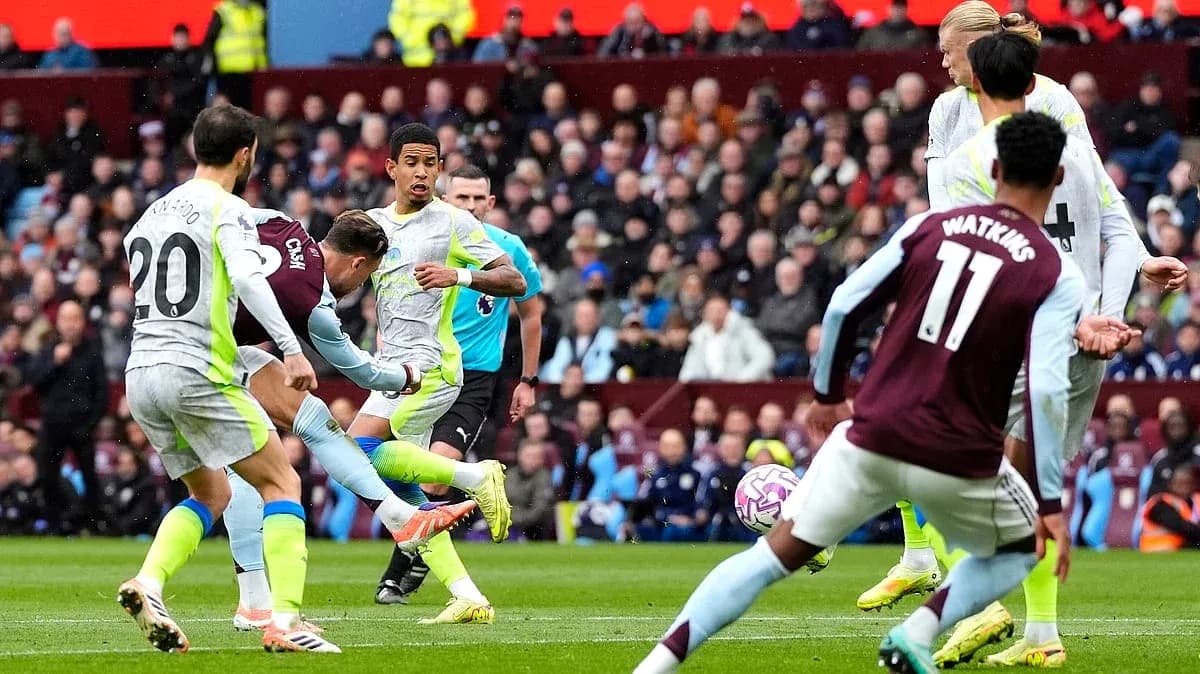
Aston Villa’s season suggests a front-foot, possession-friendly side most often set up in a 4-2-3-1 shape (32 matches in that formation). With 50 goals in 36 league games, Aston Villa look to use a lone striker supported by creative midfielders, and players like O. Watkins bring both goals and work rate (12 league goals and 2 assists). M. Rogers, listed as a midfielder, adds a dual threat from deeper positions with 9 goals and 5 assists, giving Villa an extra runner between the lines and a key ball-carrier in transition.
Defensively, Aston Villa’s 46 goals conceded in 36 matches show they can be opened up (1.28 goals conceded per game from standings), and the absence of B. Kamara through a knee injury removes a recognised midfield shield. Alysson is also ruled out with a muscle injury, while A. Onana is questionable with a calf injury; that combination may reduce Villa’s options to control central spaces and press Liverpool’s midfield.
Liverpool are also built on a 4-2-3-1 base (32 matches in that system), with flexibility to switch into other attacking shapes when chasing games. Their 60 league goals underline a side with multiple threats (1.67 goals per game from standings), and the data-backed creativity of C. Gakpo (7 goals and 5 assists) and D. Szoboszlai (6 goals and 5 assists, plus a high passing volume) suggests Liverpool can hurt Villa both from wide areas and central zones. H. Ekitike’s 11 league goals add a penalty-box presence, though he is listed as missing with an Achilles tendon injury for this specific fixture, which may push more responsibility onto other attackers.
Defensively, Liverpool’s 48 goals conceded in 36 games (1.33 per match from standings) show a back line that can be breached but often holds firm enough for their attack to win matches. D. Szoboszlai’s single red card this year highlights his combative edge in midfield, something Liverpool will need with W. Endo ruled out by a foot injury. Alisson’s absence with a muscle injury is significant for Liverpool’s build-up and shot-stopping, forcing a change in goal. M. Salah is also missing with a thigh injury, removing a proven source of 7 goals and 6 assists and potentially making Liverpool slightly less explosive in the final third.
Both benches are affected: Aston Villa lose depth up front with Alysson out, while Liverpool are further hit by injuries to C. Bradley, H. Ekitike, G. Leoni and W. Endo, and face uncertainty over I. Konate and F. Wirtz, both listed as questionable. Even so, Liverpool’s comparison edge in the prediction model (total comparison 64.0% to 36.0%) suggests their structure and depth still look marginally stronger.
Statistical Snapshot
- Competition: Premier League, season 2025 — 15 May 2026.
- Venue: Villa Park, Birmingham.
- Prediction: Win or draw — Double chance : draw or Liverpool.
- Win Probabilities: Home 10% / Draw 45% / Away 45%.
- Model: Aston Villa 36.0% — Liverpool 64.0%.
Betting Verdict
The prediction model clearly leans towards Liverpool avoiding defeat, and the double-chance angle reflects both their stronger recent form (DLWWW) and superior attacking record (60 league goals versus Aston Villa’s 50). Head-to-head trends also support Liverpool’s side of the market, with recent wins of 2-0 at Anfield in November 2025 and November 2024, and only a draw at Villa Park in February 2025 to interrupt that control. With bookmakers generally pricing Liverpool to win at around 2.20–2.33 and Aston Villa at roughly 2.80–3.02, the advised “Double chance : draw or Liverpool” aligns with both the statistical edge and the injury picture that slightly weakens Villa’s midfield shield. For bettors, siding with Liverpool not to lose looks the most defensible position in a high-stakes night at Villa Park.