.svg&w=384&q=75 "naujapitch logo")
Arsenal Triumphs in Nerve-Wracking Finale Against Crystal Palace
Selhurst Park’s final act of the 2025–26 Premier League season closed with a narrow, nervy 2–1 win for champions Arsenal over a Crystal Palace side that finished the campaign in 15th but never stopped swinging. Following this result, the table tells the broad story: Arsenal top with 85 points and a formidable goal difference of 44 (71 scored, 27 conceded), Palace safe but scarred at 45 points and a goal difference of -10 (41 scored, 51 conceded). Yet on the pitch, the gap felt more like a chess match than a procession.
I. The Big Picture: Structures and Season DNA
Oliver Glasner doubled down on his season-long identity, rolling out the familiar 3-4-2-1. D. Henderson anchored a back three of N. Clyne, J. Lerma and C. Riad, with the width entrusted to D. Munoz on the right and the young R. Cardines on the left. Inside, W. Hughes and D. Kamada formed the central hinge, while J. Devenny and I. Sarr supported lone striker J. S. Larsen.
It was a shape that mirrored Palace’s season: structurally bold, occasionally brittle. At home they have averaged 1.0 goals for and 1.2 against, their Selhurst Park record reading 4 wins, 9 draws and 6 defeats. The three-at-the-back base has been their default – they used 3-4-2-1 in 33 league matches – but the numbers underline how fine the margins have been. They have kept 7 clean sheets at home yet also failed to score in 7 home games, living permanently on a knife-edge.
Mikel Arteta, meanwhile, leaned into control with a 4-2-3-1. K. Arrizabalaga started in goal behind a back four of M. Zubimendi, C. Mosquera, P. Hincapie and R. Calafiori. The double pivot of C. Norgaard and M. Lewis-Skelly sat beneath a fluid band of three – N. Madueke, academy product M. Dowman and G. Martinelli – with Gabriel Jesus at the tip.
Heading into this game, Arsenal’s season profile was that of a ruthless, well-balanced champion. Overall they averaged 1.9 goals for and just 0.7 against per match, with 19 clean sheets in total. On their travels, 11 wins from 19, scoring 30 and conceding only 16, spoke to a side that could suffocate games as effectively away as at the Emirates. The 4-2-3-1 here was less about experimentation and more about layering control onto a squad already used to 4-3-3 and 4-2-3-1 rotations (24 and 14 league uses respectively).
II. Tactical Voids: Absences and Discipline
Both managers had to navigate important absences. Palace were without C. Doucoure (knee injury), C. Richards (ankle injury) and B. Sosa, all of whom would have added either physical presence or left-sided balance to a back line that has conceded 51 league goals. The loss of Doucoure in particular robbed Glasner of a natural ball-winner at the base of midfield, forcing Lerma into the back three and leaving Hughes and Kamada to manage central traffic without a true destroyer.
Arsenal’s defensive options were thinned by the absence of J. Timber (ankle injury) and B. White (knee injury). In a side that has conceded just 27 goals all season, their missing versatility was not trivial. It pushed Arteta towards a more experimental use of Zubimendi as a nominal right-back and increased the onus on Mosquera and Hincapie to handle aerial and transitional threats without White’s recovery pace.
Disciplinary patterns framed the emotional temperature. Across the season, Palace’s yellow cards have been spread, but with notable spikes: 18.42% of their bookings arriving between 31–45 minutes and another 18.42% in the 46–60 and 76–90 ranges. There is also a red-card warning zone between 46–75 minutes, where both of their league dismissals occurred. Arsenal, by contrast, tend to heat up late: 21.57% of their yellows fall between 61–75 minutes and 25.49% between 76–90, a sign of a side that presses and duels aggressively as games tighten.
In this match, that context mattered. Palace’s need to chase after going behind before half-time (0–1 at the break) risked dragging them into their most combustible window, while Arsenal’s late-game aggression always threatened to turn the final quarter-hour into a card-strewn siege.
III. Key Matchups: Hunter vs Shield, Engine Room Battles
The pure “Hunter vs Shield” narrative came from the bench. V. Gyökeres, Arsenal’s 14-goal league striker, started among the substitutes but loomed over the contest. His season numbers – 14 goals and 1 assist, with 41 shots and 22 on target – have been a major part of Arsenal’s 71-goal haul. Had Arteta turned to him, it would have been a direct test of an elite finisher against a Palace defence that concedes 1.3 goals per game overall and has allowed 28 on their travels and 23 at home.
Palace’s own Hunter, J. Mateta, also watched the early acts from the bench. With 12 league goals and 6 blocked shots in his defensive work, he has been both target man and auxiliary defender. His presence in reserve underlined Glasner’s intent: stretch Arsenal first with mobility – Sarr, Devenny, J. S. Larsen – then unleash Mateta’s penalty-box gravity if the game remained alive.
The true battle, though, was in the “Engine Room”. For Palace, Hughes and Kamada were tasked with knitting together a side that has often oscillated between compact and chaotic. Kamada’s ability to receive between the lines and link to Sarr and Devenny was central to Palace’s plan to bypass Arsenal’s first press. Without Doucoure, Hughes had to double as tempo-setter and spoiler.
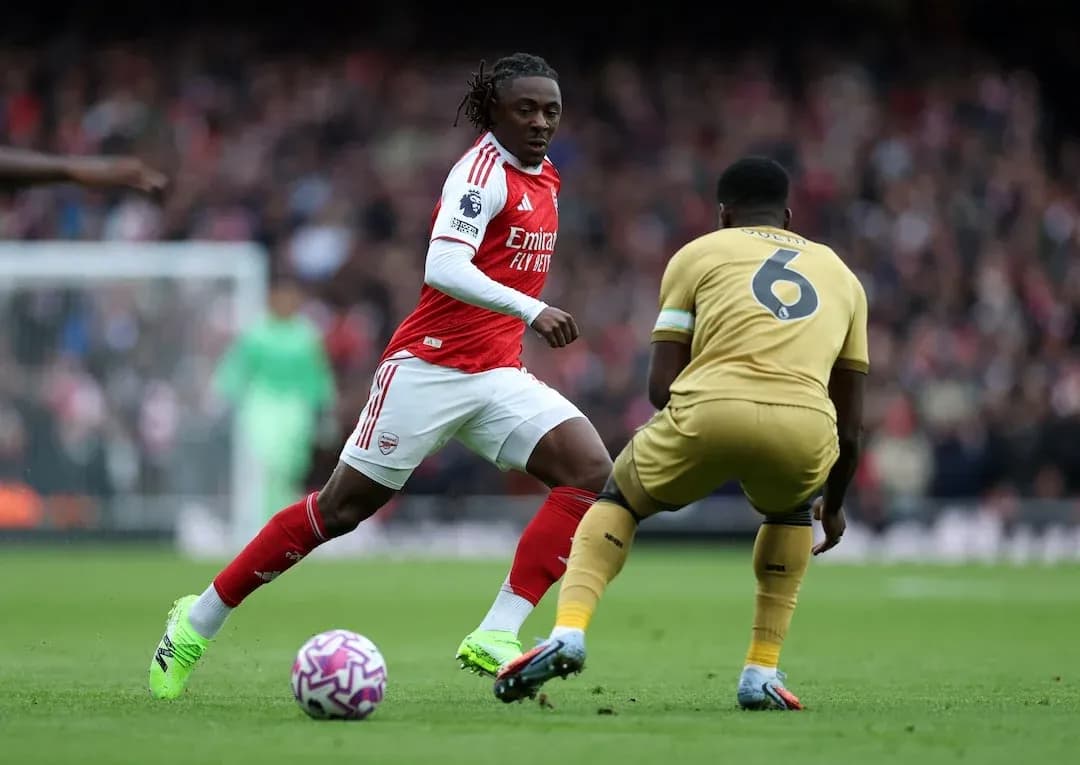
Opposite them, Norgaard and Lewis-Skelly formed a carefully calibrated axis. Norgaard, with his positional discipline, screened transitions and allowed the full-backs – especially Calafiori – to step into midfield. Lewis-Skelly’s role was more elastic, shuttling to support Madueke on the right and Dowman centrally, ensuring Arsenal could flood the half-spaces without losing their rest-defence structure.
In the wide channels, Munoz versus Martinelli and Cardines versus Madueke shaped the game’s rhythm. Munoz’s willingness to push high risked exposing Clyne and Lerma to wide isolations if possession was lost, while Cardines, still learning the top-flight craft, faced one of the league’s most direct one-v-one threats in Madueke.
IV. Statistical Prognosis and Tactical Verdict
Following this result, the numbers broadly validated Arsenal’s approach. A side that has failed to score only 3 times all season once again found a way, leaning on structure rather than chaos. Their season-long defensive average of 0.8 goals conceded away was nudged but not broken by Palace’s solitary reply in the second half.
For Palace, the performance fit their campaign arc. Overall they average 1.1 goals for and 1.3 against; here they scored once and conceded twice, a microcosm of a team that competes but too often comes up just short against the division’s elite. The 3-4-2-1 gave them enough bodies to disrupt Arsenal’s build-up, yet without Doucoure and Richards the back three lacked a dominant, front-foot defender to consistently step out and break Arsenal’s lines of possession.
In a hypothetical xG frame, Arsenal’s controlled possession, superior season attacking average (1.9 goals per game) and Palace’s negative goal difference would have forecast a narrow away win with the visitors shading the quality of chances. The final 2–1 scoreline, the champions managing the game’s key phases and Palace rallying without quite landing the knockout, felt entirely in keeping with both squads’ 38-game stories.