.svg&w=384&q=75 "naujapitch logo")
England's Challenges Ahead of Panama Match
In another universe, England would be strolling into New Jersey with their feet up and their captain wrapped in cotton wool. The only argument would be whether Harry Kane should sit this one out or chase the Golden Boot pack of Lionel Messi, Erling Haaland and Kylian Mbappé against Group L’s weakest seeds.
That world disappeared with the goalless grind against Ghana.
Thomas Tuchel’s side failed to wrap up top spot with a game to spare on Tuesday, and the ripple effect is brutal. Instead of a gentle tune‑up against Panama, England are staring at a possible run of four games in 13 days and a manager wrestling with risk, rotation and rhythm.
This was the fixture Ollie Watkins and Ivan Toney would have circled as Kane’s rest day. Instead, England still need to clinch first place. The question is no longer simply how much to spare Kane before the last 32, but how far Tuchel dares to stretch a squad already fraying at the edges.
Defensive gambles come home to roost
There will be changes on Saturday night. Some are non-negotiable.
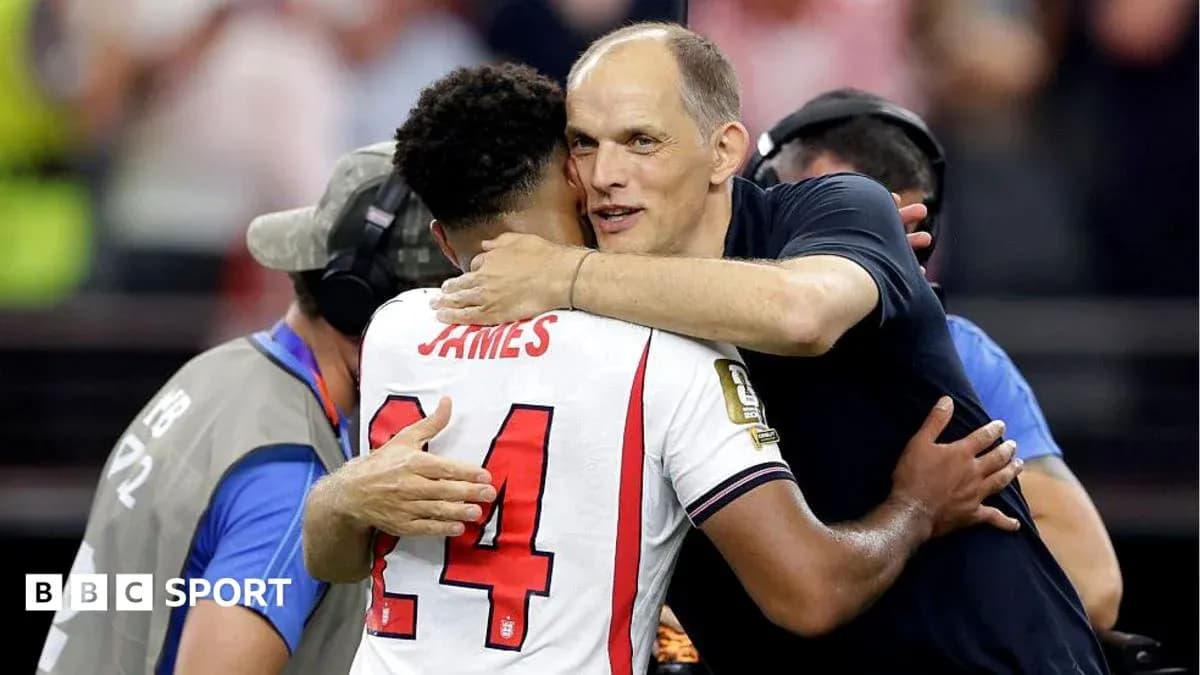
Declan Rice is one booking away from a ban and finished the Ghana game with strapping on his left calf. More damaging still is the loss of Reece James, whose latest hamstring problem rules him out for at least two matches and strips England of their most natural attacking right-back.
No one can claim surprise. James has battled hamstring issues all season and missed almost two months at the end of the campaign. Tuchel knew the risk. His defensive gambles are now biting hard.
He named only three attacking full-backs in his squad. Tino Livramento, another physically fragile option, has already gone home and been replaced not by a like-for-like runner but by centre-back Trevoh Chalobah. The creative burden on the flanks now leans heavily on the young Nico O’Reilly.
The alternatives to James at right-back – Ezri Konsa, Jarell Quansah and Djed Spence – are all more comfortable defending than marauding. None naturally hug the touchline and overlap. Against deep, stubborn opponents, that matters. The decision to leave Trent Alexander-Arnold at home will be questioned louder than ever.
What should have been a straightforward assignment against Panama now feels loaded. The cost of drawing with Ghana is simple: England cannot ease off.
Kane, Bellingham and the problem of the low block
Do Kane and Jude Bellingham go again? Some of the stars have to. Tuchel will not risk a second-placed finish that could twist England’s path through the knockouts, and he knows momentum has slipped since the thrilling win over Croatia gave way to another flat second group game at a major tournament.
There is no panic in his voice, but there is realism. England must improve against low blocks.
Ghana’s compact 4-5-1 turned Tuesday into a slog. Panama will likely offer more of the same. Thomas Christiansen’s side are already out after 1-0 defeats to Ghana and Croatia, yet they have been awkward in both games and are a world away from the naïve team that lost 6-1 to England at the 2018 World Cup.
Tuchel expects a difficult night against a team whose back five can quickly become a back six or seven. He knows his England have looked most ordinary when faced with that kind of resistance. They were exhilarating when Croatia, Serbia and Wales left space to attack. The memories are less flattering against Andorra, Albania and Latvia in qualifying, when deep defences dragged the tempo down and dulled England’s edge.
Ghana did it again. Thomas Partey tracked Kane relentlessly, choking off the captain’s instinct to drop into midfield and dictate play. The numbers were damning: Kane had just 19 touches and exchanged only three passes with Bellingham. England enjoyed 78.8% possession but did not hit the target until the second half.
Tuchel is still searching for the antidote.
“It is normal that it is difficult for us to overcome these blocks,” he said afterwards. “We want to be active and did enough to win [against Ghana]. We had to do a lot to control the counterattacks, which we couldn’t twice and twice it was very dangerous.
“I haven’t found the recipe where: ‘They do this, then we do this and then we are fine.’ We will try to find a very active and aggressive approach against Panama but we cannot just be stupid and naive. We cannot just be open and put seven players on the last line and defend with three. It’s not serious enough.”
Tuchel craves control, rehearsed movements, well-drilled patterns. He wants England to engineer overloads in key zones and then accelerate. The snag?
“There was no overload against Ghana,” he admitted. “There will very likely be no overload against Panama.”
So the dial has to move. More risk on the ball. More courage in tight spaces. Less fear of losing control.
Time for the supporting cast
England cannot allow Panama to drag them into a stop-start scrap. Bellingham’s frustration was obvious against Ghana. He conceded a needless free-kick just before half-time, a small but telling sign of irritation.
The centre-backs must step higher, commit defenders, and punch passes through the lines. Kobbie Mainoo’s press resistance and ability in congested midfield zones could be invaluable if Tuchel decides Rice needs a breather. Out wide, the message is clear: run at your full-back, force the issue.
Tuchel hopes Bukayo Saka is fit enough to return on the right in place of Noni Madueke. On the left, Anthony Gordon has struggled to impose himself and may stand aside for Marcus Rashford. Another option is to turn to Eberechi Eze or Morgan Rogers, asking them to drift infield and knit play around Bellingham and Kane.
Bellingham constantly offered himself against Ghana. He was not found often enough.
Tuchel feels the connections on the left have frayed since Gordon and O’Reilly combined so promisingly in the friendly win over Costa Rica earlier this month. “I thought: ‘OK, left side is solved,’” he said. “We played the first match and they’re not clicking. It was not the same penetration, not the same verticality, and this was the same in the second match.”
Spence, a right-footer on the wrong flank, offered little going forward after replacing the more adventurous O’Reilly at left-back against Ghana. Rashford did not appear until the 83rd minute and has yet to convince Tuchel that he can dominate a game from the start.
“He’s a candidate to start,” Tuchel said. “But the left side in general needs to provide more threat.”
One-against-one or nothing
Tuchel keeps bringing the conversation back to the collective. He talks about encouraging his players to embrace the “one-against-ones”, knowing Panama will do everything to smother the overloads he usually seeks.
“It is difficult to accelerate the match against these low blocks,” he said. “It needs this one moment of quality and a bit more precision with the crossing. Are we arriving aggressively enough with the cross? How can we shoot more from outside the box, have a deflection and force this goal in?”
He is trying to keep perspective. Ghana, coached by Carlos Queiroz, are designed to spoil. “I have experienced matches like this in the group stages of the Champions League,” Tuchel said. “You know they will celebrate their duels, they will celebrate their counterattack. Once they come over the middle line of the pitch they celebrate like a goal. It was like that. They celebrated a 0-0 like they won.”
England live under a different sky. Expectations are heavier. Style matters as much as progress. Against Panama, they will be demanded not just to win, but to entertain, to ease the tension that has crept in since New Jersey became a chore instead of a luxury.
Tuchel must loosen the handbrake without losing the wheel. How he solves that riddle now will shape more than one awkward evening against a low block; it may define how far this England side can really go.