.svg&w=384&q=75 "naujapitch logo")
Aston Villa's Tactical Masterclass at Etihad Stadium
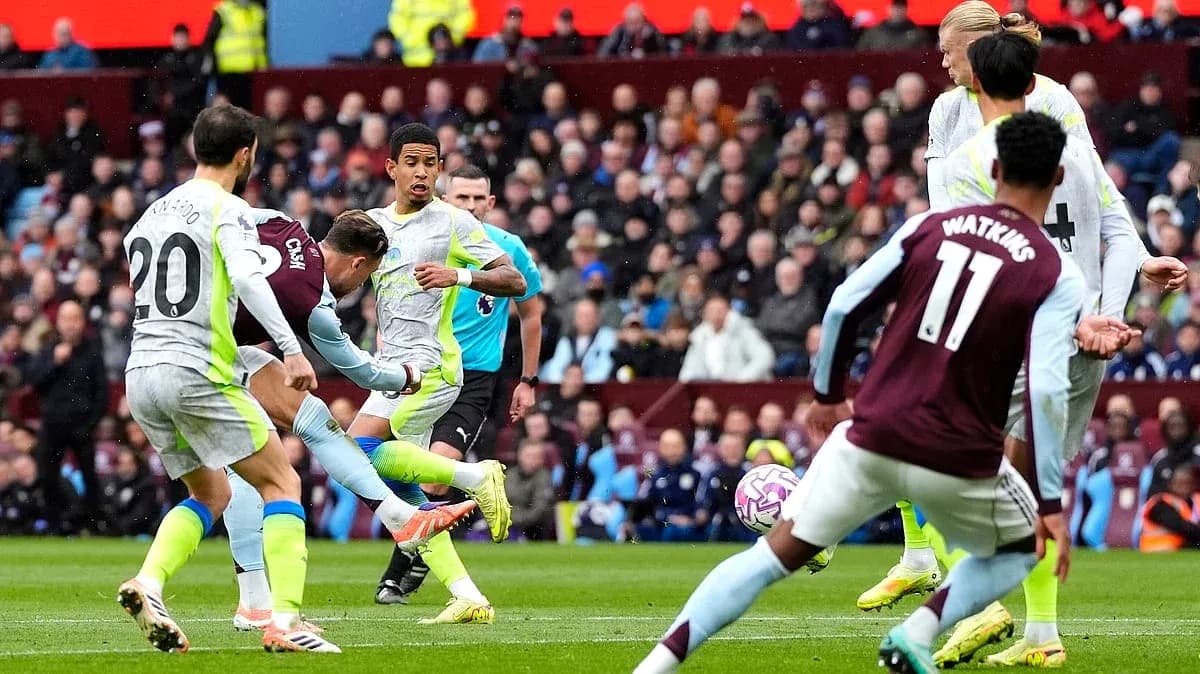
Under a grey Manchester sky at the Etihad Stadium, a season’s worth of patterns and probabilities were turned on their head. Manchester City, the league’s most polished home side, fell 2–1 to Aston Villa despite leading 1–0 at half-time, a reversal that echoed not chaos but a carefully constructed tactical ambush.
Heading into this game, City’s seasonal DNA was clear. At home they had been ruthless: 14 wins from 19, scoring 45 and conceding just 14. That is an average of 2.4 goals scored and 0.7 conceded at the Etihad, the platform for a total campaign goal difference of +42 (77 scored, 35 against) and a 2nd-place finish on 78 points. Aston Villa arrived as dangerous visitors but still underdogs: 4th in the table on 65 points, with a total goal difference of +7 (56 for, 49 against) and a more modest away profile – 7 wins, 6 draws, 6 defeats, 24 scored and 27 conceded on their travels.
Yet by full time, Unai Emery’s side had bent those numbers to their will. City’s 4-2-2-2 – a shape they had only used twice in total this league season – met Villa’s season-long 4-2-3-1, a system Emery had deployed 34 times. The contrast was telling: City experimenting, Villa repeating a well-rehearsed script.
I. The big picture: structure and intent
Pep Guardiola’s XI told a story of controlled aggression. J. Trafford behind a back four of R. Lewis, J. Stones, R. Dias and N. Ake suggested the usual high line and rest-defence platform. Ahead, Nico and Bernardo Silva as a double pivot, with A. Semenyo and Savinho as narrow attacking midfielders behind a fluid front pair of P. Foden and T. Reijnders.
This was a gamble on verticality and rotations rather than City’s more familiar 4-3-3 or 4-1-4-1, the latter their most-used shape with 13 appearances across the campaign. It aimed to overload Villa’s double pivot and pin their back four.
Emery, without key figures, stayed loyal to his core structure. M. Bizot replaced the missing E. Martinez in goal, shielded by A. Garcia, V. Lindelof, T. Mings and I. Maatsen. In front, L. Bogarde and Douglas Luiz formed the engine room, with L. Bailey, R. Barkley and E. Buendia supporting lone striker O. Watkins.
Martinez, B. Kamara and Alysson were all listed as “Missing Fixture” through injury, stripping Villa of their usual penalty-box authority, a key midfield destroyer and depth. Yet the 4-2-3-1 was unshaken: Emery trusted the system more than the individuals.
II. Tactical voids and discipline
The absences forced Villa into a more collective defensive effort. Without Kamara’s ball-winning, Bogarde and Douglas Luiz had to screen space more intelligently than aggressively, narrowing lanes into City’s half-spaces where Semenyo and Savinho sought to operate. Villa’s season card profile – a heavy 29.31% of their yellows arriving between 46-60 minutes and 17.24% in the 61-75 window – hints at a team that often walks the disciplinary tightrope just after half-time when pressing intensity spikes.
City, by contrast, spread their cautions more evenly, but with a late-game tilt: 20.90% of their yellows came between 76-90 minutes and 19.40% between 46-60. This points to a side that often has to foul in transition when legs and concentration dip, particularly as they chase games or protect narrow leads.
In this fixture, that disciplinary tendency intersected with the narrative: City, ahead 1-0 at the break, were forced to manage risk as Villa pushed in the second half. The structural void for City was not personnel – their squad was largely intact – but the relative unfamiliarity of the 4-2-2-2, which left their double pivot exposed whenever Villa broke the first line of pressure.
III. Key matchups – Hunter vs Shield, Engine Room
The headline duel was always going to be the “Hunter vs Shield” confrontation: O. Watkins against City’s defensive record at home. Overall, City had conceded just 35 goals in 38 league games, 14 of those at home. Watkins arrived as Villa’s primary marksman, with 16 league goals and 3 assists in total, off 60 shots and 38 on target. His movement across the front line, combined with his 283 total duels and 116 won, made him the ideal forward to probe City’s high line.
He was supported by creators who did not start but shaped the season’s narrative: M. Rogers, with 10 goals and 6 assists overall, and L. Digne, with 6 assists from left-back. Even from the bench, Digne’s profile – 728 total passes with 26 key passes – loomed as an option to swing the game with delivery, especially against a City side that had occasionally been vulnerable to crosses when pushed back.
In midfield, the “Engine Room” clash was between Douglas Luiz and Bernardo Silva. Douglas Luiz, sitting at the base of Villa’s structure, had to read when to step out to Bernardo, who across the season had been City’s metronome: 2 goals, 4 assists, 2196 passes at 90% accuracy, 47 key passes, and 53 tackles. Bernardo’s 10 yellow cards underline how often he operates on the edge, breaking counters and setting tempo. Here, his dual role – progress the ball and protect transitions – became harder in a 4-2-2-2 with less cover behind him.
IV. Statistical prognosis and xG logic
If we frame this match through an Expected Goals lens, the pre-game numbers skewed heavily toward City. At home they averaged 2.4 goals scored and 0.7 conceded; Villa on their travels averaged 1.3 scored and 1.4 conceded. Overlay that with City’s 16 clean sheets overall (9 at home) against Villa’s 9 in total (3 away), and the model would have leaned toward a City win, perhaps in the 2.0–1.0 xG range.
But football lives in the gaps between structure and execution. Villa’s away defensive record – 27 conceded on their travels – suggested vulnerability, yet Emery’s settled 4-2-3-1 and Watkins’ efficiency tilted the balance on the day. City’s penalty record (3 scored from 3 in total, but with 1 miss overall in the league from E. Haaland) never came into play here, but it underlined another subtle fragility: even their most clinical finisher is not flawless from the spot.
Following this result, the story is less about City’s collapse than Villa’s tactical maturity. Emery’s side took a model that predicted City control and bent it through disciplined structure, intelligent pressing in that volatile 46-60 minute window, and the ruthless edge of a striker like Watkins against a defence that, for once, could not turn possession into protection.
In the end, the 2-1 scoreline felt like the logical outcome of a clash between a team leaning into an experimental shape and another fully at ease in its season-long identity. At the Etihad, Villa’s 4-2-3-1 was not just a formation; it was a blueprint that turned probability into an upset and an away campaign defined by 1.3 goals per game into a statement win against the league’s most formidable home machine.