.svg&w=384&q=75 "naujapitch logo")
Nottingham Forest and Bournemouth End Season in 1-1 Draw
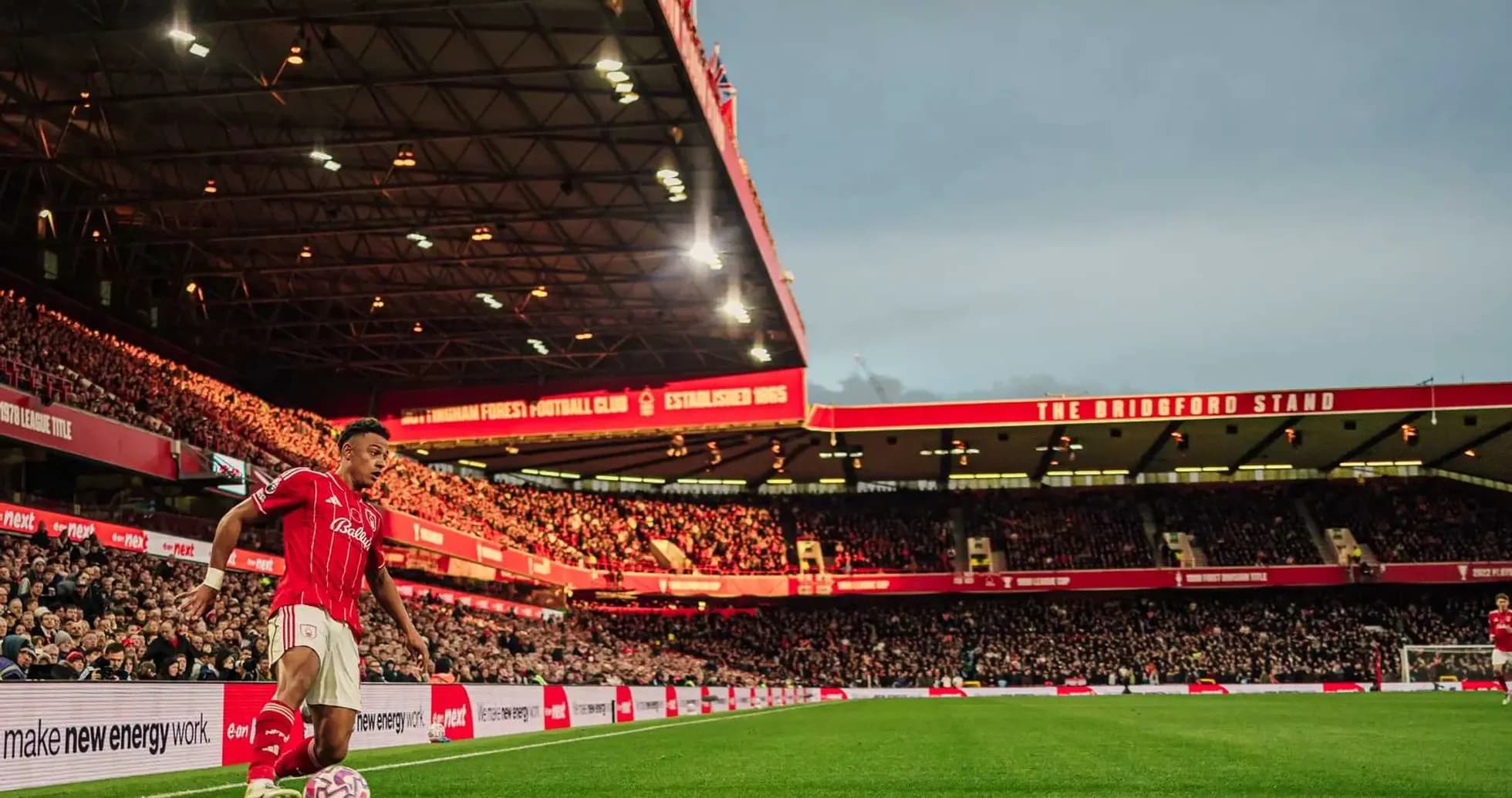
The City Ground’s final act of the 2025–26 Premier League season ended in a stalemate, a 1-1 draw that neatly encapsulated the contrasting trajectories of Nottingham Forest and Bournemouth.
I. The Big Picture – contrasting seasons, shared spoils
Following this result, Forest close their campaign in 16th place on 44 points, their overall goal difference locked at -3 from 48 goals scored and 51 conceded. At home they have been fragile but stubborn: only 4 wins from 19, yet 8 draws speak to a side that often clung on rather than collapsed, with 20 home goals for and 23 against.
Bournemouth, by contrast, complete a quietly excellent season. Sixth place with 57 points and a positive overall goal difference of 4 (58 scored, 54 conceded) earns them a Europa League league-phase berth. On their travels they have been awkward visitors: 6 away wins, 8 draws and only 5 defeats, scoring 29 and conceding 34.
The tactical shapes told their own story. Vitor Pereira rolled the dice with a 4-4-2, pairing Igor Jesus and C. Wood up top, and pushing M. Gibbs-White from his usual central “10” role into a nominal right-sided berth that in reality floated inside. Andoni Iraola stayed faithful to his season-long blueprint: a 4-2-3-1 built on aggression and verticality, with T. Adams and A. Toth anchoring midfield and Evanilson spearheading a fluid band of three in Rayan, E. J. Kroupi and M. Tavernier.
II. Tactical voids – absences that shaped the contest
Both managers arrived hamstrung by key absentees.
Forest’s defensive core was badly hit. Murillo’s muscle injury and W. Boly’s knee issue stripped Pereira of aerial dominance and front-foot aggression at centre-back. O. Aina’s injury removed a versatile full-back option, while N. Savona’s knee problem further thinned the defensive pool. In attack, the absence of C. Hudson-Odoi robbed Forest of a direct, one-v-one threat on the flanks, pushing more creative and transition responsibility onto Gibbs-White and the young wide man O. Hutchinson.
For Bournemouth, the disciplinary ledger bit hard. R. Christie, a red-card absentee, had been one of Iraola’s most industrious midfield pressers, his season marked by 27 tackles, 12 interceptions and a red that ultimately cost him this finale. Alongside him, Álex Jiménez – suspended and also the league’s leading yellow-card magnet for Bournemouth with 10 bookings – deprived the visitors of their most combative wide defender. His 69 tackles, 11 blocked shots and 27 interceptions this season underline how central he has been to their high-intensity defensive identity. J. Soler’s hamstring injury further reduced creative rotation in the attacking midfield line.
These voids forced both coaches into subtle recalibrations: Forest leaning on N. Milenkovic and Morato as a rebuilt central pairing in front of M. Sels, Bournemouth trusting J. Hill and M. Senesi to marshal the back line without Jiménez’s aggression on the flank.
Disciplinary trends also hung over the fixture. Heading into this game, Forest’s yellow-card profile peaked between 46-60 minutes at 25.00% of their bookings, while Bournemouth’s late-game edge was more combustible, with 26.14% of their yellows arriving between 76-90 minutes and a further 21.59% from 91-105. This was always likely to be a match where the emotional temperature rose as legs tired.
III. Key matchups – Hunter vs Shield, and the engine room
Hunter vs Shield
The headline duel was always going to revolve around M. Gibbs-White. Overall this campaign he produced 15 league goals and 4 assists from midfield, with 59 shots (32 on target) and 49 key passes. Forest’s season-long attacking profile – 1.3 goals per game overall, 1.1 at home – has been heavily dependent on his ability to knit transitions, find pockets and carry the ball between the lines.
Bournemouth’s shield was a collective, not an individual. On their travels they conceded 34 goals, an away average of 1.8 per game, a figure that underlines their vulnerability when pressed deep but also their willingness to play on the edge. The centre-back pairing of Senesi and Hill, protected by Adams and Toth, was tasked with compressing the half-spaces Gibbs-White loves. With Jiménez suspended, the full-back unit lacked its most aggressive presser, placing extra onus on A. Smith and A. Truffert to step high without leaving Evanilson isolated from service.
In the end, Forest’s opener before the interval reflected this tension: Gibbs-White drifting off the line, combining with E. Anderson and feeding one of the front two. Bournemouth’s equaliser after the break showcased their own attacking spread – Evanilson’s movement pinning centre-backs, Kroupi ghosting between the lines, Tavernier and Rayan attacking the second phase.
The Engine Room
The midfield battle was the game’s true hinge. Forest’s I. Sangare and E. Anderson formed a double axis with Gibbs-White and Hutchinson tucking in. Sangare’s job was to screen and break up Bournemouth’s vertical surges; Anderson to connect first and second phases and release the wide players early.
Opposite them, T. Adams and A. Toth were quintessential Iraola pivots: aggressive in the press, quick to step into duels, and tasked with feeding the advanced trio early. With Bournemouth’s season-long attacking average at 1.5 goals per game both home and away, their capacity to create chances from central turnovers has been a defining trait.
In narrative terms, this engine-room clash felt like a contest between Forest’s need for control and Bournemouth’s thirst for chaos. Periods of Forest pressure – especially either side of half-time, when their seasonal card data shows a combined 48.33% of yellows between 31-60 minutes – came when Sangare and Anderson managed to slow Bournemouth’s transitions. When Adams and Toth wrestled back tempo, the visitors’ attacking four looked capable of carving out the equaliser that eventually arrived.
IV. Statistical prognosis – a draw that fits the numbers
Following this result, the season-long numbers paint a coherent picture of why 1-1 felt inevitable. Forest, with 11 wins, 11 draws and 16 defeats overall, have been a side of fine margins, their goals for (48) and against (51) almost perfectly balanced with their 1.3 goals scored and 1.3 conceded per game. At home, their 20 goals scored and 23 conceded in 19 matches, coupled with 9 home games where they failed to score, underline a chronic difficulty in turning pressure into multiple goals.
Bournemouth, meanwhile, have lived on the knife-edge of high-scoring contests: 58 goals for and 54 against overall, averaging 1.5 scored and 1.4 conceded per game. Their 18 draws across the campaign – nearly half their fixtures – reveal a team that often punches but also gets punched, especially away where their defensive average of 1.8 goals conceded per match has been their main flaw.
In xG terms, this match would almost certainly mirror those trends: Forest creating enough to justify a goal, Bournemouth carving out comparable quality at the other end. Forest’s perfect penalty record this season (3 scored from 3, 100.00% conversion, 0 missed) never came into play, but Bournemouth’s own spotless record from the spot (5 scored, 0 missed) only added to the sense that any penalty might have tipped a finely poised contest.
Defensively, Forest’s 9 clean sheets overall and Bournemouth’s 11 suggest both are capable of shutting games down, but the structural absences – Murillo and Boly for Forest, Jiménez and Christie for Bournemouth – nudged the balance towards a score draw rather than a stalemate.
In the end, the City Ground finale became a microcosm of the season: Forest resilient yet limited, dependent on Gibbs-White’s invention and the graft of a back four led by N. Williams, whose campaign has blended attacking thrust with 96 tackles, 17 blocked shots and 47 interceptions. Bournemouth, meanwhile, walked off as a Europa League side, their 4-2-3-1 once again delivering enough attacking menace to rescue something, yet not quite enough defensive control to silence a relegation-battling host.
One point each, one goal each, and a final whistle that felt less like closure and more like a promise: next season, these two will meet again, Forest still searching for stability, Bournemouth determined to turn their adventurous numbers into something even more substantial.