.svg&w=384&q=75 "naujapitch logo")
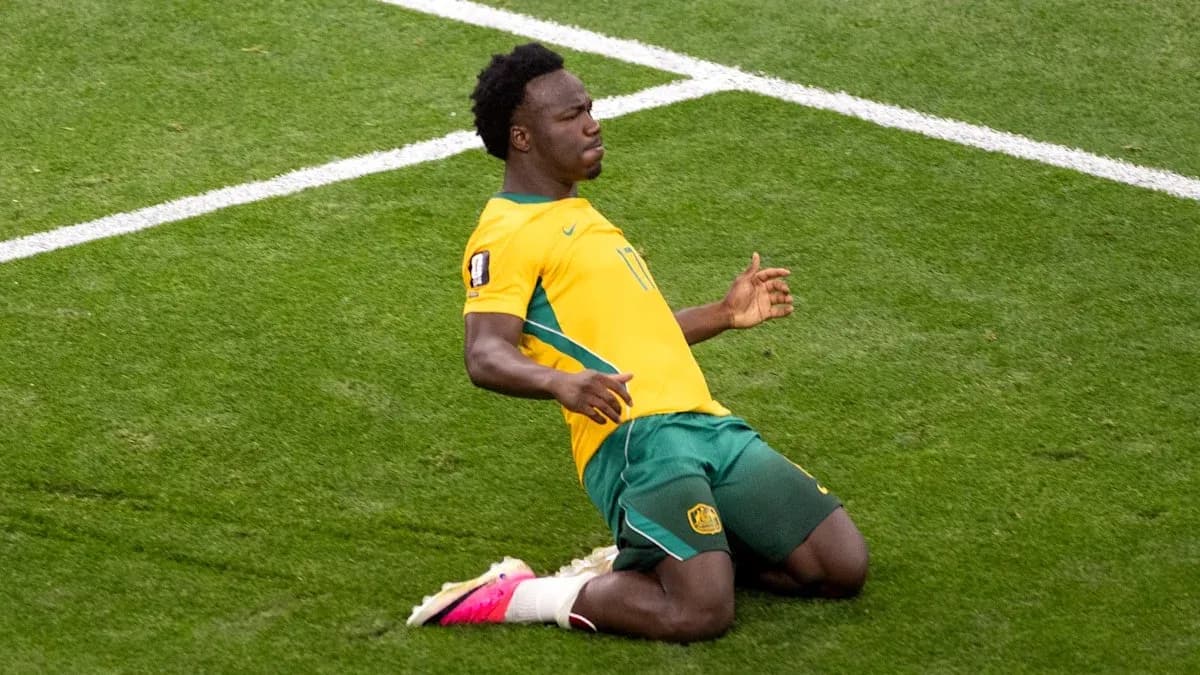
Socceroos Advance Despite Striker Concerns
The Socceroos are through. The performance up front is not.
Australia’s 0-0 stalemate with Paraguay booked a place in the FIFA World Cup round of 32, a job done without flourish but with just enough control. The unexpected headline, though, didn’t come from a striker, a playmaker or a seasoned leader. It came from a fullback.
Jordan Bos, thrust into the starting XI after Jacob Italiano’s late injury withdrawal, became the team’s most dangerous outlet. That, for two former Socceroos, is exactly where the problem lies.
Bos shines, questions burn
Tony Popovic shuffled his deck when Italiano pulled out. Aziz Behich, the long-serving Melbourne City left-back, moved to the left side of midfield. Bos took the right flank. It was the tactical tweak many had been waiting to see, and it worked. Bos attacked with purpose, stretched Paraguay’s back line and repeatedly gave Australia an outlet that the forwards simply didn’t provide.
On Stan Sport’s Added Time, Robbie Slater didn’t hide his unease.
“Up front is a bit of a worry when we’re looking at Jordy Bos as one of the most threatening (for Australia),” he said.
That line hung over the entire assessment of the Socceroos’ display. When your most incisive player is a converted fullback on the wing, the spotlight inevitably swings to the men whose job it is to score.
Scott McDonald agreed. The former striker expected this tournament to showcase the likes of Mo Toure or Nestory Irankunda in the decisive moments. Instead, Toure stayed on the bench against Paraguay, and Irankunda — a natural winger — carried the No.9 role.
The No.9 dilemma
For McDonald, that shift is more than a one-off experiment. It is a red flag.
“There is a problem in terms of the No.9. Not bringing (Mo) Toure on instead of Tete Yengi tells me today that there’s no trust there,” he said.
That lack of trust cuts deep in a position built on confidence. If you are Toure, watching from the sidelines while another forward gets the nod, the message is brutal.
“Does he go and start him (Toure) out of the blue in the next game? You just can’t tell with Tony. But as a striker, being Toure, I don’t like that. That doesn’t fill me with confidence that my coach trusts me.”
McDonald’s verdict on the role was blunt: whoever leads the line for Australia at this World Cup is being sent into a grind.
“No matter who we put up there, it’s a thankless task up there. Look at Nestory (on Friday), he had very little and was living off scraps.
“But also when he plays up top, we don’t have a box outlet. Jordy Bos playing on the right-hand side was brilliant and it gave us that outlet.”
Bos, a defender by trade, offering the penalty-box presence and wide threat that the centre-forward could not. It’s an irony that underlines the structural issue.
Irankunda out of position, under the microscope
Irankunda, still only 20, carries the raw power and flair to terrify defences from wide areas. As a No.9 or even a No.10, the demands change. Back to goal. Hold-up play. Constant wrestling with centre-backs. It is not his natural terrain.
“Look, he’s gotta hold it up a little bit better,” McDonald said. “I think at times he struggled because it’s not his natural game.”
Against a fierce, physical South American opponent like Paraguay, those weaknesses were exposed. Australia often left him isolated, with little support close enough to combine. The game plan pinned him between three defenders in a back three, with almost no space to spin into the channels he usually loves.
“If there are some players getting closer to you, then what are you meant to do?” McDonald asked, pointing to the lack of support around the young forward.
Paraguay knew exactly where the threat lay. They crowded him, suffocated the space, and forced him away from the areas where he can drive at full-backs and cut inside. Irankunda wanted to drift wide, to find grass and face up his marker. The structure pinned him central.
“They were aware of his threat also, with three taking care of him. But he probably sometimes needs to be more in central positions and wait for things to happen.”
That is the paradox. The system demands he stays central; his instincts tell him to roam.
Learning the dark arts of a striker
McDonald turned to a modern reference point to make his case.
“As we see the best strikers in the world – like Erling Haaland – they’re not interested any more. They just get into the right areas and allow others and trust others to do the dirty work then get on the end of things.”
That is the education Irankunda now faces. Less ball, more positioning. Less highlight-reel dribbling, more patience. Trust the supply line, then finish.
“That’s not naturally probably where (Irankunda) thinks. He wants to be the guy creating that and doing things, getting on the edge of the box and having shots. So if you’re gonna play that role, you just need to play it a little bit more smarter and be a bit more patient.”
McDonald admitted he never loved that setup either.
“I didn’t like it either. I mean, for the majority of my career it was always you played off the big man or whatever.”
Then came the line that cuts to the heart of Australia’s centre-forward identity.
“But I’ve always said it, if you can head it, you’ve got a better chance of being a No.9 for the Socceroos. It’s as simple as that.”
Right now, Australia’s most convincing aerial outlet is a marauding fullback-turned-winger in Bos, not the men wearing the No.9’s burden.
The Socceroos march on to the knockouts, their path still alive. The question is whether Popovic can find a striker who looks as dangerous as his right-sided defender before the stakes rise and the margins shrink.