.svg&w=384&q=75 "naujapitch logo")
Spain vs Austria: Round of 32 Clash of Football Ideologies
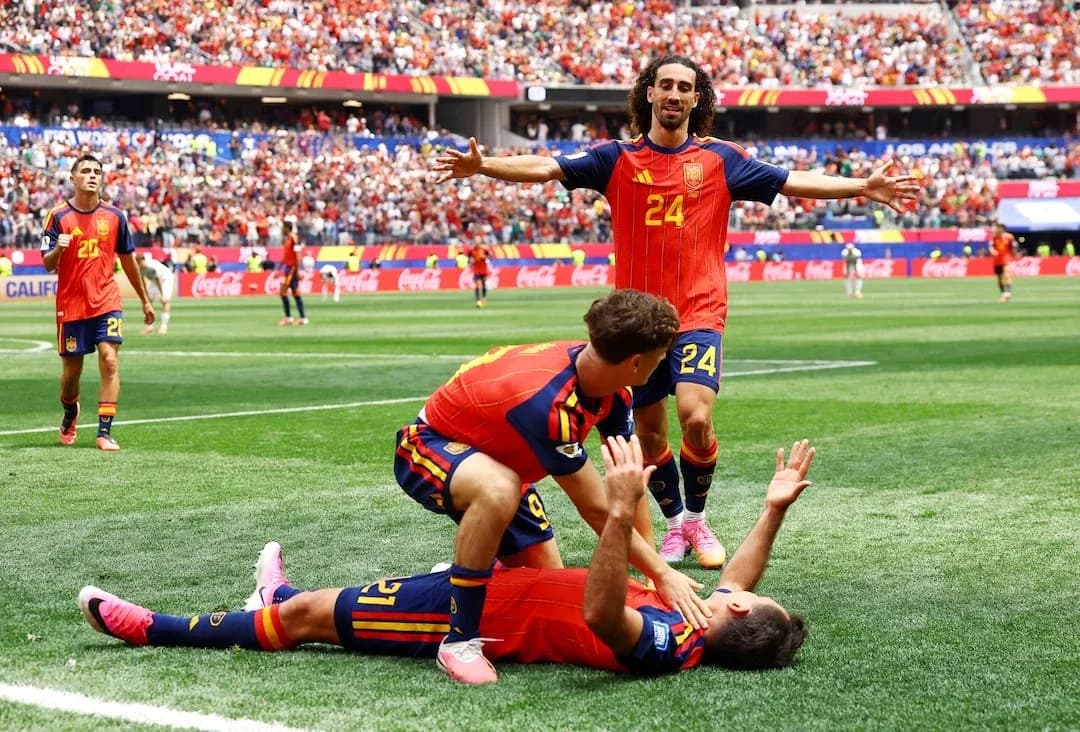
SoFi Stadium in Inglewood stages a Round of 32 clash that feels like a meeting of two different footballing ideologies. Spain arrive as group winners from Group H, carrying seven points and a goal difference of 5 after three matches in which they scored 5 and conceded 0 overall. Austria, second in Group J with four points and a goal difference of 0 from six scored and six conceded overall, come as disruptors: imperfect, volatile, but dangerous.
Luis de la Fuente doubles down on control. Spain’s season profile is ruthless in its clarity: across the campaign they have played 4 matches in total, winning 3 and drawing 1, with no defeats. At home they have played 3, winning 2 and drawing 1; on their travels they have played 1 and won it. The scoring pattern reinforces the identity: 8 goals in total, with 7 at home and 1 away. That translates to 2.3 goals at home on average and 1.0 away, for a total average of 2.0. More striking is the defensive record: they have not conceded a single goal overall. Four clean sheets in four, three at home and one away, speak to a side that smothers games long before they become chaotic.
Austria’s path is more jagged. Across the campaign they have played 4 matches in total, with 1 win, 1 draw and 2 defeats. At home they have played 1, winning it; on their travels they have played 3, drawing 1 and losing 2. They have scored 6 goals in total, split evenly between home and away – 3 at home, 3 away – but the defensive side is where the alarm bells ring: 9 conceded overall, 1 at home and 8 on their travels. That yields an average of 3.0 goals for at home and 1.0 away, but 1.0 conceded at home and 2.7 away, for 2.3 conceded in total. There are no clean sheets, home or away. This is a team that lives with risk.
Both coaches set up in a mirrored 4-2-3-1, but the personnel tell different stories. For Spain, Unai Simón anchors a back four of Pedro Porro, Pau Cubarsí, Aymeric Laporte and Marc Cucurella. Ahead of them, Rodri and Pedri form the double pivot, with Lamine Yamal, Dani Olmo and Álex Baena operating behind Mikel Oyarzabal as the lone forward.
Ralf Rangnick’s Austria respond with Alexander Schlager in goal, a defence of Stefan Posch, Kevin Danso, David Alaba and Konrad Laimer. Nicolas Seiwald and Xaver Schlager sit as the holding pair, with Romano Schmid, Paul Wanner and Marcel Sabitzer supporting Michael Gregoritsch up front.
The tactical voids here are less about absences – there is no explicit injury list provided – and more about structural frailties. Spain’s disciplinary profile is remarkably clean: across the campaign their yellow cards are sparse, and when they do arrive, they cluster between 46–60 minutes and 91–105 minutes, each window accounting for 50.00% of their total cautions. There are no red cards recorded. That suggests a side that rarely loses emotional control, even as intensity rises after half-time and into extra periods.
Austria, by contrast, carry a more combustible edge. Their yellow cards are spread across the match, but with a clear late-game surge: 20.00% in the first 15 minutes, another 20.00% between 31–45 minutes, and then 60.00% from 76–90 minutes. The pattern hints at a team that starts combative, then grows increasingly desperate as matches slip away. There are no red cards in their season data, but the disciplinary spotlight falls squarely on Stefan Posch. Across the tournament he has collected 2 yellow cards, committed 7 fouls and been involved in 35 duels, winning 16. He has also committed one penalty. His aggressive front-foot defending is both asset and liability in a game where Spain will tease and probe in the half-spaces.
The “Hunter vs Shield” duel is unambiguous. Mikel Oyarzabal arrives as one of the World Cup’s most clinical forwards: 4 goals and 1 assist in 4 appearances, from 15 shots with 8 on target. He has started every match, averaging 301 minutes overall with a rating of 7.7. He is not just a finisher but a reference point, linking play with 69 passes and 2 key passes recorded, and willing to work without the ball – 3 tackles and 23 duels, winning 10.
He faces an Austrian defence that, on their travels, concedes 2.7 goals on average and has already suffered a 3-0 defeat away. The total goals against figure of 9, set against 6 scored, underlines a team whose goal difference overall sits at -3. Spain, by contrast, have an overall goal difference of 8 (8 scored, 0 conceded). Oyarzabal’s movement between the lines, flanked by the creativity of Olmo and the directness of Lamine Yamal, will relentlessly test Danso’s positioning and Posch’s discipline. Any mistimed step from Posch – already Austria’s leading figure for both yellow and red card tallies in the wider competition context – could tilt the tie.
In the “Engine Room” battle, Rodri and Pedri against Seiwald and Xaver Schlager feels decisive. Spain’s entire season is built on territorial suffocation: four matches, no defeats, just one game where they failed to score at home, and four clean sheets overall. Rodri’s metronomic passing and positional sense should pin Austria back, allowing Cucurella and Porro to push high and create a de facto front five. Pedri’s role between the lines will drag Seiwald out of his comfort zone; if Austria’s double pivot is forced to chase shadows, their back four will be left exposed to late runs from Baena and inverted movements from Lamine Yamal.
Austria’s best hope lies in transition. With Sabitzer and Schmid capable of carrying the ball and Gregoritsch a threat in the box, they can hurt Spain if they break through the first press. But their own numbers hint at the cost of that ambition: 0 clean sheets in 4 matches, and 2 games on their travels where they failed to score at all.
From a statistical prognosis, Spain’s defensive solidity – 0.0 goals conceded on average overall – combined with an attacking output of 2.3 goals at home and 2.0 in total, points towards a match they should control both territorially and on the scoreboard. Austria’s away profile of 1.0 goal scored and 2.7 conceded on average suggests that, even if they create moments, they are unlikely to sustain resistance across 90 minutes.
This Round of 32 tie, then, shapes up as a contest between a side that has perfected control and one that thrives in chaos. Unless Austria can bend the rhythm into something wild and transitional, Spain’s structure, their unblemished defensive record, and the cutting edge of Oyarzabal should carry them through.