.svg&w=384&q=75 "naujapitch logo")
Switzerland's Tactical Mastery in 2-0 Victory Over Algeria
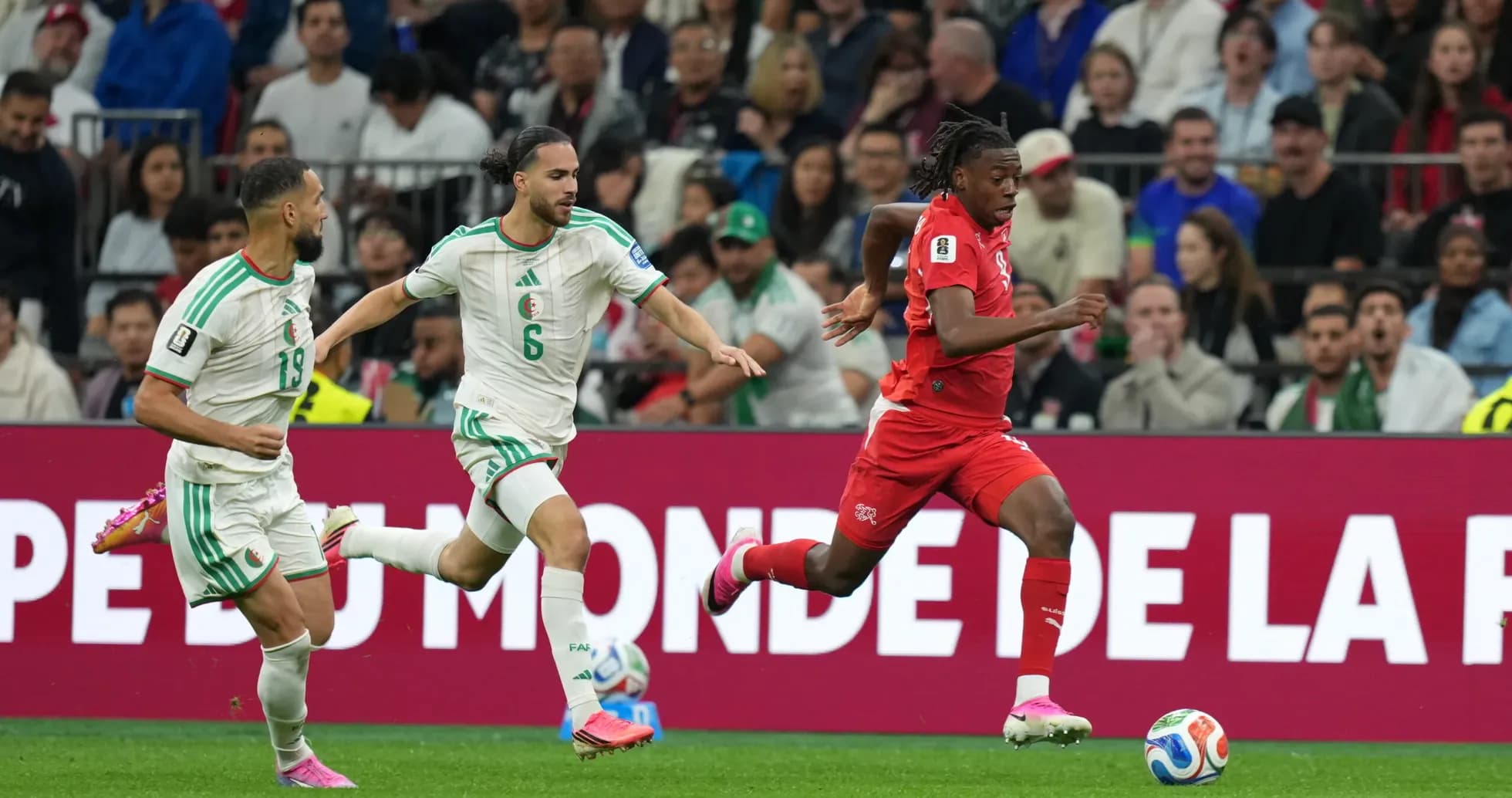
Switzerland’s 2-0 win over Algeria at BC Place was a textbook example of how to control a knockout tie without needing territorial dominance. In this World Cup Round of 32 fixture, Murat Yakin’s side accepted a 45% share of the ball but translated their phases of possession into cleaner chances and a superior penalty-box presence, while Algeria’s more expansive 55% possession never really destabilised the Swiss block.
Structurally, Switzerland lined up in a 4-2-3-1 that behaved like a compact 4-4-1-1 out of possession. Manuel Akanji and Nico Elvedi formed a conservative central pairing, protected by the double pivot of Remo Freuler and Granit Xhaka. Ricardo Rodríguez and Denis Zakaria stayed relatively narrow, inviting Algeria to the flanks but denying central progression. Ahead of them, Dan Ndoye and Rubén Vargas worked as industrious wide midfielders, with Johan Manzambi operating between the lines behind Breel Embolo.
Opening Goal
The opening goal on 10 minutes encapsulated the Swiss plan. Switzerland targeted early vertical connections into Embolo, then used Manzambi as a second-wave runner. B. Embolo finished from a move assisted by J. Manzambi, exploiting the half-space before Algeria’s back four could reset. With nine of Switzerland’s 11 shots coming from inside the box, the structure consistently created high-quality looks close to goal rather than speculative efforts.
Algeria’s 4-3-3, under Vladimir Petkovic, was designed to dominate the ball. Ramiz Zerrouki, Nabil Bentaleb and Farès Chaïbi formed a technical midfield triangle behind a front line of Riyad Mahrez, Ibrahim Maza and Houssem Aouar. They succeeded in circulation terms: 561 total passes to Switzerland’s 436, with an impressive 476 accurate (85%) against Switzerland’s 354 (81%). However, much of this possession was in front of Switzerland’s block. Algeria managed only eight total shots, five inside the box, and just two on target, a reflection of how rarely they could access the central zones between Swiss lines.
Second Half
The second half began with a decisive tactical blow. At 46', D. Ndoye struck Switzerland’s second, turning a controlled performance into a commanding scoreline. With xG at 2.56 for Switzerland against 0.73 for Algeria, the 2-0 score closely mirrored the underlying chance quality: the Swiss consistently engineered clearer opportunities, while Algeria’s attacks were largely sterile.
Out of possession, Switzerland were disciplined and economical. They committed 10 fouls to Algeria’s 12 and avoided any cards, maintaining structural integrity and preventing the game from becoming chaotic. Their pressing trigger was typically a sideways or backward pass from Algeria’s full-backs, at which point Ndoye and Vargas would jump to the outside centre-backs while Manzambi screened the pivot. This forced Algeria wide, where crosses were comfortably handled by Akanji and Elvedi.
Algeria’s attempts to change the dynamic came mainly through substitutions and a more aggressive attacking shape. On 58', J. Hadjam (IN) came on for H. Aouar (OUT), and A. Gouiri (IN) replaced R. Zerrouki (OUT), shifting the emphasis towards more direct threat from the left and additional presence in the final third. Later, at 71', A. Hadj Moussa (IN) came on for R. Mahrez (OUT) and H. Boudaoui (IN) for N. Bentaleb (OUT), moves that aimed to add energy and pressing intensity. Yet the Swiss block continued to absorb pressure, with Switzerland’s back four rarely being pulled apart.
The disciplinary events underline the tactical story. Algeria collected two yellow cards: at 36', F. Chaibi (Algeria) — Tripping, reflecting frustration at Switzerland’s secure midfield circulation; and at 72', H. Boudaoui (Algeria) — Roughing, as Algeria pushed more aggressively to recover the ball. Switzerland, by contrast, managed their defensive duels with control, avoiding bookings and reducing the risk of destabilising set-piece situations around their box.
Goalkeeping played a quieter, but still defined, role. Gregor Kobel (Switzerland) made 2 saves, aligning with Algeria’s two shots on goal, and his calm distribution supported Switzerland’s preference for building through Xhaka and Freuler when they did have the ball. Luca Zidane (Algeria) also registered 2 saves, but his defence allowed 11 total shots and nine inside the box, leaving him repeatedly exposed to high-quality situations. The negative goals prevented value for both keepers (-0.29 for each team) suggests that the finishing slightly outstripped the goalkeeping on both sides, but Switzerland’s superior shot locations were the decisive factor.
Yakin’s in-game management further consolidated control. At 71', F. Rieder (IN) came on for R. Vargas (OUT), and N. Okafor (IN) replaced J. Manzambi (OUT), injecting fresh legs into the attacking midfield line to maintain counter-attacking threat. Later, at 83', Z. Amdouni (IN) came on for B. Embolo (OUT), and at 87' S. Widmer (IN) for D. Zakaria (OUT) plus M. Aebischer (IN) for D. Ndoye (OUT) helped lock down the flanks and protect the 2-0 lead without sacrificing the ability to break.
Statistically, the verdict is clear: Algeria’s 55% possession and higher passing volume did not translate into dangerous territory or sustained penalty-box pressure. Switzerland’s 11 total shots to Algeria’s eight, coupled with a superior xG of 2.56 to 0.73, underline that Yakin’s side controlled the game through structure, vertical efficiency and box occupation rather than ball dominance. The Swiss blocked two shots to Algeria’s three, but more importantly, they consistently forced Algeria into lower-quality attempts.
In sum, this was a tactically mature Swiss performance: compact without the ball, incisive with it, and emotionally controlled in a knockout context. Algeria’s technical midfield and possession framework lacked the mechanisms to unpick Switzerland’s organisation, and once Ndoye’s goal made it 2-0, the tactical contest tilted decisively towards Swiss game management rather than Algerian comeback potential.