.svg&w=384&q=75 "naujapitch logo")
Harry Kane's Defining Performance in World Cup
Thierry Henry leaned back in the Fox studio and almost winced as he described it. The inside-of-the-foot strike, the body twisting away, the balance somehow held at the very last moment. Harry Kane’s second goal against the Democratic Republic of the Congo was not just a match-winner; it was a finish that made one of the greatest strikers of all time joke he might “break my back” trying it now.
You did not need Henry’s words to understand the difficulty, but they sharpened the picture. Kane wasn’t just swinging a leg. He rotated through his entire frame, arms whipping through the air to generate that extra surge of power, happy to crash into the turf if that’s what the shot demanded. This was technique fused with raw athleticism, the kind of movement you only see from a body in peak condition.
And England needed every ounce of it.
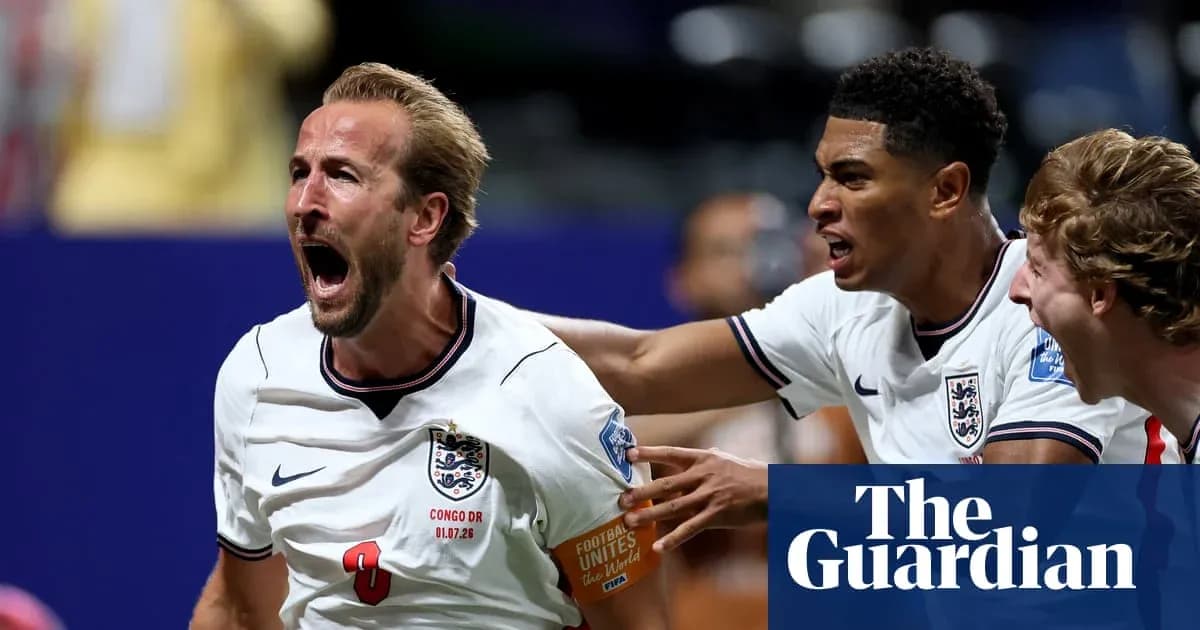
Kane is the reason they are still at this World Cup. The reason Thomas Tuchel is still in a job at Bayern Munich. The captain dragged his team through a game they had no right to win, first with a clever, glancing header to level it, then with that outrageous late strike to beat the DRC and book a last-16 tie with Mexico. It felt like more than a rescue act. It felt like the defining performance of his England career.
Those goals took him to 83 and 84 for his country, from 118 caps. He has long since disappeared over the horizon as England’s record scorer, but this tournament has pushed the conversation somewhere else entirely. Five goals in England’s first four games. Another Golden Boot firmly in range. Gary Lineker’s World Cup goals record already gone.
This is not just a prolific striker. This is a modern great whose numbers and influence are starting to demand a place in the loftiest company.
On the Stick to Football podcast this week, Gary Neville, Roy Keane, Ian Wright and Jill Scott tossed around the ultimate bar-room question: where does Kane sit in the pantheon? When they nudged him up alongside Bobby Moore and Sir Bobby Charlton in England’s top three, it did not sound outlandish. It sounded like a debate whose time has come.
There is, though, one line still missing from the Kane résumé. Moore lifted the World Cup in 1966. Charlton won the Ballon d’Or that same year. They delivered on the biggest stage, at the sharp end of a tournament. Kane, for all his goals, has never quite owned a semi-final or final in the same way.
He has often arrived at tournaments nursing knocks or chasing fitness. He faded in previous campaigns. He was subdued in the Euro 2020 final. In Qatar, he lashed a late penalty over the bar against France in the quarter-final, a miss that still hangs heavy over his international story. After he was substituted in the Euro 2024 final defeat to Spain, some were quick to say the decline had begun.
Not quite. Not even close.
Kane has 72 goals for club and country this season. He is firmly in the Ballon d’Or conversation. At this World Cup he has covered 43,433 metres, more ground than any other England player. Those are not the numbers of a fading force; they are the numbers of a player who has decided that “good enough” is nowhere near enough.
He has layered his game over the years, adding new angles, new weapons. The penalty-box predator is still there, but now he drops off the front line, threads passes between defenders, dictates tempo like a No 10. Few strikers in world football can slip a through-ball with his precision. The violence of his second goal against the DRC was a reminder that the old power is still intact, but the way he moves and manages his body tells the story of a professional obsessed with marginal gains.
The winter break in Germany has helped. So has Bayern’s routine Bundesliga dominance, which allows them to rest their star forward rather than run him into the ground. Kane has seized the opportunity.
“It’s probably the best I’ve felt in my career,” he said. At the start of the season he made a deliberate decision: be even fitter, recover smarter, squeeze every last drop out of preparation. “You need a bit of luck to stay injury free,” he admitted, but luck tends to favour those who do the work.
He studies his numbers after every match. Distance covered. Sprints. High-intensity runs. “It’s really pleasing,” he said, because those stats are not vanity metrics for him; they are proof that the standard he sets for himself is the standard he demands from everyone else. “If you’ve got the leaders training and running like I do, it only helps.”
That mentality has knitted him tightly to Jude Bellingham, the other pillar of this England campaign. Between them, they have dragged Gareth Southgate’s team through performances that have lurched from stodgy to chaotic. The wingers have flickered without truly burning. The midfield looks heavy-legged. The defence has had its moments of panic. Right-back has turned into an injury riddle.
Now comes Mexico in Mexico City, the Azteca roaring, altitude biting, a nation on the charge.
“There is not much we could do with altitude training,” Kane said. England spent 10 days in the Florida heat to acclimatise, but the thin air of Mexico City is another challenge entirely. To prepare properly they would have had to base themselves there for days, maybe weeks, and that was never realistic. “It wouldn’t have been worth it,” he said.
So they go in armed with science, small tricks, and a simple mindset: deal with it. “We’re professional athletes. We have to deal with adversity every now and then,” Kane said. If they come through it, he believes, the hardship will only make the win taste sweeter.
He talks now about peaking at the right time. Tournament football is a strange beast; it rarely rewards teams who blaze from the first whistle and try to hold that level for a month. Kyle Walker, watching on as a former England right-back, pointed to the DRC game and said there is a particular joy in winning when you play badly.
Kane did not hesitate. “One hundred per cent.” You almost never see a side “come out of the gates hot and then sustain that all the way through to the end,” he said. The trick is to grow into it. To learn on the job. To accept that sometimes the perfect game is a fantasy.
“We hope that we can play our style,” Kane said, but he knows what awaits them at the Azteca: a home team playing for pride, for a place in the next round, for a country that will turn the stadium into a cauldron. There will be moments when England cannot breathe, when the pitch feels uphill, when passes die in the thin air. “You might need to grind it out. You might need to find a difficult way to win.”
That is where his evolution as a leader matters most.
Kane has grown louder, more visible, more willing to step into the emotional space that captains sometimes avoid. After the win over the DRC in Atlanta, he gathered his teammates into a huddle on the pitch and spoke. It was not his natural instinct; he admitted he does not like those moments to look staged. But this one, he felt, was necessary.
He wanted them to feel it. To celebrate it. To understand that, for England, routine wins at tournaments have never been guaranteed. “After the Panama game I felt like we didn’t really celebrate the moment as much as we probably should have,” he said. This time, he refused to let it pass like just another group-stage tick in the box.
The aim now is not to relive old scars but to write something new. Kane has been overcoming obstacles since he was a kid, and the DRC match gave him another one to process in real time. He was furious at being denied a first-half penalty after colliding with goalkeeper Lionel Mpasi, the officials deciding he had manufactured the contact.
“It’s a clear penalty,” he insisted. He spoke about the speed of the game, the push in the back, the danger of leaving a leg planted and risking “serious, serious injury”. He could not understand what the referee expected him to do, or why VAR stayed silent. “I was really surprised it wasn’t given,” he said. “In the end it doesn’t matter because we won.”
That last line tells you where his head is now. The personal slight is parked. The numbers are there, the fitness is there, the form is there. The debate about his place in England’s history will rage on, louder with every goal he scores.
But the real verdict will be delivered somewhere else entirely, under the Mexico City sky, with the air thin, the noise thick, and Harry Kane chasing the one chapter his career still lacks.