.svg&w=384&q=75 "naujapitch logo")
Saudi Arabia and Uruguay Battle to a Draw in World Cup 2026 Opener
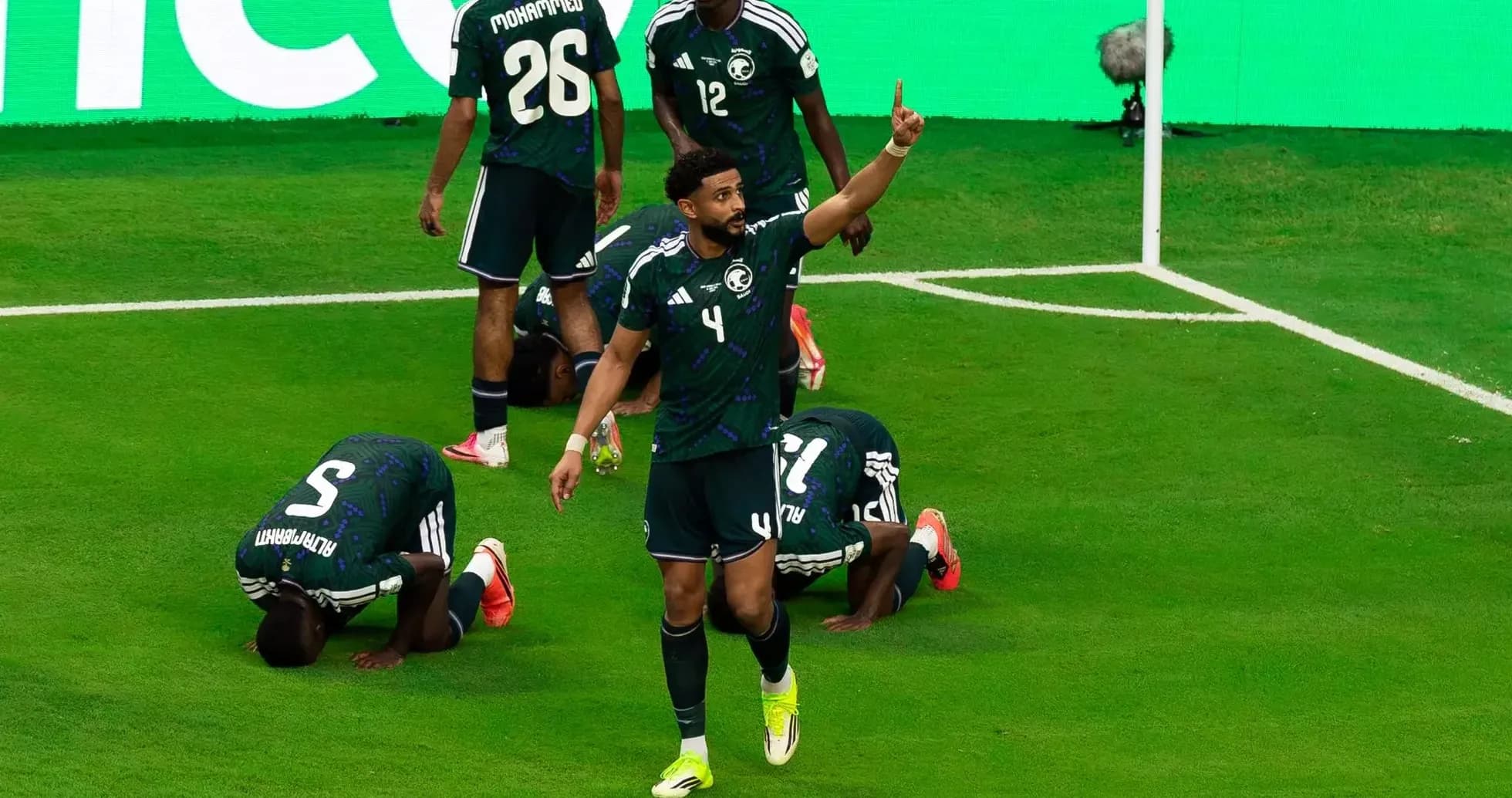
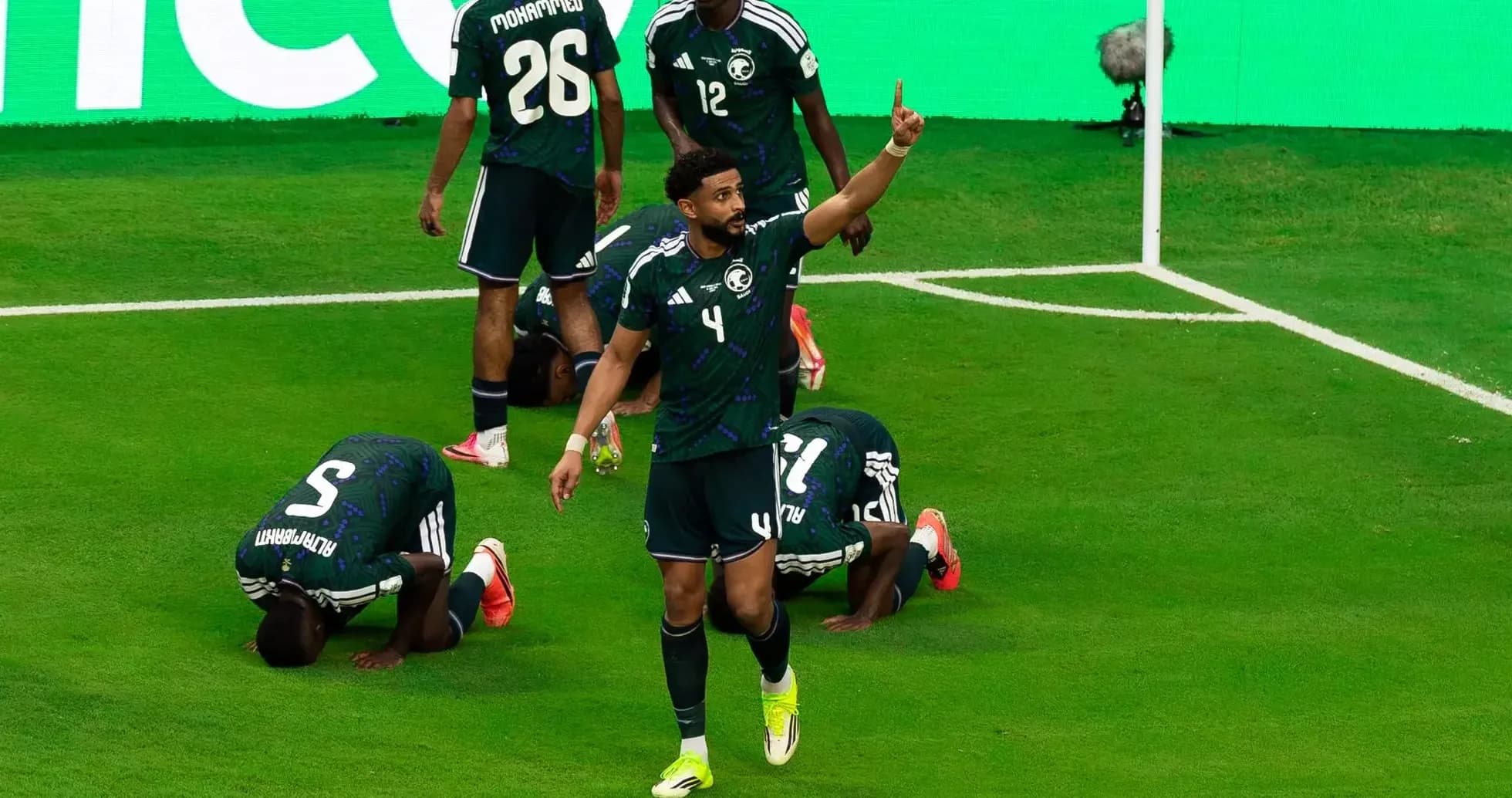
Under the lights of Hard Rock Stadium in Miami Gardens, Saudi Arabia and Uruguay opened their World Cup 2026 journeys with a 1–1 draw that felt less like a quiet introduction and more like a statement of intent from both benches. Following this result, Group H is delicately poised: Uruguay sit 1st and Saudi Arabia 2nd, each with 1 point, each with a goal difference of 0, and each having shown enough to believe the knockout “Round of 32” is within reach.
I. The Big Picture – Two Identities, One Stalemate
On paper, this was a clash of contrasting blueprints. Saudi Arabia, under Georgios Donis, lined up in a classic 4-4-2, a shape that speaks of compact lines, clear roles and direct verticality. Uruguay, with Marcelo Bielsa in the dugout, answered with a 4-2-3-1, a system built for controlled aggression, pressing triggers and numerical overloads between the lines.
Heading into this game, both sides were statistical blank slates in this World Cup cycle. Following this result, the numbers begin to sketch their early DNA. Saudi Arabia, having played 1 match at home, have scored 1 goal and conceded 1, with an average of 1.0 goal for and 1.0 against at home. Uruguay, on their travels, mirror that exactly: in total this campaign they have played 1 match away, scoring 1 and conceding 1, averaging 1.0 goal for and 1.0 against away. Both carry a goal difference of 0 overall, and both have yet to keep a clean sheet or fail to score.
II. Tactical Voids and Discipline – Where the Edges Appeared
There were no recorded absentees in the data, meaning both managers had their full squads available and could lean on their preferred structures. The real “voids” were therefore tactical rather than personnel-based.
For Saudi Arabia, the 4-4-2 depended on the defensive line of S. Abdulhamid, A. Al Amri, H. Tambakti and M. Al Harbi remaining narrow and disciplined in front of goalkeeper M. Al Owais. The midfield quartet of M. Abu Al Shamat, M. Kanno, A. Al Khaibari and S. Al Dawsari were tasked with shuttling laterally, closing central lanes to F. Valverde and R. Bentancur while still supporting the front pairing of F. Al Buraikan and M. Al Juwayr.
The disciplinary profile offers an early warning sign for Donis. Heading into this game, Saudi Arabia’s yellow-card distribution shows a single caution in the 31–45 minute window, accounting for 100.00% of their bookings so far. It suggests a pattern of stress as the first half closes, when concentration can dip and the opposition’s tempo rises. Uruguay, by contrast, have no recorded yellow or red cards across any time window following this result, a sign of controlled aggression and structural balance in Bielsa’s pressing scheme.
III. Key Matchups – Hunter vs Shield, Engine Room vs Enforcer
Hunter vs Shield
For Saudi Arabia, the “hunters” are clearly the front two, but their threat is built on the supply lines behind them. F. Al Buraikan, leading the line, thrives on early service and quick combinations, while M. Al Juwayr offers movement into the half-spaces to drag centre-backs out. Their challenge was to find gaps between Uruguay’s central defenders S. Caceres and M. Olivera, protected by the double pivot.
Uruguay’s “shield” began with that pivot: M. Ugarte and R. Bentancur. Their task was twofold—screen passes into Al Buraikan’s feet and track the late runs of Saudi midfielders, especially M. Kanno, who is comfortable stepping beyond the ball. The fact that Saudi Arabia still found a way to score in this opening fixture underscores how fine the margins were; Uruguay’s away record now reads 1 goal conceded in 1 match on their travels, an away average of 1.0 goal against.
On the other side, Uruguay’s spearhead was D. Nunez, supported by an aggressive line of three in M. Araujo, F. Vinas and F. Valverde. Nunez’s movement across the front sought to isolate full-backs, particularly testing the Saudi left side of M. Al Harbi and H. Tambakti. Saudi Arabia’s home defensive numbers now show 1 goal conceded in 1 match, an average of 1.0 at home, which feels like a fair reflection of how often Nunez and company were able to threaten.
Engine Room – Control vs Containment
The central duel defined the rhythm. For Saudi Arabia, M. Kanno and A. Al Khaibari were the metronomes and the destroyers rolled into one. Their job was to compress space around Valverde, whose role in Bielsa’s 4-2-3-1 was that of a roaming conductor, drifting between lines, linking with F. Vinas and feeding Nunez.
M. Ugarte, meanwhile, was Uruguay’s pure enforcer, anchoring transitions and allowing Bentancur to step higher into the right half-space. The Saudi wide midfielders, M. Abu Al Shamat on the right and S. Al Dawsari on the left, had to constantly decide between tucking in to help central overloads or sprinting out to meet full-backs G. Varela and M. Vina. The 1–1 scoreline is a testament to how evenly this engine-room battle was fought: neither side fully imposed its will, but neither ceded control completely.
IV. Statistical Prognosis – What This Draw Really Says
With both teams on identical overall records—1 match played, 0 wins, 1 draw, 0 losses, 1 goal for, 1 against, goal difference 0—the margins in Group H are already razor-thin. The absence of penalties for both sides (0 taken, 0 scored, 0 missed) hints at attacks built more on open-play construction than set-piece chaos, at least so far.
In xG terms—though not provided explicitly, we can infer from patterns of play and structure—Uruguay’s layered attacking unit and Bielsa’s verticality likely produced a slightly higher volume of chances, particularly through Nunez and Valverde arriving late. Saudi Arabia, however, showed that their 4-4-2 can generate efficient, high-quality moments, especially when S. Al Dawsari drifts inside and Al Buraikan pins the back line.
Defensively, neither side can yet claim solidity: 1.0 goal conceded per match for Saudi Arabia at home and 1.0 for Uruguay away is serviceable but far from watertight. The late-first-half booking profile for Saudi Arabia is a small but notable crack; in tight group games, a mistimed challenge in the 31–45 window—especially something like a 45+4' incident—could tilt the balance.
The verdict: this 1–1 draw does not expose glaring weaknesses so much as it confirms the outlines of two coherent, contrasting projects. Saudi Arabia’s compact 4-4-2, powered by disciplined lines and direct forwards, looks capable of grinding out results. Uruguay’s 4-2-3-1, rich with midfield quality and spearheaded by D. Nunez, suggests a side whose underlying xG profile will improve as automatisms sharpen.
Heading into the remaining group fixtures, expect Saudi Arabia to double down on structure and transitional punch, while Uruguay lean into volume and variety of chances. If defensive tightening matches the promise of their attacking schemes, both have the tools—by numbers and by narrative—to turn this shared point into a launchpad for the knockout rounds.