.svg&w=384&q=75 "naujapitch logo")
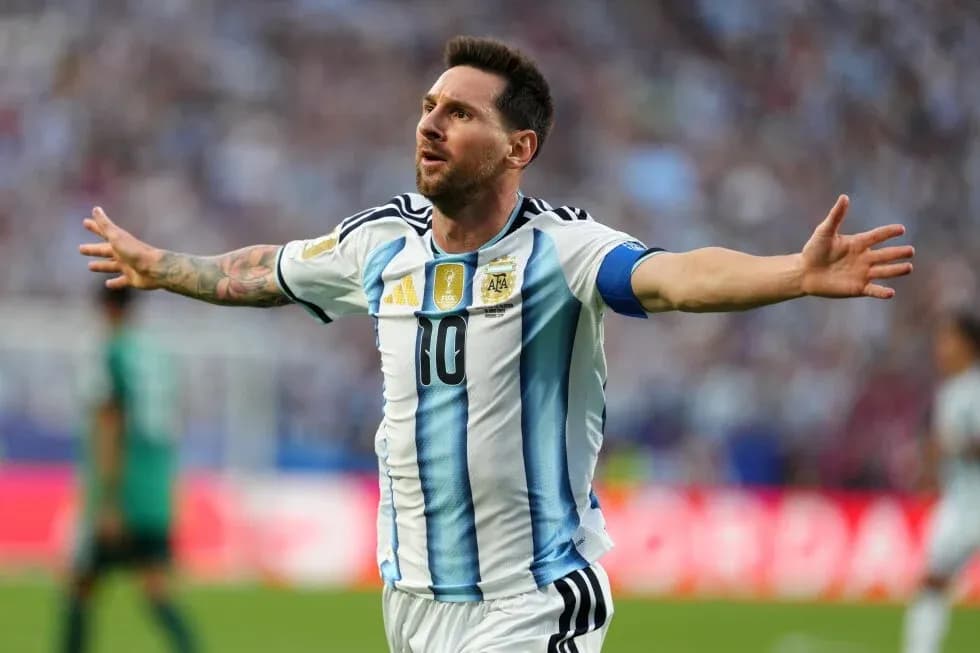
Lionel Messi Scores Hat Trick in Argentina's 3–0 Victory Over Algeria
KANSAS CITY, Mo. — The tears came first.
Lionel Messi, shirt clinging to him in the Midwestern heat, dragged the front of his white-and-blue jersey across his face, trying to hide what 20 years of World Cups rarely revealed: vulnerability. He had just scored Argentina’s opening goal against Algeria, and the weight of a bruising few days away from football finally spilled out in front of 69,045 people.
Then he did what he has always done.
He scored again. And again.
By the final whistle of Argentina’s 3–0 win over Les Fennecs, the questions that had circled him — the hamstring, the age, the possibility of back-to-back World Cups at 39 — felt almost insulting. Messi walked off level with Miroslav Klose atop the men’s World Cup scoring charts, his hat trick dragging him to 16 goals at the tournament and into yet another slice of history.
“I’ve had some tough days. It wasn’t related to football,” Messi said of the tears, stopping there, leaving the rest behind the curtain. “I thank my teammates, the coaching staff and the delegation for helping me.”
A night of records and reminders
This was not just another Messi performance. It landed on an anniversary that underlined the scale of his career.
Exactly 20 years after his World Cup debut against Serbia and Montenegro — he scored that day, too — the pride of Rosario became only the second man to find the net in five editions of the tournament. His sixth World Cup, his 200th international appearance, his 61st career hat trick, his first ever on this stage. The numbers read like a career retrospective, not the opening act of another campaign.
The first goal came early, born from a player who knows him better than most. Rodrigo De Paul, his Inter Miami teammate and long-time Argentina lieutenant, threaded a clever pass into space. Messi ghosted into the gap, opened his body and finished with the kind of inevitability that silences defenders before the ball even crosses the line.
The second was opportunism. A loose rebound dropped in the box early in the second half, and Messi pounced, hammering it home before Algeria could reset.
The third, just before he came off to a standing ovation, was pure technique — a clean, crisp strike that felt like a signature on a document he has been writing since 2006.
On the touchline, Lionel Scaloni simply ran out of language.
“At a loss for words about Leo. What can I say?” the Argentina coach admitted. “He’s incredible.”
Two decades on, still the standard
Messi now sits on 16 World Cup goals, tied with Klose and staring down the outright record with the calm of a man who has been chasing and breaking marks his entire life. This was his fifth straight World Cup match with a goal, another streak to add to a career already crammed with them.
“It makes me very happy to have lived through everything that came my way. What I’m living though now is the cherry on top,” Messi said. “I’m very happy and grateful for this wonderful group. I enjoy it so much.”
The “cherry on top” line landed with the weight of someone who knows the end is closer than the beginning, but refuses to treat this as a farewell tour. His movement was sharp, his touches crisp, his influence total. The minor hamstring issue that had slowed him at Inter Miami in the build-up looked like a footnote.
“This is my sixth World Cup, and I still feel like I’m in good shape,” he said. “Fortunately, I’m doing well, and today we managed to win a tough match. It’s important to start the tournament with a victory in the first game, as that’s never easy in a World Cup.”
Only Cristiano Ronaldo and Bader al-Mutawa have more men’s international caps than Messi’s 200. Only Messi and Ronaldo have scored in five World Cups. The list of peers is shrinking fast.
“Class is permanent,” Algeria coach Vladimir Petkovic said. “He’s fortunate to have the privilege that the entire Argentina team works for him, and supports him, and for a number of years now — decades — he’s done incredible things.”
Outshining the new generation
On a day that was supposed to belong to the next wave, the old master stole the stage again.
Kylian Mbappé struck twice in France’s 3–1 win over Senegal to move to 14 World Cup goals and into a tie for fourth on the all-time list. Erling Haaland scored twice in Norway’s 4–1 victory over Iraq. Both made their statements.
Messi turned theirs into undercards.
“Messi is a madman,” Haaland posted on Snapchat as Argentina’s game unfolded, a blunt assessment from a striker who knows what ruthless finishing looks like.
The contrast was striking: two forwards at their physical peak, tearing through defenses, and a 38-year-old, days from 39, dictating everything with timing, vision and that left foot that still bends matches to his will.
Heartland, hijacked by No. 10
Kansas City has seen its share of stars at Arrowhead, from NFL legends to visiting icons. It has never seen anything quite like this.
Argentina is one of four teams using the Kansas City metro as a base camp, and the region has surrendered itself to Messi-mania. On match day, the highways into the stadium turned into a moving sea of No. 10 shirts. Families, groups of friends, kids on shoulders, drums, flags, songs in Spanish echoing off the concrete.
Inside the downtown Power & Light District, a watch party turned surreal when a goat — an actual goat — was led on stage by former NFL quarterback-turned-Fox broadcaster Jameis Winston, draped in an Argentina jersey. The crowd roared at the joke before the game had even started.
An hour later, Messi scored. The symbolism wrote itself. The GOAT debate, once a barstool argument, feels increasingly one-sided with each passing night like this.
“It’s an advantage to have Leo because of how he handles the group and pushes it forward. Because of who he is,” De Paul said. “He doesn’t care about individual records. He prioritizes the group, and for us it’s incredible.”
The engine still runs the same
The hamstring scare? Forgotten. The age? Irrelevant. The burden of defending a title? Shared across a squad that has been built, unapologetically, around him.
Messi remains the system. Teammates run for him, cover for him, find him. In return, he gives them clarity. When he drops into midfield, the game slows to his rhythm. When he darts between center backs, panic follows. When he stands over the ball, 30 yards from goal, an entire stadium holds its breath.
His 200th cap did not feel like a milestone ceremony. It felt like a declaration that he is not done rewriting what is possible at this age, on this stage.
Cristiano Ronaldo will step out for his 229th international appearance on Wednesday. The two men have defined an era, pushed each other, traded records. Now, as Messi chases Klose’s World Cup tally and another deep run with Argentina, the question shifts.
How many more nights like this does he have left — and how many more will the rest of the world have to find a way to stop him?