.svg&w=384&q=75 "naujapitch logo")
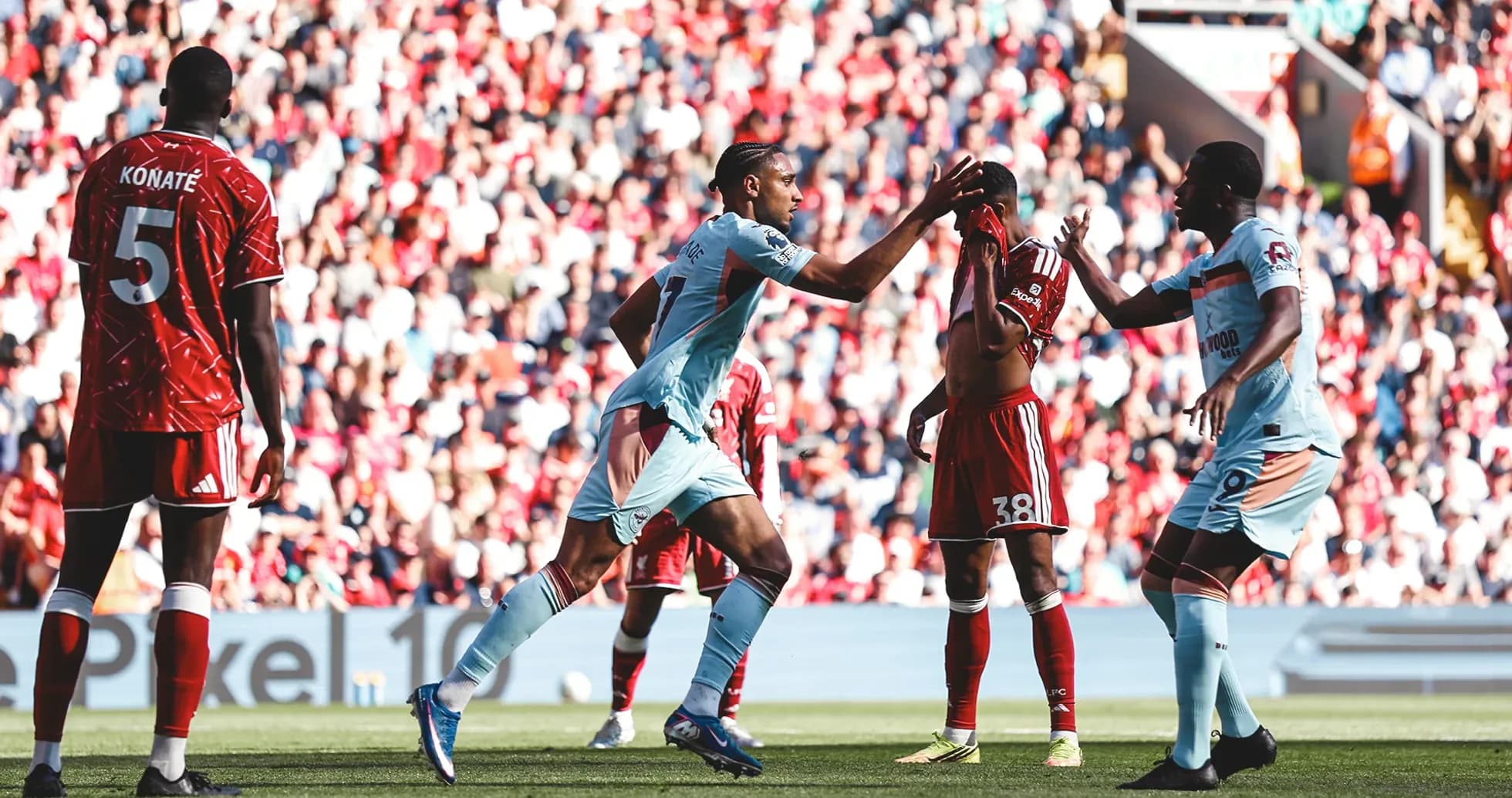
Liverpool vs Brentford: Tactical Insights from the 2025–26 Premier League Draw
Anfield’s final act of the 2025–26 Premier League season ended not with a roar but with a murmur: Liverpool 1–1 Brentford, a draw that crystallised the identities of both sides. Heading into this game, Liverpool were already locked into 5th with 60 points and a goal difference of 10 (63 scored, 53 conceded in total), Brentford in 9th on 53 points with a goal difference of 3 (55 for, 52 against in total). The table said “nearly men” for both; the pitch offered a more nuanced story.
I. The Big Picture – Two 4-2-3-1s, two different moods
Both coaches doubled down on their seasonal blueprint. Arne Slot again trusted the 4-2-3-1 that Liverpool used in 34 league matches, with Alisson behind a back four of C. Jones, I. Konate, V. van Dijk and A. Robertson. Ahead of them, R. Gravenberch and A. Mac Allister formed the double pivot, with an attacking band of M. Salah, D. Szoboszlai and the young R. Ngumoha behind C. Gakpo as the nominal striker.
Keith Andrews mirrored the shape but not the intent. Brentford’s 4-2-3-1, their go-to in 29 league games, was built around solidity and direct threat. C. Kelleher started in goal, protected by M. Kayode, S. van den Berg, N. Collins and K. Lewis-Potter. J. Henderson and V. Janelt screened the back line, while D. Ouattara, M. Jensen and K. Schade supported the league’s second-top scorer, I. Thiago, through the middle.
The formations matched on paper, but the seasonal DNA told us what to expect. At home, Liverpool averaged 1.8 goals for and 1.1 against; Brentford, on their travels, managed 1.2 goals for and conceded 1.6. Anfield usually bends to Liverpool’s attacking will. Brentford’s away record – 6 wins, 3 draws, 10 defeats – suggested a side that can punch up, but often absorbs more than it dishes out.
II. Tactical Voids – Who was missing, and what that changed
Liverpool’s absentees were clustered in youth and depth rather than in their established core, but they still reshaped Slot’s options. S. Bajcetic (hamstring), C. Bradley (knee), H. Ekitike (Achilles tendon) and G. Leoni (knee) were all ruled out. The loss of Ekitike in particular removed an 11-goal, 4-assist attacking outlet and a different profile of striker; it forced Slot to lean more heavily on Gakpo as the central reference, with A. Isak only available from the bench.
Brentford’s missing trio cut closer to structural flexibility. F. Carvalho (knee), R. Henry (hamstring) and A. Milambo (knee) deprived Andrews of rotation in wide and defensive areas. Without Henry’s natural left-back presence, K. Lewis-Potter had to continue his hybrid role as a defender, nudging Brentford towards a slightly more conservative full-back interpretation.
Disciplinary trends also hovered over the contest. Liverpool’s season-long yellow-card pattern showed a pronounced late-game surge: 31.58% of their yellows came between 76-90 minutes, with another 17.54% in added time (91-105). Brentford were similar but a touch more front-loaded in the middle phases, with 21.74% of their yellows between 61-75 and 26.09% between 76-90. Both sides, in other words, tend to grow more desperate – and more reckless – as matches tighten in the closing stages.
Red-card histories coloured the risk profile. D. Szoboszlai’s single red this season and K. Schade’s own dismissal, coupled with his 6 yellows, underlined how fine the line can be for two of the game’s most combative attacking midfielders.
III. Key Matchups – Hunter vs Shield, Engine Room vs Enforcer
Hunter vs Shield was always going to revolve around I. Thiago. With 22 league goals in total, 67 shots and 43 on target, plus 8 penalties scored and 1 missed, he is Brentford’s cutting edge. His duel volume – 524 total, 202 won – speaks to a centre-forward who thrives on contact, second balls and chaos.
Up against him, Liverpool’s defensive “shield” is collective. Overall, they conceded 53 goals in total, but that number splits starkly: 20 at home, 33 away. At Anfield they are far more secure, allowing only 1.1 goals against on average. V. van Dijk and I. Konate form a pairing built to handle aerial threat and physical duels, while Alisson’s presence behind them has underpinned 5 home clean sheets this season. The tactical question was whether Liverpool’s high line and aggressive pressing would starve Thiago of service, or whether Brentford could drag the game into his preferred territory: broken play, crosses, and quick transitions.
In the Engine Room, the duel was subtler. For Liverpool, D. Szoboszlai is the primary tempo-setter and line-breaker. Across the season he delivered 7 assists and 6 goals, with 78 key passes and an impressive 87% pass accuracy from 2,184 total passes. He also brings bite: 55 tackles, 8 blocked shots and 30 interceptions, but with that comes edge – 8 yellow cards and a red, plus a missed penalty that lingers in the narrative whenever Liverpool search for a decisive moment from the spot.
Alongside him, A. Mac Allister and R. Gravenberch offered contrasting profiles: one a metronome, one a carrier. They were tasked with outmanoeuvring J. Henderson and V. Janelt, who form Brentford’s enforcer pair. Henderson’s role as organiser and first passer from deep aimed to connect with Jensen between the lines and Schade wide, while Janelt’s job was to disrupt Liverpool’s rhythm, especially in the central half-spaces where Szoboszlai and Salah like to combine.
Out wide, Mohamed Salah’s creative season – 7 goals and 7 assists, 49 key passes – demanded special attention. Brentford’s full-backs, particularly K. Lewis-Potter repurposed on the left, had to manage Salah’s inside runs while also tracking the overlaps of A. Robertson and the underlaps of Gakpo drifting from the nine into pockets.
IV. Statistical Prognosis – A draw that fits the numbers
Following this result, the numbers sit neatly with the eye test. Liverpool finished with 17 wins, 9 draws and 12 defeats from 38 matches, scoring 63 and conceding 53 in total. Brentford closed on 14 wins, 11 draws and 13 defeats, with 55 scored and 52 conceded in total. Both sides ended with identical total goals-against averages of 1.4, and similar total goals-for averages (Liverpool 1.7, Brentford 1.4).
Liverpool’s home profile – strong but not dominant, with 10 wins, 6 draws and 3 losses – and Brentford’s away pattern – competitive but porous – pointed towards a tight contest rather than a rout. Without minute-by-minute xG, we lean on structural evidence: Liverpool’s heavier attacking volume at Anfield, Brentford’s reliance on Thiago’s efficiency and penalties (8 scored, 1 missed), and both teams’ propensity to open up late when chasing a result.
A 1–1 scoreline reflects a meeting where Liverpool’s superior home firepower was blunted just enough by Brentford’s organisation, and where Thiago’s predatory instincts – honed over 3,295 league minutes – found a way to leave a mark. For Slot, the story is of a side that can control but not always kill. For Andrews, it is of a team that travels with a clear, repeatable plan: compact, direct, and always one Thiago moment away from a result.