.svg&w=384&q=75 "naujapitch logo")
Chelsea's Tactical Masterclass in 2-1 Victory Over Tottenham
Chelsea’s 2-1 win over Tottenham at Stamford Bridge was a tactical paradox: the hosts ceded control of the ball but controlled the scoreboard, while Tottenham’s structure produced territory and volume without enough incision.
Both sides lined up in a 4-2-3-1, but the interpretations were very different. Chelsea, under Calum McFarlane, built a compact, vertically direct side. The double pivot of Andrey Santos and Moises Caicedo stayed narrow and relatively deep, protecting the central lane and allowing the attacking trio of Pedro Neto, Cole Palmer and Enzo Fernandez to spring forward quickly once possession was won. Liam Delap worked as a classic channel-running 9, constantly stretching the space behind Micky van de Ven and Kevin Danso rather than dropping in.
Tottenham, with Roberto De Zerbi in charge, leaned into a more patient, possession-dominant approach. Their 56% of the ball and 538 total passes (473 accurate, 88%) reflect a clear plan to progress methodically through the thirds. The double pivot of Rodrigo Bentancur and Joao Palhinha tried to dictate rhythm, with Randal Kolo Muani and Mathys Tel occupying the half-spaces and Richarlison pinning the centre-backs. The full-backs Pedro Porro and Destiny Udogie pushed high to create width, often leaving the two centre-backs exposed to Chelsea’s counters.
Opening Goal
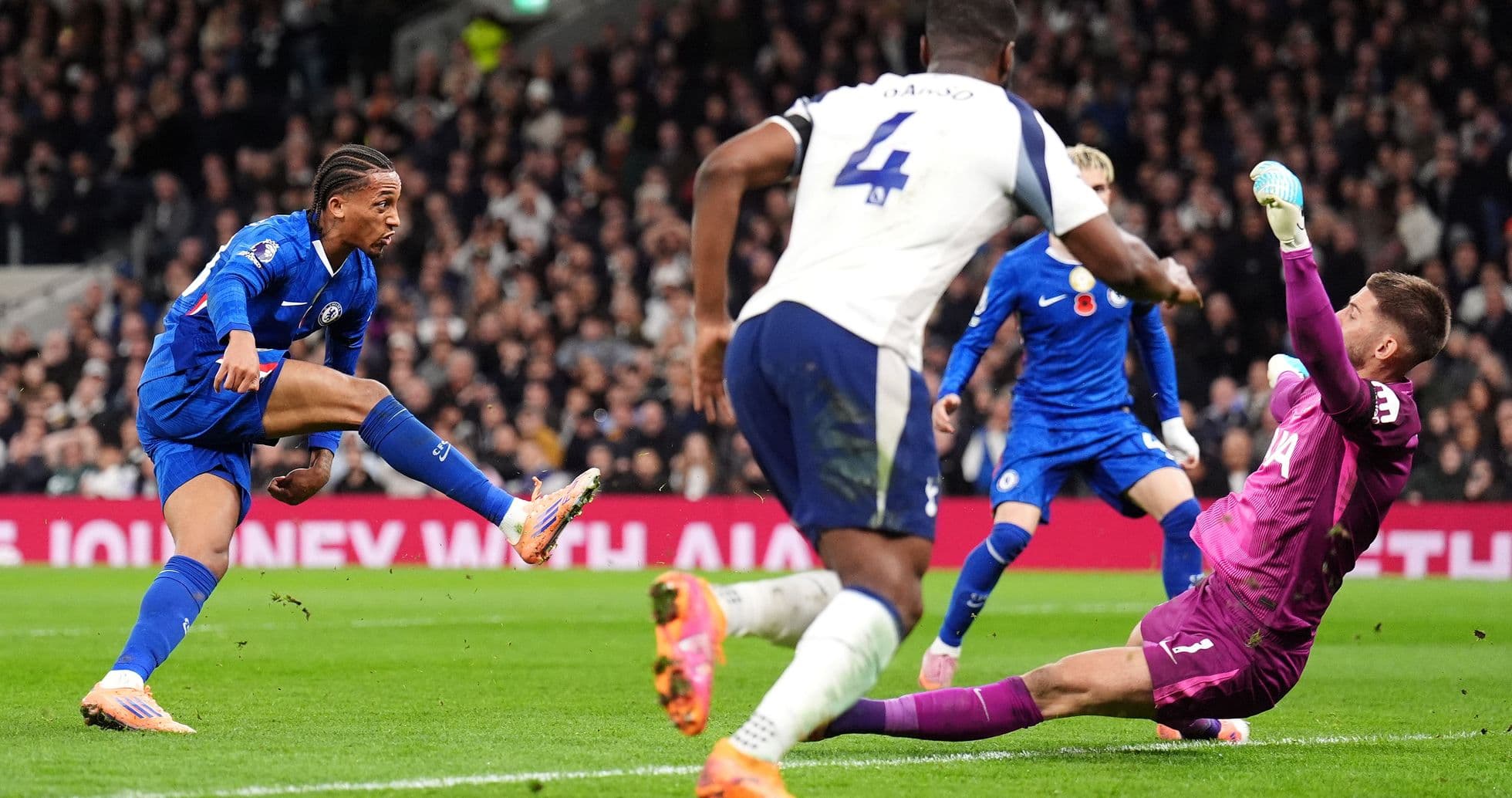
The opening goal on 18 minutes was emblematic of Chelsea’s approach. Breaking from a more reserved block, they found Pedro Neto in space, and his assist to Enzo Fernandez came after a sharp vertical progression rather than a long spell of possession. It was one of only nine total shots Chelsea managed, but their shot selection was relatively clean: four shots on goal from just nine attempts, with four inside the box. The 0.63 xG underlines that they did not create many big chances, but they maximised the few structured attacks they had.
Defensive Strategy
Defensively, Chelsea were prepared to suffer without the ball. Their 44% possession and 425 passes (355 accurate, 84%) show a lower-tempo, lower-volume passing game, but the shape behind the ball was disciplined. Wesley Fofana and Jorrel Hato stayed tight to Richarlison, while Marc Cucurella and J. Acheampong managed the wide overloads. The trade-off was physical intensity: 11 fouls and four yellow cards, with Hato booked for Time wasting, Cucurella for Argument, and both Delap and Dário Essugo for Foul. Those bookings capture a team willing to disrupt rhythm, slow the game and contest duels aggressively to protect a lead.
Goalkeeping Performances
In goal, R. Sanchez (Chelsea) made 2 saves. The underlying numbers are telling: Tottenham generated 1.72 xG but scored only once, while Sanchez’s goals prevented figure of -1.08 suggests that, relative to shot quality, he conceded more than an average keeper might be expected to. Yet structurally, Chelsea limited the clarity of central shots, forcing Spurs to work hard for their openings even when they reached good zones.
On the other side, A. Kinsky (Tottenham) also recorded 2 saves, with a goals prevented value of -1.08. Chelsea scored twice from a modest 0.63 xG, indicating that Kinsky was beaten by relatively low-probability shots, or that the finishing from Fernandez and Santos outstripped the model’s expectations. Defensively, Spurs allowed only four shots on goal and just two blocked shots overall, but their line was repeatedly exposed in transition, particularly when both full-backs were high.
Second Goal and Substitutions
The second Chelsea goal on 67 minutes, finished by Andrey Santos from an Enzo Fernandez assist, was another transition moment that punished Spurs’ rest defence. With Tottenham’s structure tilted forward, Chelsea found space between the lines and attacked the backpedalling centre-backs. The timing of Spurs’ triple substitution at 69 minutes — James Maddison (IN) came on for R. Kolo Muani (OUT), D. Spence (IN) came on for D. Udogie (OUT), and P. M. Sarr (IN) came on for J. Palhinha (OUT) — was a clear attempt to add creativity and fresh legs in midfield and at full-back, but it came just after the damage of the second goal.
Tottenham’s Attacking Profile
Tottenham’s attacking profile was volume-heavy but slightly blunt. They matched Chelsea’s nine total shots but produced eight shots inside the box compared to Chelsea’s four, highlighting their territorial dominance. However, with only three shots on goal, the final action was lacking. Richarlison’s 74th-minute goal, assisted by P. M. Sarr, finally converted that pressure, coming just after Chelsea had reshaped with Trevoh Chalobah (IN) for J. Acheampong (OUT) to reinforce the back line. It forced Chelsea into an even deeper, more conservative block for the closing phase.
Disciplinary Profile
Spurs’ disciplinary profile reflects their aggressive attempt to regain the ball high: 18 fouls and three yellow cards, all for Foul, to Pedro Porro, Micky van de Ven and Destiny Udogie. Their counter-press and high line squeezed Chelsea for long spells, but the lack of clean turnovers in central zones meant much of their possession was in front of Chelsea’s block rather than between the lines.
Late Substitutions
The late wave of Chelsea substitutions at 89 minutes — A. Garnacho (IN) for P. Neto (OUT), D. Essugo (IN) for C. Palmer (OUT), and S. Mheuka (IN) for L. Delap (OUT) — signalled a shift to energy and defensive running rather than control. Essugo’s booking at 90+2' for Foul underlined the tactical choice to protect the 2-1 scoreline through disruption and compactness rather than ball retention.
Statistical Verdict
Statistically, the verdict is clear: Tottenham’s higher xG (1.72 to 0.63), greater possession, more passes and more shots inside the box suggest a side that structurally controlled the game but lacked efficiency in the box. Chelsea, by contrast, executed a low-volume, high-impact plan, leaning on vertical transitions, compact defending and clinical finishing. The 2-1 scoreline reflects tactical clarity from the hosts and a Tottenham side that, despite good underlying numbers, could not translate territorial dominance into points.