.svg&w=384&q=75 "naujapitch logo")
Brighton vs Manchester United: Tactical Analysis of the 3-0 Defeat
The season at the Amex Stadium closed under hard, unforgiving light. Brighton, chasing a European place, ran into a Manchester United side that arrived with Champions League status already secured and left with a 3-0 win that underlined the gulf in penalty-box quality more than in pure structure.
I. The Big Picture – Structure vs. Cutting Edge
Following this result, the table tells a stark story. Brighton finish 8th on 53 points, with a goal difference of 6 built from 52 goals scored and 46 conceded overall. Their season-long identity remains intact: at home they have been proactive and reasonably clinical, averaging 1.6 goals scored and 1.1 conceded, with 9 wins from 19 at the Amex. The 4-2-3-1 Fabian Hurzeler trusted again here has been his default, used in 33 league games.
Manchester United, by contrast, complete the campaign in 3rd with 71 points and a goal difference of 19 (69 scored, 50 conceded overall). Their attack has been one of the division’s sharper blades: at home they average 2.1 goals, and even on their travels they carry 1.6 goals per game. Michael Carrick’s own 4-2-3-1 here sits alongside a 3-4-2-1 used extensively across the season, but the constants are tempo and verticality.
The full-time scoreline – Brighton 0-3 Manchester United – reflects that contrast. Brighton’s possession and patterns were there, but United’s front line and Bruno Fernandes’ orchestration turned territory into goals.
II. Tactical Voids – Absences and the Discipline Landscape
Both sides entered this fixture with notable absentees that shaped the tactical script.
For Brighton, the absence of K. Mitoma through a hamstring injury stripped Hurzeler of his most natural one‑v‑one winger, the player who usually stretches back lines and opens inside lanes for runners like D. Welbeck. S. Tzimas and A. Webster were also missing with knee injuries, further thinning defensive rotation and limiting options to alter the back line’s profile mid-game. As a result, the back four of F. Kadioglu, L. Dunk, J. P. van Hecke and M. Wieffer was locked in from the start, with no like-for-like centre-back cover on the bench beyond O. Boscagli.
Manchester United’s voids were even more symbolic. Casemiro, one of the league’s most card-prone midfielders with 10 yellows and 1 yellow-red this season, was inactive. His absence removed a natural enforcer but also a frequent disciplinary risk in a side that already shows a strong late-game card spike: 20.31% of their yellow cards come between 76-90 minutes, and 21.88% between 46-60. M. de Ligt (back injury) and B. Šeško (leg injury) were also missing, forcing Carrick to trust H. Maguire and L. Martinez as his central pairing with no elite aerial replacement.
Brighton themselves are no strangers to disciplinary edges. Across the season, their yellow-card distribution peaks between 46-60 minutes at 27.91%, then again late, with 15.12% in each of the 76-90 and 91-105 ranges. L. Dunk, who started here, epitomises that combative streak with 10 yellows this campaign. Yet in this match, discipline was less about cards and more about United’s capacity to stay compact and ruthless when Brighton tried to accelerate.
III. Key Matchups – Hunter vs Shield, Engine Room vs Enforcer
Hunter vs Shield
For Brighton, the attacking burden again fell on D. Welbeck, whose season of 13 league goals has been built on intelligent movement rather than sheer volume. His penalty record this season is imperfect – he has scored 1 but missed 2 – a reminder that even Brighton’s most experienced finisher has had fine margins go against him.
He faced a United defence that, over the season, has been solid but not watertight, conceding 26 goals away at an average of 1.4 per game. On paper, Welbeck’s clever runs across the front of Maguire and into the channels beside L. Martinez looked like a viable route to chances. In practice, United’s structure in front of them – with K. Mainoo and M. Mount screening – meant that Welbeck was often isolated, feeding on half-chances rather than clear sights of goal.
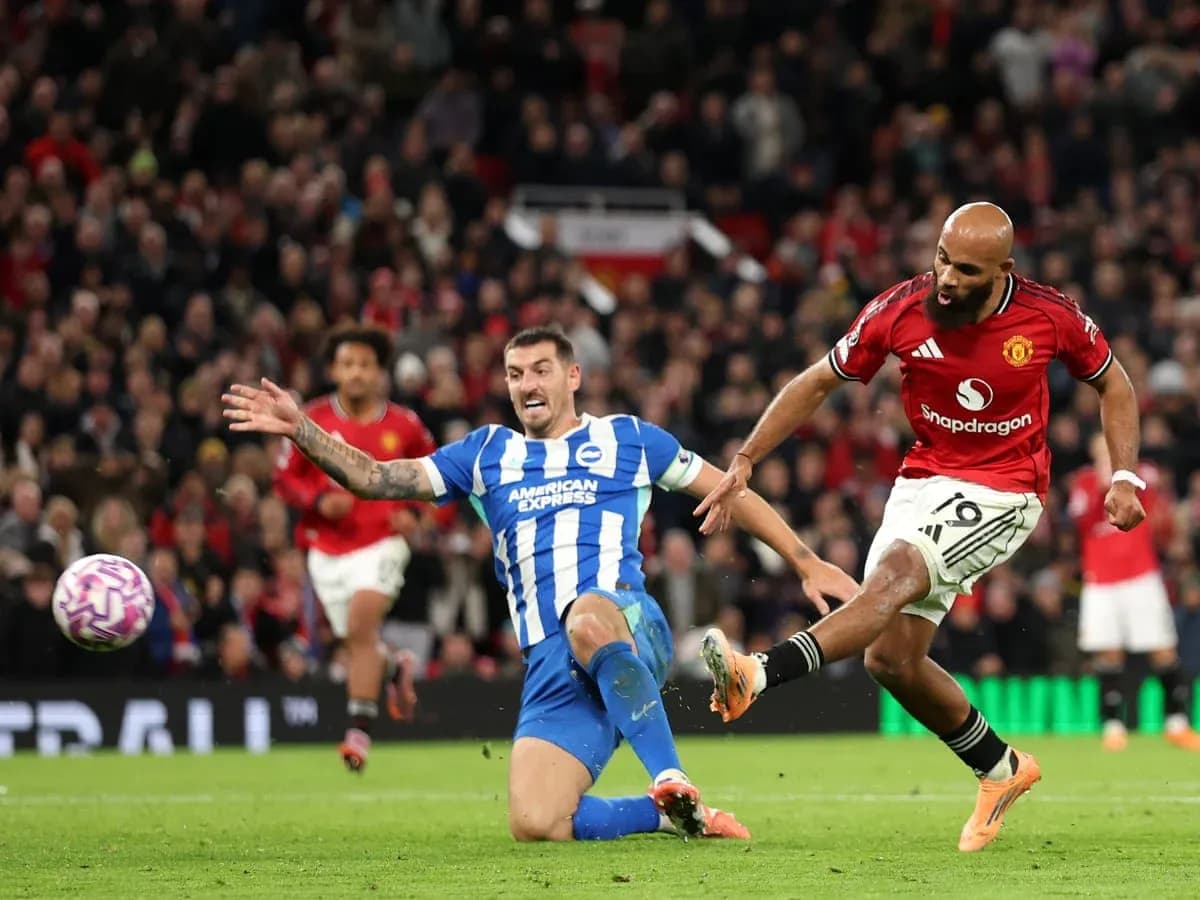
At the other end, B. Mbeumo led the line for United. His 11 goals and 3 assists in the league show a player comfortable both finishing and linking. His duel numbers – 265 contested, 86 won – underline how frequently he engages defenders physically. Against L. Dunk, who has won 127 of 217 duels and blocked 27 shots this season, this was always going to be a collision of timing and strength. United’s opener, and the broader pattern of the game, tilted that duel decisively towards the visitors: Mbeumo’s willingness to run channels and drag Dunk wide repeatedly opened interior lanes for late-arriving midfielders.
Engine Room – Bruno Fernandes vs Brighton’s Double Pivot
If there was a true centre of gravity in this game, it was Bruno Fernandes. Heading into this fixture, he was the league’s top creator with 21 assists and 9 goals, supported by 137 key passes and 1,994 total passes at 82% accuracy. Operating as the central “10” in United’s 4-2-3-1, he constantly probed the half-spaces behind Brighton’s double pivot of P. Gross and J. Milner.
Gross, typically Brighton’s own metronome, and Milner, the experienced organiser, were tasked with both progressing the ball and tracking Fernandes’ movements. That dual responsibility stretched them. Whenever Brighton’s full-backs, particularly Kadioglu and M. De Cuyper, advanced, Fernandes found pockets between the lines, threading passes into A. Diallo and P. Dorgu or slipping Mbeumo in behind. His season-long output – 4 penalties scored but 2 missed – hints at a high-risk, high-reward profile; in open play, that same risk translated into line-breaking passes that Brighton rarely intercepted early enough.
Without Casemiro, United’s “enforcer” role was shared by Mainoo and Mount. Mainoo’s positioning allowed Bruno to stay higher, while Mount’s energy helped close down Brighton’s central build-up. For long spells, that triangle outnumbered Brighton’s midfield three of Gross, Milner and D. Gomez, forcing J. Hinshelwood to drop deeper than ideal and blunting Brighton’s own attacking transitions.
IV. Statistical Prognosis – xG Shadows and Defensive Solidity
Even without explicit xG numbers, the season data and the 3-0 final score sketch a clear expected-goals logic.
Brighton, over the campaign, average 1.4 goals per game overall, but they have failed to score in 9 matches. This was another addition to that column. The pattern fits: when their wide threat is reduced – as it was by Mitoma’s absence – they can dominate phases of play without generating enough high-quality chances. Their home defence, conceding 1.1 goals per game, is usually stable, but United’s attack sits above the league’s median. With 69 goals overall and 30 away, United reliably manufacture chances even against structured back lines.
United’s clean-sheet record – 8 in total, split evenly home and away – underpins the idea that when they score first, they become hard to dislodge. Once they established a two-goal cushion by half-time (0-2 at the break), the game state shifted decisively in their favour. Brighton were forced to commit more bodies forward, and United’s transitions, driven by Fernandes’ passing and the running of Mbeumo, Diallo and Dorgu, only became more dangerous.
Defensively, United’s numbers remain imperfect – 50 goals conceded overall at 1.3 per game – but the blend of Maguire’s aerial strength, Martinez’s aggression, and Luke Shaw’s recovery pace on the left gives them enough resilience when protected by a compact midfield. Shaw’s season profile, with 9 yellow cards and 301 duels contested (166 won), reflects the risk in his front-foot defending, yet here his timing and positioning were largely in sync with the collective block.
Following this result, the tactical verdict is that Brighton’s structure is European-calibre, but their margin for error in both boxes is slim. United, meanwhile, leave the Amex as a side whose attacking ceiling, powered by Bruno Fernandes and a multi-faceted forward line, makes them worthy of their 3rd-place finish – and whose defensive platform, while not flawless, is robust enough to carry them deep into games where the xG balance is tilted by individual quality rather than volume alone.