.svg&w=384&q=75 "naujapitch logo")
Bournemouth vs Manchester City: Tactical Battle Ends in 1-1 Draw
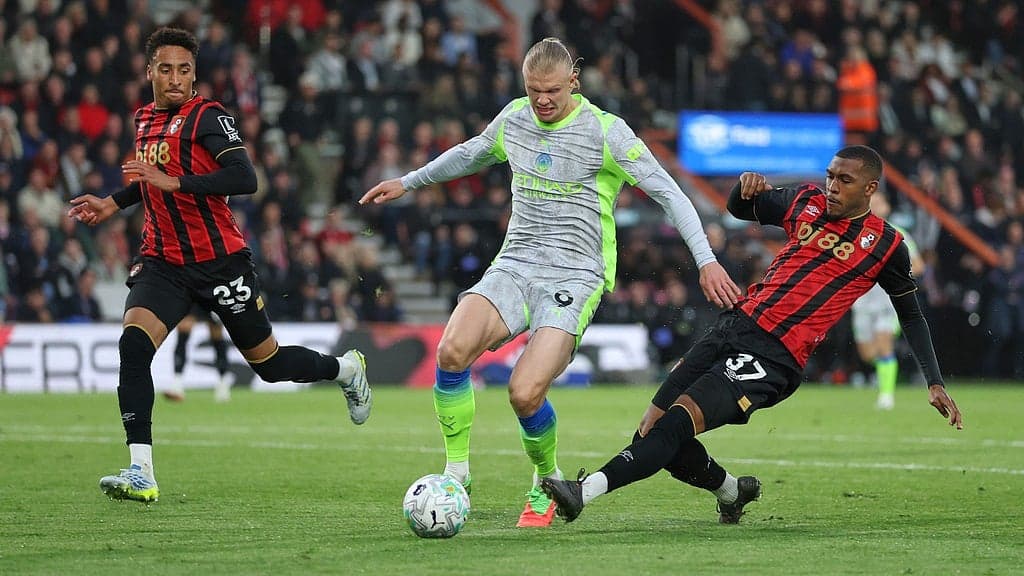
Bournemouth and Manchester City shared a 1-1 draw at Vitality Stadium in Round 37 of the Premier League, a result that reflected a finely poised tactical battle more than any sense of randomness. Bournemouth led from the 39th minute through E. J. Kroupi and held that advantage until the 90th minute, when Erling Haaland salvaged a point for Pep Guardiola’s side. Possession tilted 55%–45% towards Manchester City, but Bournemouth’s compact 4-2-3-1 and direct transitions produced a higher xG (1.99 to 1.68) and forced City into a late rescue act despite their territorial control.
I. Scoring sequence and disciplinary log
The opening phase was tense and physical, with Bournemouth’s double pivot setting the tone. The first disciplinary flashpoint came at 37', when Tyler Adams (Bournemouth) received a yellow card — Argument — signalling the emotional edge in central midfield.
Two minutes later Bournemouth translated their aggression into incision. At 39', E. J. Kroupi (Bournemouth) scored a Normal Goal, assisted by A. Truffert. The move encapsulated Andoni Iraola’s plan: the full back advancing from the 4-2-3-1 line, combining high on the left, and Kroupi arriving from the central attacking midfield lane to finish. That strike defined a first half in which Bournemouth accepted less of the ball but created the clearer moments, taking a 1-0 lead into half-time.
Guardiola reacted early in the second half. At 56', a triple substitution reshaped City’s 4-1-4-1: P. Foden (IN) came on for M. Kovacic (OUT); R. Cherki (IN) came on for B. Silva (OUT); Savinho (IN) came on for A. Semenyo (OUT). This injected more verticality and one-versus-one threat in the half-spaces.
Bournemouth’s defensive line, however, remained aggressive. At 59', James Hill (Bournemouth) was booked — Foul — reflecting the centre-back’s readiness to step out and disrupt City’s combinations between the lines.
Iraola then turned to his bench to refresh his pressing unit and protect the lead. At 76', J. Kluivert (IN) came on for E. J. Kroupi (OUT), a like-for-like switch aimed at preserving the energy in the number ten role for counter-attacks. Simultaneously, City added another direct runner at 76' as O. Marmoush (IN) came on for J. Doku (OUT), maintaining the wide threat on the left.
Bournemouth doubled down on defensive solidity late on. At 84', D. Brooks (IN) came on for Rayan (OUT), adding fresh legs on the flank, and at 89', E. Unal (IN) came on for Evanilson (OUT), giving Bournemouth a forward better suited to holding clearances and drawing fouls.
The closing minutes were fractious. At 90+3', Justin Kluivert (Bournemouth) was shown a yellow card — Argument — in the same incident window as Rodri (Manchester City), who also received a yellow card — Argument — at 90+3', underlining the rising tension as City chased an equaliser. Bournemouth’s full back line was also under stress; at 90+6', Adrien Truffert (Bournemouth) collected a yellow card — Foul — for a late defensive intervention.
Between those bookings came the decisive late twist. At 90', E. Haaland (Manchester City) struck a Normal Goal (no assist) to make it 1-1, capitalising on City’s sustained pressure and their numerical commitment forward in the final phase. The match closed with Bournemouth on four yellow cards and Manchester City on one, total five.
II. Tactical breakdown and personnel
Bournemouth’s 4-2-3-1 was built on vertical compactness and a clear left-sided bias. A. Truffert at left back and M. Tavernier on that flank, with Kroupi drifting towards the same side, formed the primary progression channel. The 39' goal was a textbook example: Truffert advancing from a nominal back four into an auxiliary playmaker zone, while Kroupi attacked the inside-left pocket behind Evanilson.
Out of possession, Bournemouth’s 4-2-3-1 flattened into a 4-4-1-1, with Tyler Adams and A. Scott screening Rodri and blocking central access. Adams’ yellow for Argument at 37' did not change his defensive intensity; Bournemouth continued to foul high (16 fouls overall) to prevent City from settling into their rhythm between the lines.
Manchester City’s 4-1-4-1, with Rodri as the lone pivot, was designed to pin Bournemouth back via sustained possession and width. However, the initial interior pairing of M. Kovacic and B. Silva could not consistently disorganise Bournemouth’s double pivot. City had 55% possession and 14 total shots (10 inside the box), but much of their first-hour play was in front of Bournemouth’s compact block.
Guardiola’s triple change at 56' was the key tactical inflection. P. Foden’s introduction for Kovacic added a more aggressive runner into the right half-space, looking to combine with Savinho (for A. Semenyo) and R. Cherki (for B. Silva) to overload Bournemouth’s right side, where A. Smith and James Hill had to defend larger spaces. This reconfiguration shifted City from a more controlled, pass-heavy structure to a more chaotic, dribble-and-cutback model, reflected in their 5 shots on goal and 6 blocked shots as Bournemouth threw bodies in the way.
Bournemouth’s substitutions were more conservative and game-state driven. Removing Kroupi for Kluivert at 76' preserved the pressing intensity on Rodri’s zone and kept a counter-attacking threat. Brooks for Rayan at 84' and Unal for Evanilson at 89' were aimed at managing fatigue and giving Bournemouth an outlet to hold the ball in advanced areas. The late yellow cards for Kluivert (Argument) and Truffert (Foul) illustrated how thin the margin became as Bournemouth tried to close out the game under increasing pressure.
In goal, D. Petrovic made 3 saves for Bournemouth, with a goals prevented figure of 0.29, indicating that his shot-stopping slightly outperformed the quality of chances faced. For Manchester City, G. Donnarumma made 2 saves, also with goals prevented of 0.29, reflecting a similar degree of efficiency. Both goalkeepers were reliable rather than spectacular; the defensive structures in front of them, and the volume of blocks (Bournemouth 3, City 6), did much of the heavy lifting.
III. Statistical verdict
The underlying numbers reinforce the sense of a balanced contest with contrasting styles. Bournemouth produced 10 total shots to City’s 14, but their xG of 1.99 edged City’s 1.68, suggesting that Iraola’s side carved out slightly better-quality chances despite having less of the ball. Bournemouth’s shot profile was relatively even (6 inside the box, 4 outside), while City concentrated heavily in the area (10 inside, 4 outside), consistent with their territorial dominance.
In possession, Manchester City’s 527 passes, 458 accurate (87%), against Bournemouth’s 431 passes, 346 accurate (80%), underline City’s control phase but also Bournemouth’s competence in building when they chose to play. Bournemouth’s 7 corners to City’s 6 and their willingness to commit to duels (16 fouls to 7) show a home side that combined set-piece threat with aggressive defending.
Discipline was clearly tilted: Bournemouth finished with 4 yellow cards (Adams, James Hill, Justin Kluivert, Adrien Truffert) versus City’s single booking for Rodri, total five. That imbalance mirrored Bournemouth’s strategy of disrupting City’s rhythm, even at the cost of cards, while City largely trusted their structure and patience.
Ultimately, the 1-1 scoreline, with Bournemouth leading 1-0 at half-time and conceding at 90', reflects City’s territorial pressure and late quality, but the xG edge and shot quality underline that Bournemouth’s game plan was close to delivering a statement win at Vitality Stadium.