.svg&w=384&q=75 "naujapitch logo")
Bournemouth Holds Manchester City to a 1–1 Draw: A Tactical Analysis
The Vitality Stadium had the feel of a cup tie more than a late-season league fixture. Bournemouth, heading into this game sixth in the Premier League with 56 points and a goal difference of 4 (57 scored, 53 conceded overall), were chasing a Europa League place. Manchester City arrived as the division’s great measuring stick, second with 78 points and a formidable goal difference of 43 (76 for, 33 against overall). Ninety minutes later, the 1–1 full-time score felt like a statement: Bournemouth are no longer just survivors; they are a problem for the elite.
I. The Big Picture – Structures and Seasonal DNA
Andoni Iraola trusted his season-long blueprint, rolling again with a 4-2-3-1 that has been his default in 35 of Bournemouth’s 37 league matches. D. Petrovic anchored a back four of A. Smith, J. Hill, M. Senesi and A. Truffert, with T. Adams and A. Scott as the double pivot. Ahead of them, a fluid line of three – Rayan, E. J. Kroupi and M. Tavernier – worked behind lone striker Evanilson.
The structure mirrored Bournemouth’s broader identity: compact but progressive. At home this season they have averaged 1.5 goals for and 1.1 against, losing only 2 of 19 league fixtures at the Vitality. The 4-2-3-1 gives them numbers in midfield without sacrificing the ability to break, and it showed in a first half where they went in 1–0 up at the interval.
Pep Guardiola, by contrast, leaned on the familiar control of a 4-1-4-1, one of several systems City have used in a flexible campaign. G. Donnarumma started behind a back four of M. Nunes, A. Khusanov, M. Guehi and N. O’Reilly, with Rodri as the single pivot. In front, a creative band of four – A. Semenyo, B. Silva, M. Kovacic and J. Doku – worked around E. Haaland, the league’s leading scorer with 27 goals and 8 assists in total this season.
City’s season-long numbers underline the threat: overall they average 2.1 goals scored and only 0.9 conceded, with an especially ruthless home attack. On their travels they still carry 1.7 goals per game and concede just 1.1, but this was a night where Bournemouth’s structure and intensity pushed those averages to their limit.
II. Tactical Voids and Discipline
Bournemouth’s selection came with a clear handicap: the absence of R. Christie and Álex Jiménez. Both were listed as “Missing Fixture” – Christie through a red card, Jiménez suspended. Jiménez’s absence was particularly significant. Across the season he has been one of Bournemouth’s most combative defenders, committing 35 fouls, winning 141 of 277 duels, and crucially blocking 11 shots. Removing that profile against a side that averages 2.1 goals overall could have been fatal.
Christie’s suspension also stripped Iraola of a versatile midfielder who contributes both pressing and progressive passing. His disciplinary record – 3 yellows and 1 red – hints at the edge Bournemouth often walk in midfield duels.
Yet the replacements held their nerve. Bournemouth’s season card data shows a pronounced late-game spike in yellow cards: 26.44% of their bookings arrive between 76–90 minutes, with another 21.84% between 91–105. This is a team that often plays on the brink in the closing stages. That they navigated City’s late pressure without imploding spoke to a maturing game management.
City’s discipline profile is more evenly spread, but they also show a late-game edge: 19.70% of their yellows in the 76–90 window and 19.70% between 46–60. B. Silva, with 10 yellow cards in total this season, is the emblem of that controlled aggression. His work rate and 49 tackles, plus 6 blocked shots, embody City’s counter-pressing heartbeat, and he was again central to their attempts to lock Bournemouth in.
III. Key Matchups – Hunter vs Shield, Engine Room Battles
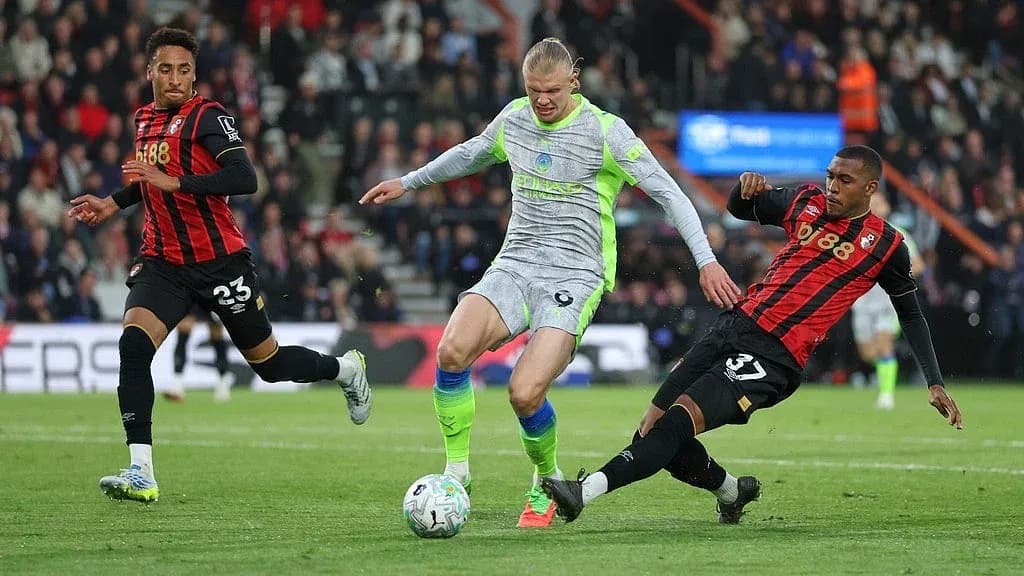
The headline duel was always going to be E. Haaland against Bournemouth’s defensive block. Haaland’s total of 27 league goals has been built on volume and efficiency: 102 shots, 59 on target, with 3 penalties scored and 1 missed. Bournemouth, overall, concede 1.4 goals per game, rising to 1.8 on their travels but a tighter 1.1 at home. At the Vitality, Iraola’s side have kept 6 clean sheets and failed to score only 4 times; this is not a soft home side.
Here, the “shield” was collective rather than individual. M. Senesi and J. Hill had to track Haaland’s movement between the lines, while Adams and Scott screened the zone in front of them. The plan was clear: deny early service, compress central spaces, and force City wide where crosses could be contested. Haaland still found his equaliser, but the fact that City were held to a single goal despite their seasonal firepower underlines how well Bournemouth’s structure held.
Further up the pitch, the “Engine Room” battle was nuanced. Rodri, with his usual metronomic presence, looked to control tempo, but Bournemouth’s double pivot refused to let City settle. A. Scott’s capacity to step out and press Kovacic, while Adams tracked runs from deep, allowed Bournemouth’s three attacking midfielders to stay high and threaten transitions.
On Bournemouth’s side, E. J. Kroupi represented the home “hunter” from midfield. With 13 league goals overall this season, he has emerged as a decisive attacking threat. His ability to receive between the lines and drive at defenders was central to Bournemouth’s first-half joy, pulling City’s back four out of shape and creating pockets for Evanilson to attack.
For City, the creative load was shared. B. Silva’s 47 key passes and 4 assists overall, combined with the bench presence of R. Cherki – 12 assists and 61 key passes in total – meant Guardiola had layers of invention at his disposal. Even when the starting 4-1-4-1 struggled to break Bournemouth down, City’s squad depth kept the pressure relentless.
IV. Statistical Prognosis – xG Echoes and Defensive Solidity
We do not have explicit xG values, but the season data sketches the underlying probabilities. Heading into this game, City’s attack at 2.1 goals per match against a Bournemouth defence conceding 1.4 overall would normally tilt expectation towards an away win, especially given City’s 16 clean sheets in total. Bournemouth’s home scoring rate of 1.5, matched against City’s 0.9 goals conceded overall, suggested that a single Bournemouth goal was likely but a clean sheet was not.
The 1–1 draw, then, feels like the equilibrium point of those forces. Bournemouth hit roughly their home attacking baseline while keeping City well below theirs. The absence of Jiménez and Christie could have opened a tactical void, but Iraola’s structure and the collective discipline of his back four plugged it.
Following this result, the narrative is clear: Bournemouth’s 4-2-3-1 is no longer just a plucky underdog system; it is a stable, European-chasing platform that can stand up to the league’s most sophisticated attack. City, for their part, remain a statistical juggernaut, but this night at the Vitality will sit as a reminder that even a 27-goal striker like Haaland can be contained, if not completely silenced, by an organised and fearless mid-table climber.