.svg&w=384&q=75 "naujapitch logo")
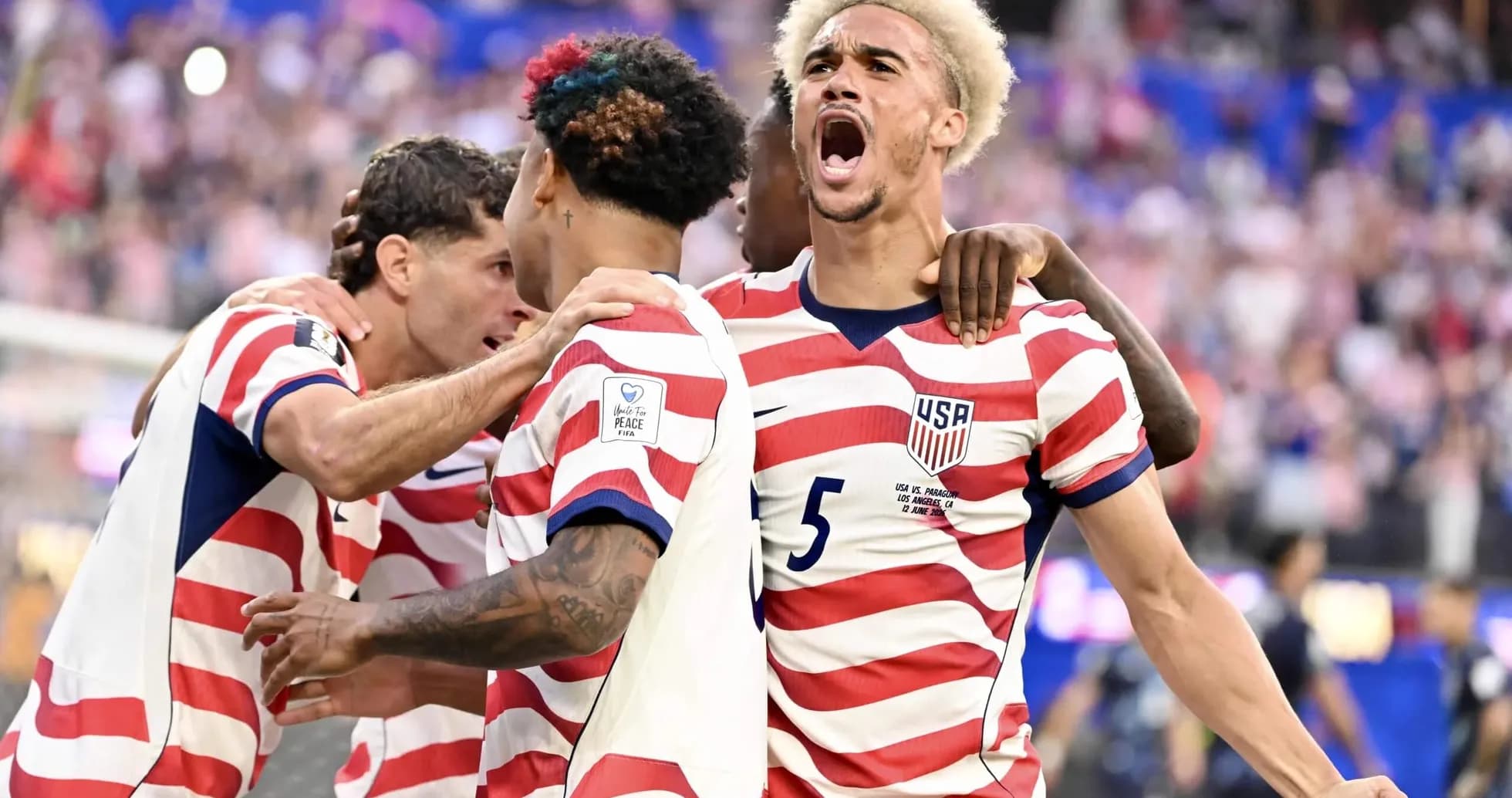
USA Dominates Paraguay in World Cup Opener
SoFi Stadium’s vast bowl had barely settled into its first World Cup night when USA tore into Paraguay with a statement performance that felt less like an opener and more like a declaration. Following this result, a 4–1 win that puts them top of Group D with 3 points and a goal difference of +3 (4 goals for, 1 against), Mauricio Pochettino’s side look like a team whose squad structure and tactical identity are already sharply defined.
I. The Big Picture – Structure and Intent
On paper it was 4-2-3-1 versus 4-4-2, but in practice USA’s shape constantly morphed. With M. Freese in goal behind a back four of A. Robinson, T. Ream, C. Richards and A. Freeman, the base was stable and technically secure. Ahead of them, T. Adams and M. Tillman formed the double pivot, but their roles were asymmetrical: Adams anchoring and screening, Tillman stepping higher to connect with the trio of S. Dest, W. McKennie and C. Pulisic behind lone striker F. Balogun.
Paraguay’s 4-4-2 under Gustavo Alfaro was more orthodox. O. Gill started in goal, shielded by J. Alonso, O. Alderete, G. Gomez and J. Caceres. Across midfield, D. Gomez and A. Cubas sat more centrally, with D. Bobadilla and M. Almiron tasked with bridging to the front two, A. Sanabria and J. Enciso. It was a structure designed for compactness and counterpunching rather than expansive possession.
Heading into this game, the numbers were a blank canvas. Following this result, that canvas is painted starkly: USA have played 1 match in total, winning it, with 4.0 total goals scored on average and 1.0 conceded. Paraguay, by contrast, have played 1 away match in total, losing 4–1, scoring 1.0 goal on their travels but conceding 4.0.
II. Tactical Voids – Discipline, Depth and the Bench
With no absentees listed, both coaches had full squads, and the way the game unfolded highlighted the differing depths. USA’s bench options – G. Reyna, H. Wright, R. Pepi, B. Aaronson, M. Robinson, M. McKenzie, J. Scally and others – gave Pochettino multiple ways to alter tempo and threat without sacrificing control. Reyna’s cameo, 17 minutes with 1 goal from 1 shot and 100% passing accuracy, underlined how the attacking ceiling of this group extends beyond the starting XI.
Paraguay’s changes, including the introduction of Maurício and A. Arce, brought some spark – Maurício’s 1 goal from 1 shot, 20 passes at 70% accuracy and 2 tackles showed his ability to influence both phases – but the structural issues behind them were harder to patch.
The disciplinary ledger reveals another fault line. USA’s season card profile so far shows a single yellow arriving between 46–60 minutes (100.00% of their total yellows in that window), suggesting a tendency to reset physical tone early in the second half but otherwise maintain composure. Paraguay’s yellows are scattered more dangerously: 1 between 0–15 (20.00%), 1 between 46–60 (20.00%), 2 between 76–90 (40.00%) and 1 between 91–105 (20.00%). That late-game surge of 40.00% in the 76–90 window hints at emotional and physical fraying when chasing matches.
Individually, Paraguay’s key disciplinary figures tell a similar story. J. Caceres, with 1 yellow, 5 tackles and 3 fouls committed, and M. Almiron, also booked with 2 tackles and 1 foul committed, are high-effort, high-contact players. A. Arce’s yellow and 8 duels contested in just 37 minutes underline a substitute who arrives with aggression but limited control. For a side already conceding 4.0 away goals on average, that edge easily tips into vulnerability.
III. Key Matchups – Hunter vs Shield, Engine Room vs Enforcer
The “Hunter vs Shield” duel is embodied by F. Balogun against Paraguay’s central defensive axis. Balogun’s profile after this match is that of a classic tournament spearhead: 2 goals from 4 shots (3 on target), 10 duels contested with 5 won, and 4 fouls drawn. He is both finisher and reference point, constantly pinning centre-backs and forcing them into decisions they do not want to make.
On the other side, G. Gomez and O. Alderete are asked to be the Shield for a team whose total goals against on their travels now stands at 4.0. Their task is complicated by the fact that USA’s threat is multi-directional: Pulisic’s 22 passes at 81% accuracy, 2 key passes and 3 successful dribbles from 5 attempts, plus Tillman’s 38 passes at 78% with 3 key passes and 5 drawn fouls, mean that if they focus solely on Balogun’s runs, the half-spaces behind them are carved open.
In the “Engine Room” battle, T. Adams and M. Tillman face Paraguay’s A. Cubas and D. Gomez, with Maurício and M. Almiron drifting into those channels. Adams’ screening allows USA’s full-backs to step high, especially Freeman, whose 74 passes at 86% accuracy, 1 assist, 2 interceptions and 13 duels (8 won) mark him as an auxiliary playmaker from the right. For Paraguay, Almiron’s 23 passes at 78% accuracy, 2 key passes and 2 successful dribbles make him the primary conduit; but his yellow card and heavy workload in duels show how much he is forced to work just to get Paraguay up the pitch.
Enciso is Paraguay’s most balanced offensive outlet: 25 passes at 80% accuracy, 1 key pass, 4 dribbles attempted with 2 successful, 14 duels with 8 won. His duel with Robinson and Ream on USA’s left is crucial; if he can consistently beat the first man, Paraguay can drag the USA block into uncomfortable lateral sprints. Yet the evidence from this match suggests USA’s wide defenders, especially Freeman, are comfortable defending large spaces while still contributing to build-up.
IV. Statistical Prognosis – xG Shadow and Defensive Solidity
We lack explicit xG numbers, but the shot and goal profiles sketch a clear Expected Goals story. USA’s 4 goals from a frontline where Balogun had 4 shots, Tillman 3 and Reyna 1, combined with multiple key passes from Pulisic and Tillman, point to repeated high-quality entries into the box rather than speculative efforts. Their total record – 4 goals from 1 match in total, with no fixtures where they failed to score – suggests that this is not a one-off finishing spike but the product of consistent chance creation.
Defensively, conceding 1 goal in total from 1 match, with 0 clean sheets so far, hints at a minor vulnerability in transitions rather than systemic fragility. Paraguay’s ability to generate a goal through Maurício, from limited shooting volume, shows that if USA’s rest defence loses concentration, they can be punctured. But Paraguay’s overall attacking profile – 1 goal in total, 1.0 on their travels, and no match where they have failed to score yet – is overshadowed by the structural leak at the back: 4 goals conceded, all away, at an average of 4.0.
In narrative terms, following this result USA emerge as a side whose squad is layered with complementary profiles: Balogun the Hunter, Pulisic and Tillman the creative knives, Adams the shield, Freeman the modern full-back playmaker, and Reyna the devastating closer from the bench. Paraguay, by contrast, lean heavily on the improvisation of Almiron, Enciso and Maurício to offset a back line that is overworked and overexposed.
If this match is a prologue for the campaign, the prognosis is clear. USA’s blend of tactical clarity, attacking depth and relative defensive control should continue to generate strong xG advantages and manageable defensive workloads. Paraguay will need to tighten their defensive structure and temper their late-game disciplinary spikes if they are to convert the individual quality of Enciso, Almiron and Maurício into results rather than just moments.