.svg&w=384&q=75 "naujapitch logo")
Brazil and Morocco's Tactical Battle Ends in 1-1 Draw
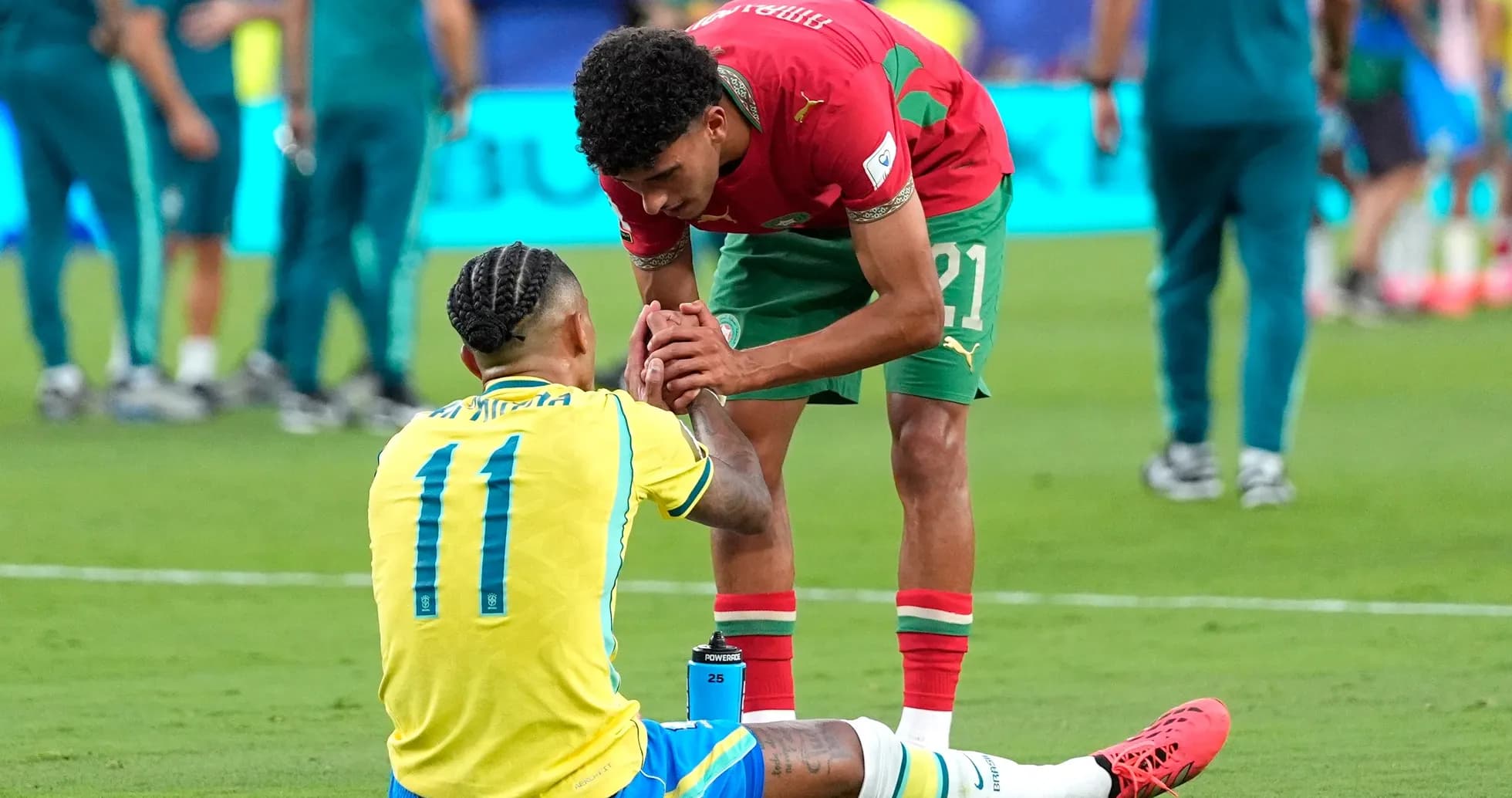
Brazil and Morocco opened their World Cup campaigns at MetLife Stadium with mirrored 4-2-3-1 structures and a 1-1 scoreline that accurately reflected a match of fine margins. Brazil had more of the ball (54% possession) and a slight territorial edge, but Morocco’s compactness, counter-attacking threat and set defensive traps meant the game never tilted decisively either way. Both sides produced 12 shots, and both generated similar xG (Brazil 1.24, Morocco 1.28), underlining how evenly the contest was played despite stylistic contrasts.
Brazil's Formation
Brazil’s 4-2-3-1 under Carlo Ancelotti was built around controlled progression and half-space occupation. Casemiro and Bruno Guimarães formed the double pivot, with Lucas Paquetá as the central 10, Raphinha and Vinícius Júnior wide and Igor Thiago as the lone striker. The full-backs, Douglas Santos on the left and Roger Ibañez nominally on the right, were tasked with providing width to free the wingers inside.
In possession, Brazil used Bruno Guimarães as the main connector, dropping alongside or just ahead of Casemiro to help circulate through Morocco’s first line. The 501 total passes, with 441 accurate (88%), show a team comfortable recycling the ball, but the distribution of shots hints at where Morocco forced them to play. Nine of Brazil’s 12 shots came from inside the box, evidence that the structure did create penetration, yet they were limited to four shots on goal and had four efforts blocked. Morocco’s back four plus double pivot consistently collapsed into the box, turning many promising entries into crowded, low-quality finishes or blocked attempts.
The left side was Brazil’s primary offensive lane. Vinícius Júnior, starting as a nominal wide midfielder, repeatedly attacked the inside-left channel, combining with Douglas Santos’ overlapping runs and Paquetá’s movements towards that half-space. His equalising goal, assisted by Bruno Guimarães, was the clearest expression of this pattern: central circulation to draw Morocco’s midfield, a vertical connection into the left channel, and Vinícius attacking the gap between full-back and centre-back. Raphinha, by contrast, had less structural support on the right, particularly once Roger Ibañez, who had been booked for a Foul at 43', was substituted at half-time for Danilo. The double change at 46' — Danilo (IN) came on for Roger Ibañez (OUT), and Fabinho (IN) came on for Casemiro (OUT) — subtly shifted Brazil’s balance: more stability and ball security, but slightly less aggression in early pressing and forward duels.
Fabinho’s introduction tilted the pivot towards a more positional, less confrontational profile. Casemiro’s earlier yellow card for a Foul at 37' had already made him more cautious, and the substitution protected Brazil against a second booking while maintaining a two-man screen. With Fabinho and Bruno Guimarães, Brazil could keep Morocco penned in phases, but Morocco’s structure was rarely broken; the North Africans simply sank into a 4-4-1-1 or 4-5-1 block, forcing Brazil to play around them rather than through.
The later offensive changes — Luiz Henrique (IN) for Igor Thiago (OUT) and Matheus Cunha (IN) for Lucas Paquetá (OUT) at 61', then Danilo Santos (IN) for Bruno Guimarães (OUT) at 80' — indicated a shift towards more direct, vertical threat and fresh legs in the half-spaces. However, the shot profile did not dramatically change; Morocco’s six blocked shots underline how their central defenders and double pivot continued to protect the heart of the box, even as Brazil rotated their attacking personnel.
Morocco's Formation
Morocco’s own 4-2-3-1, under Mohamed Ouahbi, was built on a disciplined mid-block and sharp transitions. Neil El Aynaoui and Ayyoub Bouaddi anchored midfield, with Azzedine Ounahi and Bilal El Khannouss starting as advanced midfielders alongside Brahim Díaz, and Ismael Saibari as the nominal striker. Out of possession, they often formed a narrow 4-4-2: Saibari and one of the attacking midfielders led the press, while the wide players tucked in to deny central progression.
Their offensive plan was clear: draw Brazil’s full-backs forward, then break into the space behind with quick combinations. The opening goal at 21' — Ismael Saibari finishing from a Brahim Díaz assist — was a textbook example. Morocco recovered and progressed quickly, with Díaz exploiting a pocket between Brazil’s midfield and defence before releasing Saibari into the channel. The fact that Morocco produced six shots inside the box and six from outside reflects a balanced threat: they could carry the ball into advanced areas but were also willing to shoot from range when Brazil’s block held.
On the ball, Morocco were slightly less secure than Brazil (432 total passes, 375 accurate, 87%), but the margin was small, and their pass selection was more vertical. With no corner kicks earned, their attacking emphasis was clearly in open play and transition rather than sustained territorial pressure. The full-backs, Achraf Hakimi and Noussair Mazraoui, chose their moments carefully to advance; Hakimi, in particular, was important in helping Morocco escape pressure on the right, but he did not push recklessly, respecting Brazil’s counter-attacking potential through Vinícius Júnior.
The substitutions from Ouahbi were largely like-for-like, aimed at maintaining intensity and defensive concentration. At 64', Samir El Mourabet (IN) came on for Azzedine Ounahi (OUT), and Chemsdine Talbi (IN) came on for Brahim Díaz (OUT), refreshing the advanced midfield line without altering the shape. At 80', Ayoube Amaimouni Echghouyab (IN) replaced Bilal El Khannouss (OUT), and Anass Salah-Eddine (IN) came on for Noussair Mazraoui (OUT), ensuring fresh legs in both the defensive line and the pressing unit. Finally, at 89', Soufiane Rahimi (IN) replaced Ismael Saibari (OUT), giving Morocco a new outlet to chase long clearances and relieve pressure late on.
Goalkeeping Performance
In goal, Alisson (Brazil) faced relatively few direct tests, with just one recorded save, but the statistics credit him with 0.46 goals prevented, suggesting that the chance he did face was of significant quality and that his intervention materially preserved the draw. Bono (Morocco), with three saves and the same 0.46 goals prevented, had a busier evening, reflecting Brazil’s higher volume of shots on goal and more consistent box entries. The symmetry in goals prevented underscores how both goalkeepers made decisive, if infrequent, contributions.
Statistical Overview
Statistically, the match was almost perfectly balanced. Both sides finished with 12 shots; Brazil had a 4-2 edge in shots on goal, while Morocco led 6-4 in blocked shots, highlighting their commitment to last-ditch defending. The xG figures — Brazil 1.24, Morocco 1.28 — confirm that neither side clearly out-created the other. Brazil’s marginal possession advantage and superior passing volume did not translate into a clear qualitative edge in chance creation.
Discipline slightly favoured Morocco: Brazil committed 15 Fouls to Morocco’s 14, and Brazil collected the only two yellow cards of the night, both for Foul, to Casemiro and Roger Ibañez in the first half. That disciplinary profile, along with the half-time substitutions of both booked players, speaks to the physical demands Morocco’s transitions placed on Brazil’s midfield and back line.
Overall, this was a tactically rich 1-1: Brazil’s structured, possession-based 4-2-3-1 met a resilient, transition-oriented Moroccan version of the same shape, and the numbers — from xG to saves to passing accuracy — confirm that neither side truly found a way to dominate the other.