.svg&w=384&q=75 "naujapitch logo")
Netherlands vs Japan 2-2 Match Report
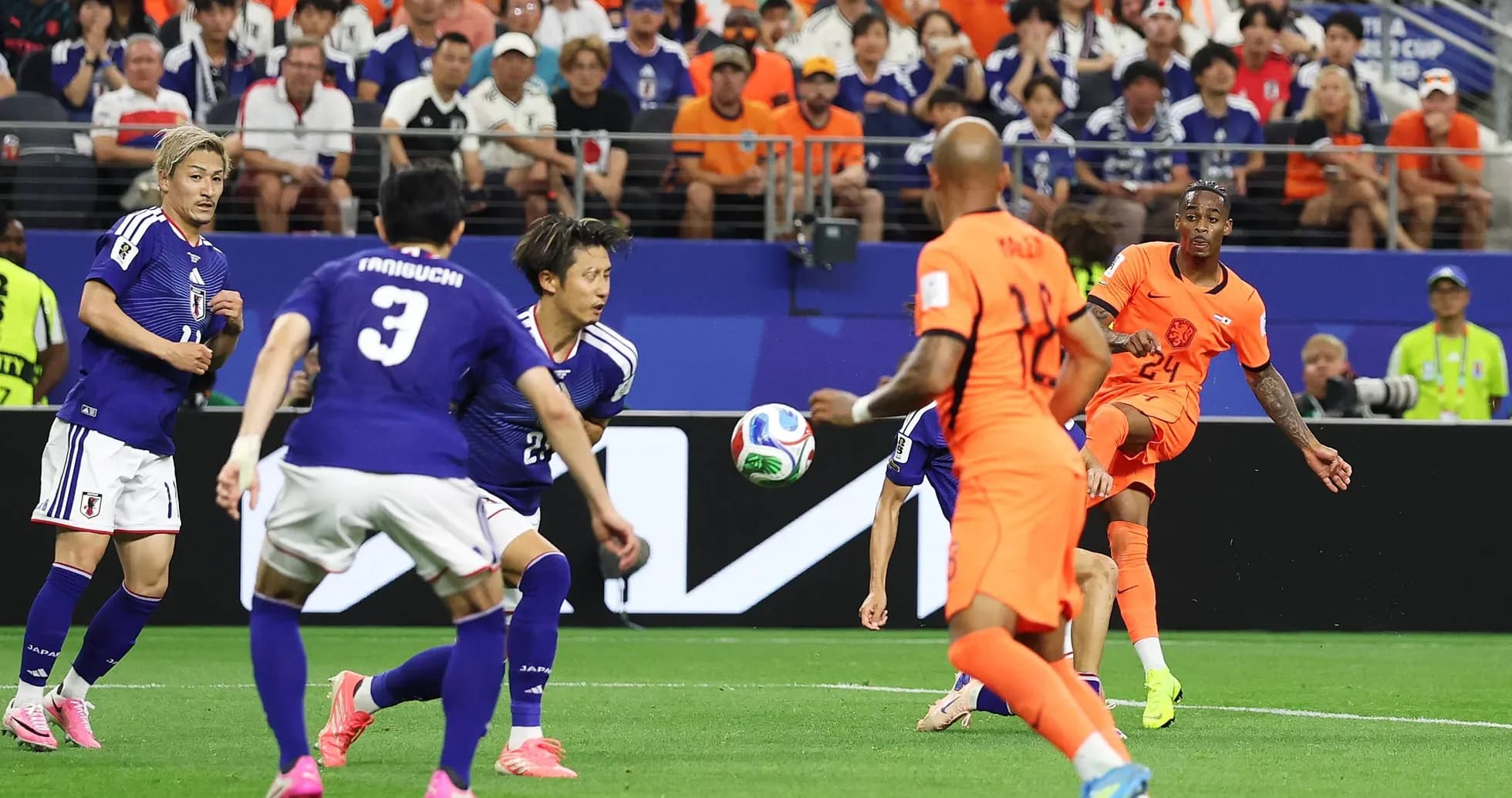
Netherlands 2-2 Japan at AT&T Stadium leaves Group F finely poised, with both sides moving to 2 points from two draws and maintaining identical records of four goals scored and four conceded. Netherlands stay second in the group on 2 points and a goal difference of 0, while Japan remain top on the same points and goal difference, separated only by group tiebreak criteria.
Match Report
The game opened in cagey fashion, with neither side able to convert territorial phases into clear chances before the interval. The breakthrough finally arrived on 51', when Netherlands took the lead. Netherlands goal — Virgil van Dijk (assisted by Ryan Gravenberch) rose to meet a set-piece delivery and powered his header beyond Zion Suzuki to make it 1-0 to the Dutch.
Japan responded quickly. On 57', Japan goal — Keito Nakamura (assisted by Takefusa Kubo) finished a well-constructed move, arriving from the left to guide Kubo’s cut-back past Bart Verbruggen and level the score at 1-1.
Netherlands then endured a brief spell of indiscipline. On 61', Crysencio Summerville (Netherlands) — yellow card (Tripping) was booked for a late challenge as Japan tried to break from midfield.
Just three minutes later, Summerville made amends in the most direct way. On 64', Netherlands goal — Crysencio Summerville (assisted by Ryan Gravenberch) restored the Dutch lead at 2-1, cutting in from the flank to finish low after Gravenberch slid a precise pass into space.
Japan turned to their bench first. On 66', Junya Ito replaced Daizen Maeda (Japan), adding fresh pace on the right to stretch the Dutch back line.
Netherlands responded with a triple attacking reshuffle on 70'. Memphis Depay replaced Donyell Malen (Netherlands), Teun Koopmeiners replaced Crysencio Summerville (Netherlands), and Quinten Timber replaced Tijjani Reijnders (Netherlands), as Ronald Koeman sought more control in midfield and a focal point up front to protect the 2-1 advantage.
Hajime Moriyasu then made a bold triple change of his own on 75'. Takehiro Tomiyasu replaced Tsuyoshi Watanabe (Japan) to freshen the back line, Koki Ogawa replaced Takefusa Kubo (Japan) to provide a penalty-box presence, and Yukinari Sugawara replaced Ritsu Doan (Japan), reshaping Japan’s right side both defensively and offensively.
Netherlands adjusted again on 81', with Nathan Aké replacing Ryan Gravenberch (Netherlands) to add defensive security on the left and help see out the game.
The Dutch aggression drew further disciplinary action on 83', when Memphis Depay (Netherlands) — yellow card (Roughing) was cautioned for a robust challenge as he pressed high.
Japan continued to chase the equaliser and altered their attack once more on 84', with Kento Shiogai replacing Ayase Ueda (Japan) to introduce fresh movement up front.
Koeman made his final change on 85', as Brian Brobbey replaced Cody Gakpo (Netherlands), adding another physical striker to help defend from the front and offer an outlet for long clearances.
Japan’s pressure finally told on 88'. Japan goal — Daichi Kamada (assisted by Koki Ogawa) made it 2-2, arriving from midfield to strike a composed finish after Ogawa’s lay-off created space on the edge of the box.
In stoppage time, Netherlands collected a third booking. On 90+1', Micky van de Ven (Netherlands) — yellow card (Holding) was shown a card for halting a Japanese counter with a tactical foul, as the Dutch clung on to preserve a point.
Fixture Statistics & Tactical Audit
- xG: Netherlands 0.79 vs Japan 0.54
- Possession: Netherlands 60% vs Japan 40%
- Shots on Target: Netherlands 6 vs Japan 3
- Goalkeeper Saves: Netherlands 1 vs Japan 4
- Blocked Shots: Netherlands 1 vs Japan 1
The underlying numbers suggest Netherlands were marginally more dangerous in terms of chance quality, edging xG 0.79 to 0.54 and registering twice as many shots on target (6 vs 3). Their 60% share of possession underlines a controlled, methodical approach, building patiently through Frenkie de Jong and Gravenberch. However, Japan’s compact 3-4-2-1 shape limited the Dutch to relatively modest xG for their volume of ball, while Japan were highly efficient, turning three efforts on goal into two scores. Suzuki’s four saves versus Verbruggen’s single stop reflect a slightly heavier workload for the Japanese goalkeeper, but Japan’s late equaliser and clinical finishing make the 2-2 scoreline broadly fair, with neither side doing enough to decisively tilt the balance.
Standings Update & Seasonal Impact
For Netherlands, the draw adds one point to their tally, moving them from 1 to 2 points in Group F. Their goals for rise from 2 to 4 and goals against from 2 to 4, keeping their goal difference at 0. They remain in second place, still in the Round of 32 qualification zone but with work to do to turn control of matches into wins.
Japan also move from 1 to 2 points, with their goals for increasing from 2 to 4 and goals against from 2 to 4, likewise holding a goal difference of 0. They stay top of Group F within the Round of 32 zone, but the identical records underline how finely balanced the group is and how decisive the final round of fixtures is likely to be.
Lineups & Personnel
Netherlands Starting XI
- GK: Bart Verbruggen
- DF: Denzel Dumfries, Jan Paul van Hecke, Virgil van Dijk, Micky van de Ven
- MF: Ryan Gravenberch, Frenkie de Jong, Tijjani Reijnders
- FW: Crysencio Summerville, Donyell Malen, Cody Gakpo
Japan Starting XI
- GK: Zion Suzuki
- DF: Tsuyoshi Watanabe, Shogo Taniguchi, Hiroki Itō
- MF: Ritsu Doan, Kaishu Sano, Daichi Kamada, Keito Nakamura
- FW: Takefusa Kubo, Daizen Maeda, Ayase Ueda
Post-Match Verdict
Netherlands delivered a controlled but not ruthless display, dominating possession (60%) and leading the xG count (0.79 vs 0.54) without translating that edge into a decisive margin. Their attacking structure functioned well in phases, with Gravenberch directly involved in both goals, but the concession of two goals from just three shots on target exposed a vulnerable defensive game state management rather than structural collapse. Japan’s performance was notably efficient in attack, turning limited final-third volume (3 shots on target) into two goals, and their compact mid-block restricted Netherlands to under 1.0 xG despite the Dutch territorial dominance. In tactical terms, Netherlands will regret their inability to close the game out after going 2-1 up and shifting to a more conservative shape, while Japan can be encouraged by their resilience, bench impact — highlighted by Ogawa’s assist for Kamada — and their capacity to strike late to protect their position at the top of the group.