.svg&w=384&q=75 "naujapitch logo")
Australia’s Tactical Masterclass Against Türkiye in World Cup Opener
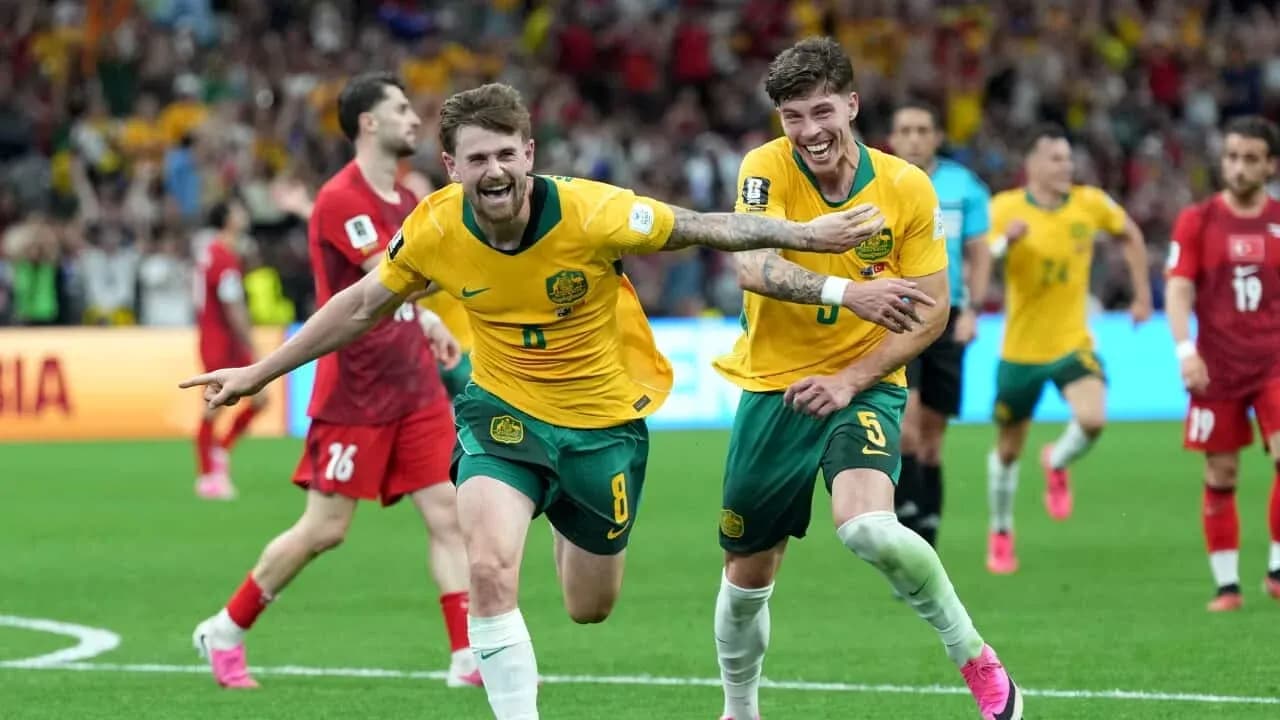
Australia’s 2-0 win over Türkiye at BC Place was a clinic in low-block efficiency and transition punch, built on a clear asymmetry of territory and chances. In a World Cup group opener where Türkiye monopolised the ball and volume of shots, Australia’s 5-4-1 under Tony Popovic absorbed pressure, struck decisively through Nestory Irankunda and Connor Metcalfe, and then managed the game with discipline and structure.
Türkiye, set up by Vincenzo Montella in a 4-2-3-1, dominated the ball (72% possession), circulation and field position. Their 707 total passes, with 638 accurate (90%), underline how much of the game was played in front of and around Australia’s block. Hakan Çalhanoğlu and Orkun Kökçü, supported by Arda Güler between the lines, tried to stretch and tilt the Australian back five, but the Socceroos’ compactness and penalty-box protection were the decisive tactical features.
Australia’s 5-4-1 was clearly designed to compress central zones. Harry Souttar, Cameron Burgess and Alessandro Circati formed a narrow trio, flanked by Jordan Bos on the left and Jacob Italiano on the right. In front, Aiden O’Neill and Connor Metcalfe sat as a double pivot, with Paul Okon-Engstler and Nestory Irankunda tucking in from wide midfield. Mohamed Touré worked as a lone forward, tasked more with pressing triggers and running channels than with link play.
Opening Goal
The opening goal on 27 minutes perfectly illustrated Australia’s plan. Winning the ball and transitioning quickly, Irankunda attacked space with Okon-Engstler providing the key forward connection. P. Okon-Engstler’s assist into N. Irankunda’s stride punished Türkiye’s advanced line, which had been pushing up to sustain pressure. With Türkiye’s full-backs high and the double pivot stretched, Australia exploited the weak side in transition for 1-0, giving their block a scoreboard platform.
From there, the match settled into a clear pattern: Türkiye circulating, Australia compressing. Türkiye produced 30 total shots, 14 inside the box and 16 from outside, but the quality of those chances was often compromised by Australian density in the final third. The Socceroos blocked 12 shots, a huge defensive workload that speaks to the organisation of the back five plus midfield four collapsing into the box. Conversely, Australia’s 9 total shots (6 inside the box) were far fewer but more selectively chosen, reflecting a strategy of only committing numbers forward when the transition picture was favourable.
The key defensive figure was Patrick Beach (Australia). Australia’s statistical block credits 8 goalkeeper saves, and in the context of Türkiye’s 8 shots on goal, that underlines how much Beach had to handle in terms of on-target efforts. His shot-stopping, combined with strong central protection from Souttar and Burgess, allowed Australia to survive long spells without the ball. On the other side, Uğurcan Çakır (Türkiye) faced just 4 shots on goal and made 2 saves, but was beaten twice in situations where Türkiye’s rest defence and box coverage were exposed.
Second Half Changes
The second half opened with Türkiye trying to inject more direct threat. At 46', Barış Alper Yılmaz (OUT) was replaced by Kenan Yıldız (IN), a move aimed at adding more penalty-box presence and individual creativity from the left. Popovic responded with like-for-like energy management on the flanks: at 61', Nestory Irankunda (OUT) made way for Nishan Velupillay (IN), preserving the vertical outlet on the right while freshening the pressing effort.
Montella doubled down on attacking control at 62', withdrawing Orkun Kökçü (OUT) for Yunus Akgün (IN), effectively tilting the 4-2-3-1 into a more aggressive, winger-driven structure. Yet this further opened Türkiye’s rest defence — and Australia capitalised. On 75', with the game stretched and substitutions bedding in, Connor Metcalfe stepped up from midfield to score Australia’s second, unassisted. The timing is crucial: just one minute after a double Australian change at 74' — Mohamed Touré (OUT) for Tete Yengi (IN), and Jacob Italiano (OUT) for Jason Geria (IN) — Australia had fresh legs up front and at right-back, enabling a more assertive counter that ended with Metcalfe’s decisive finish.
Türkiye continued to chase the game with further changes at 81', making a double substitution: İsmail Yüksek (OUT) for Salih Özcan (IN) in the pivot, and Zeki Çelik (OUT) for Mert Müldür (IN) at right-back, adding crossing threat and trying to maintain pressure. Australia, in turn, shored up the left flank and midfield control at 84' with Jordan Bos (OUT) replaced by Aziz Behich (IN) and Paul Okon-Engstler (OUT) replaced by Jackson Irvine (IN). Those moves signalled a clear shift into game-management mode: Behich’s experience and Irvine’s box-to-box work added defensive security and ball retention.
Türkiye’s final attacking roll of the dice came at 85', when Kerem Aktürkoğlu (OUT) was replaced by Deniz Gül (IN), trading a starting wide forward for fresh legs and more direct penalty-area occupation. However, Australia’s structure held. The only disciplinary flashpoint arrived at 86': 86' Yunus Akgün (Türkiye) — Roughing. It was the sole yellow card of the match, underlining that despite the stakes, Australia’s 12 fouls and Türkiye’s 4 never escalated into broader disorder.
Statistically, Türkiye’s 1.33 xG against Australia’s 0.77 shows that, on shot quality and volume, Montella’s side generated more. Yet both teams’ goals prevented values are listed at -0.95, suggesting that, relative to the xG they faced, each goalkeeper conceded slightly more than the model expected over a broader sample; within this match, though, Beach’s 8 saves were the decisive defensive performance.
Australia’s 270 total passes, with 202 accurate (75%), and just 28% possession, confirm that this was not a control-through-the-ball strategy. Instead, it was a control-through-space and control-through-box-occupation plan. Türkiye’s high passing accuracy and territorial dominance were undermined by their inability to convert circulation into clear, central finishes against a packed box and an in-form goalkeeper.
In tactical terms, Australia executed a classic underdog World Cup blueprint: structurally sound 5-4-1, ruthless in transition, intelligent use of substitutions to maintain intensity and protect wide channels, and a goalkeeper performance that underpinned the entire defensive scheme. Türkiye, by contrast, had the ball and the territory, but lacked the incisive movements and final-third combinations needed to dismantle a deep, well-drilled block — and paid for every transition they allowed.