.svg&w=384&q=75 "naujapitch logo")
Torino Triumphs Over Sassuolo: A Tactical Analysis
Under the lights of the Stadio Olimpico Grande Torino, a mid‑table duel in Serie A’s Round 36 finished with a narrow but telling verdict: Torino 2–1 Sassuolo. Following this result, a season framed by inconsistency for both clubs sharpened into something more concrete. Torino, 12th with 44 points and a goal difference of -18 (41 scored, 59 conceded), found a performance that matched their gritty home identity. Sassuolo, 11th on 49 points with a goal difference of -2 (44 for, 46 against), showed again why they are so often entertaining but rarely secure.
I. The Big Picture – Systems and Seasonal DNA
Leonardo Colucci leaned into Torino’s structural comfort, rolling out a 3‑4‑2‑1 that echoed their broader season trends. Across the campaign, they have been wedded to three‑at‑the‑back variants: 3‑5‑2 (16 times), 3‑4‑1‑2 (8), 3‑4‑2‑1 (3 before this), plus other three‑centre‑back shapes. The choice here was not just about numbers; it was about reinforcing a home persona that has yielded 8 wins from 18, with 25 goals for and 27 against. At home, Torino average 1.4 goals scored and 1.5 conceded – a side that is rarely dull, often chaotic, but always combative.
Fabio Grosso’s Sassuolo arrived in their near‑default 4‑3‑3, the shape used in 34 of 36 league matches. On their travels, they had 5 wins, 5 draws and 8 defeats from 18, scoring 21 and conceding 23 – an away average of 1.2 goals for and 1.3 against. That slight defensive looseness away from home met a Torino side that, for all its flaws, is built to exploit small cracks rather than dominate entire matches.
The first half, goalless at 0–0, felt like a chessboard slowly being tilted. Torino’s back three of L. Marianucci, S. Coco and E. Ebosse stayed compact, while the wing‑backs V. Lazaro and R. Obrador pushed high, effectively turning the 3‑4‑2‑1 into a 3‑2‑4‑1 in possession. Sassuolo’s 4‑3‑3 tried to stretch the pitch through A. Laurienté and C. Volpato flanking A. Pinamonti, but the final pass kept dying in the half‑spaces where G. Gineitis and M. Prati patrolled with quiet efficiency.
II. Tactical Voids – Absences and Discipline
Both coaches had to navigate notable absences. Torino were without Z. Aboukhlal (muscle injury), F. Anjorin (hip injury) and A. Ismajli (muscle injury). For Colucci, that meant leaning even more heavily on N. Vlasic as the advanced creative presence behind the striker, and trusting A. Njie’s energy to compensate for the lack of an extra attacking option from deep.
Sassuolo’s list was heavier and more structurally disruptive: D. Boloca (muscle injury), F. Cande and E. Pieragnolo (both knee injuries), J. Idzes (foot injury) and, crucially, A. Fadera suspended due to yellow cards. Those losses thinned Grosso’s options in both the defensive line and the wide channels, forcing a reliance on J. Doig at left‑back and W. Coulibaly at right‑back to provide both width and stability.
Season‑long disciplinary patterns also shaped the tone. Torino’s yellow cards spike late: 18.84% of their bookings arrive between 76–90 minutes, and 21.74% between 91–105, a clear sign of a side that finishes games on the edge. Sassuolo are even more volatile late on, with 28.75% of their yellows in the 76–90 window and a further 15.00% in added time. This match’s nervy closing stages were almost pre‑written in those numbers: two teams who, statistically, live dangerously when legs and minds are tired.
III. Key Matchups – Hunter vs Shield, Engine Room Battles
The headline duel was always going to be Giovanni Simeone against Sassuolo’s defensive block. Simeone has been one of Serie A’s most efficient finishers this season: 11 goals from 56 shots, 28 on target. His movement between the lines, constantly slipping off the shoulder of S. Walukiewicz and T. Muharemovic, embodied Torino’s attacking idea: create chaos around the box and let the number 18 finish the story.
Sassuolo’s “shield” is not a single defender but the structure in front of A. Muric. On their travels, they concede 1.3 goals per game; solid but not impregnable. The absence of a true destroyer in front of the back four meant that N. Matic had to be both enforcer and metronome. Across the season, he has produced 42 tackles, 10 blocks and 26 interceptions, a deep‑lying organiser who also carries disciplinary risk: 7 yellow cards and 1 red. In this match, as Torino raised the tempo after the break, Matic’s zone became the battlefield. Once he was dragged side‑to‑side by Vlasic and Njie, the central lane opened for Simeone to exploit.
The other decisive axis was the “engine room” of creativity and control. For Sassuolo, K. Thorstvedt is the hybrid eight‑ten: 4 goals, 4 assists, 30 key passes, 43 tackles and 13 blocked shots across the season. He is both outlet and presser, but he also walks a disciplinary tightrope with 8 yellow cards. Up against him were Prati and Gineitis, whose task was simple but brutal: deny Thorstvedt the half‑turn, even if it meant fouls and broken rhythm.
Out wide, Laurienté’s duel with Lazaro and Marianucci was a pure “hunter vs trap” subplot. Laurienté has 6 goals, 9 assists and 52 key passes this season, a winger who lives off isolation and 1v1s. Torino’s response was to compress the touchline, forcing him either backwards into Matic or inside into traffic, where Gineitis waited. Whenever Laurienté did escape, the back three shuffled across quickly, with Ebosse often the spare man covering depth.
IV. Statistical Prognosis – What the Numbers Say About the Contest
Overall this campaign, Torino’s 41 goals for and 59 against (GD -18) paint them as a side that must out‑fight, not out‑control, matches. Their 12 clean sheets in total show they can close the door, but the average of 1.6 goals conceded per game underlines the fragility. Sassuolo, by contrast, sit closer to equilibrium: 44 scored, 46 conceded (GD -2), with 8 clean sheets and a total scoring average of 1.2 goals per match.
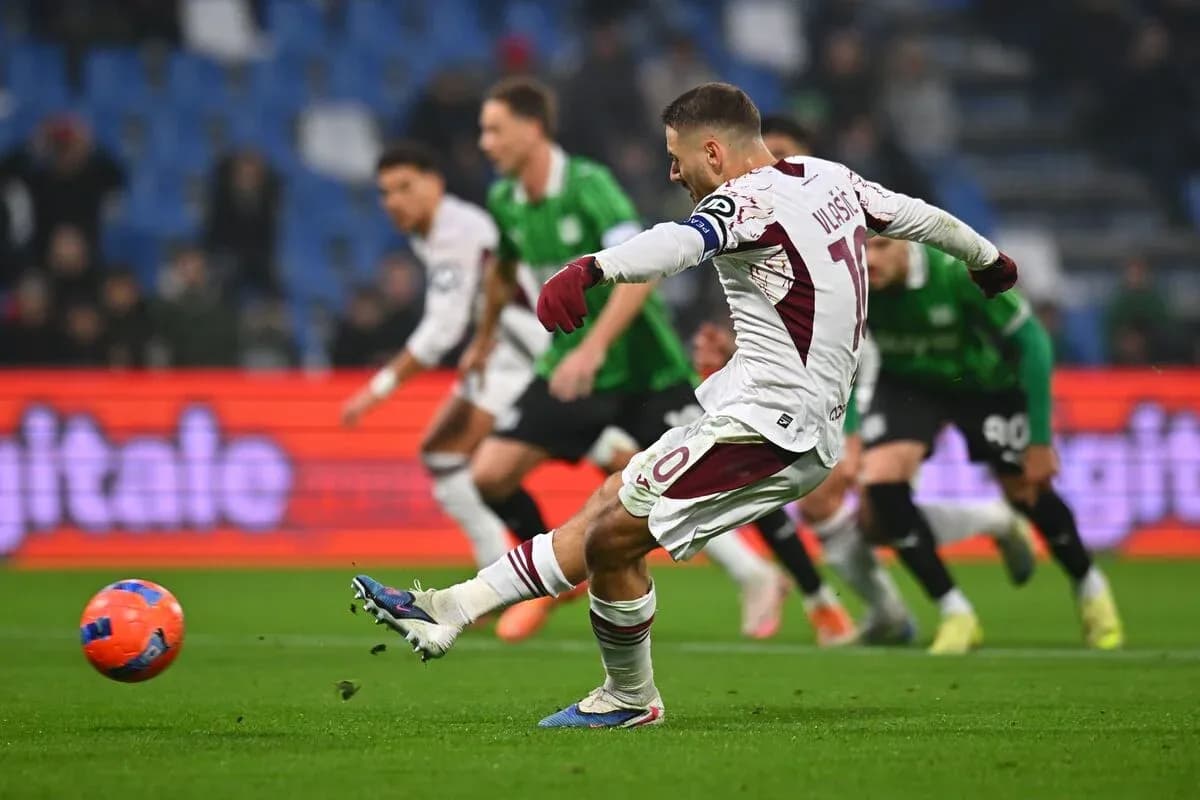
Layer expected goals logic over these patterns and the 2–1 scoreline feels aligned with probability rather than shock. Torino at home, averaging 1.4 scored and 1.5 conceded, playing a Sassuolo away side at 1.2 for and 1.3 against, almost maps directly onto a narrow home win in the 2–1 corridor. The penalty data adds nuance: Torino have taken 5 penalties this season and scored all 5 (100.00%), while Sassuolo have converted 2 of 2 overall but with a blemish in open‑play takers – Pinamonti has missed 1, and Berardi, despite scoring 2, has also missed 1. In a tight game, Torino’s perfect record from the spot versus Sassuolo’s occasional wobble under pressure subtly tilts the xG‑from‑set‑pieces balance towards the hosts.
Defensively, Torino’s reliance on late‑game aggression – and their yellow‑card surges after 76 minutes – suggests their xG against profile is spiky, with dangerous moments clustered late. Sassuolo’s own late‑card storm reinforces that image: two sides whose defensive solidity erodes with fatigue. That the match was ultimately decided by fine margins rather than collapse speaks to Torino’s improved game management on the night.
In narrative terms, this was a meeting of identities: Torino’s rugged, three‑at‑the‑back, Simeone‑led pragmatism against Sassuolo’s flowing, winger‑driven 4‑3‑3. The numbers predicted balance with a slight home lean; the pitch delivered exactly that.