.svg&w=384&q=75 "naujapitch logo")
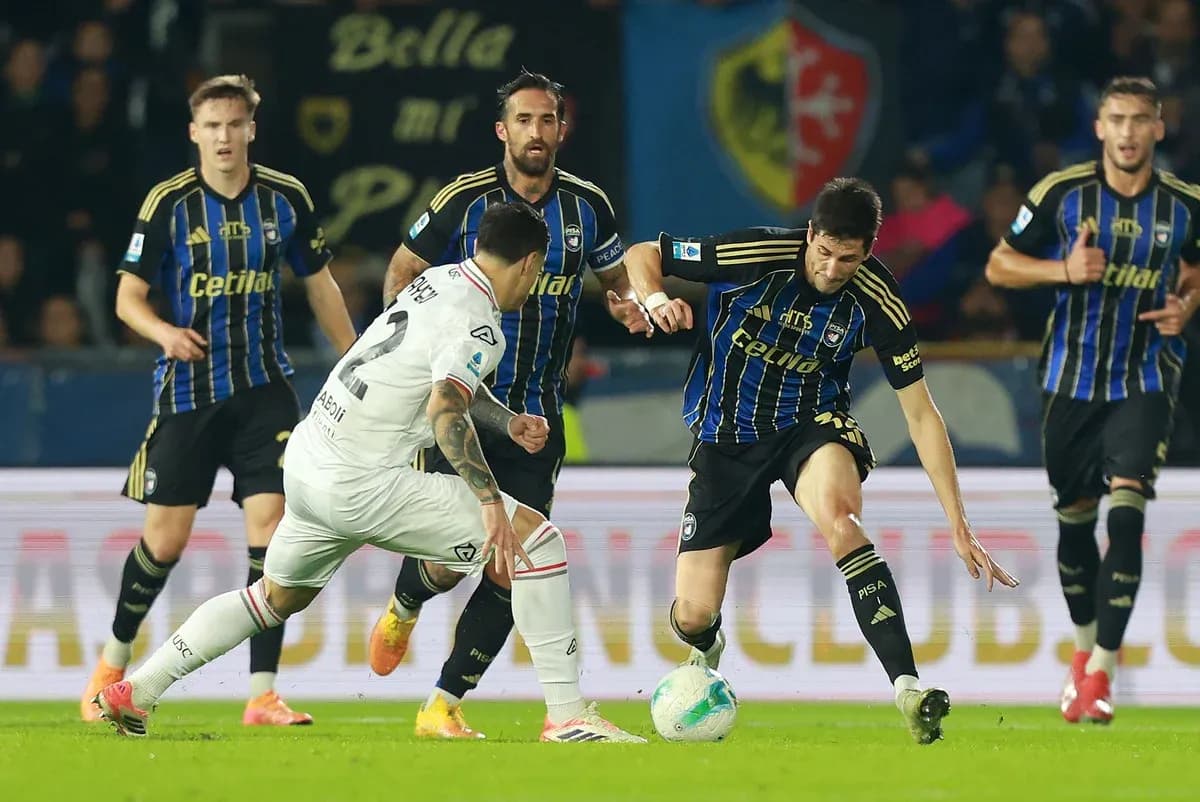
Cremonese Dismantles Pisa 3–0 in Serie A Showdown
By the time the sun had settled over Stadio Giovanni Zini, this was not the tense relegation dogfight many had anticipated. Cremonese, 18th in Serie A heading into this game with 31 points and a goal difference of -23 (30 scored, 53 conceded overall), produced one of their most complete home performances of the season, dismantling bottom‑placed Pisa 3–0.
The context made the scoreline even more symbolic. Pisa arrived in Cremona rooted to 20th, on 18 points, with an overall goal difference of -41 (25 for, 66 against) and a form line that read “LLLLL”. On their travels they had yet to win, with 0 away victories from 18, 8 draws and 10 defeats, conceding 43 goals and scoring 16. Cremonese, hardly fearsome at home with just 3 wins from 18 and an average of 0.9 home goals for and 1.4 against, suddenly found fluency and authority.
The 3–0 scoreline matched their biggest home win of the season, a reminder that this side has always had a higher ceiling than their league position suggests. In a regular season Round 36 fixture that felt like a last stand, Marco Giampaolo’s 4‑4‑2 finally clicked.
Tactical Voids and Selection Choices
Both coaches had to navigate absences that shaped the match’s tactical tone. Cremonese were without F. Baschirotto (thigh injury), R. Floriani and F. Moumbagna (both muscle injuries), and M. Payero (knock). Pisa travelled without F. Coppola (muscle injury), D. Denoon (ankle), C. Stengs (inactive) and M. Tramoni (muscle injury).
Giampaolo’s response was to lean into structure and seniority. E. Audero anchored a back four of F. Terracciano, M. Bianchetti, S. Luperto and G. Pezzella. In front of them, a hard‑working midfield band of T. Barbieri, A. Grassi, Y. Maleh and J. Vandeputte supported a classic strike pairing of F. Bonazzoli and J. Vardy. It was a line‑up that balanced legs and leadership, and crucially, it put Cremonese’s two elite Serie A contributors in their natural zones: Bonazzoli as penalty‑box reference, Vandeputte as creative conduit.
Oscar Hiljemark stuck to Pisa’s season‑long identity, rolling out a 3‑4‑2‑1. A. Semper started behind a back three of S. Canestrelli, A. Caracciolo and R. Bozhinov. The wing‑to‑wing midfield of I. Toure, E. Akinsanmiro, F. Loyola and M. Leris was asked to carry the team both vertically and defensively, while a narrow front line of S. Moreo, I. Vural and F. Stojilkovic tried to press and combine centrally.
The issue for Pisa was familiar: the system asked their midfield and wing‑backs to cover impossible distances for a side already conceding 2.4 goals per game away. Without the depth options of Coppola or the guile of Tramoni and Stengs, their bench offered energy but little transformative creativity.
Disciplinary trends also framed the risk profile. Cremonese, with 27.27% of their yellow cards arriving between 76–90 minutes, are notorious late in games for emotional fouls. Pisa mirror that pattern with 25.33% of their yellows also coming in the final quarter‑hour. Both sides walk a fine line in closing phases, but on this occasion, Cremonese’s control of territory meant they were rarely forced into desperation challenges.
Key Matchups
Hunter vs Shield
This game was always going to tilt on whether Pisa’s fragile away defence could contain Cremonese’s one reliable finisher. Overall, Pisa had shipped 66 goals heading into this game, including 43 on their travels at an away average of 2.4 conceded per match. Into that soft underbelly walked F. Bonazzoli, Cremonese’s leading scorer with 9 league goals and 2 penalties converted from 2 attempts.
Bonazzoli’s profile is that of a volume shooter with just enough efficiency to punish weak back lines: 54 shots, 30 on target, and a rating of 7 across 33 appearances. His duel numbers (236 total, 121 won) show a forward willing to contest physically, vital against a back three anchored by A. Caracciolo, who has 71 tackles and an impressive 24 blocked shots this season but also 9 yellow cards.
The duel played out exactly as the numbers hinted. Pisa’s back line, already stretched by the demands of a 3‑4‑2‑1, was repeatedly dragged into uncomfortable spaces by Bonazzoli and Vardy’s movements. Caracciolo’s instinct to step in and contest – which has served him well across 260 duels, 139 of them won – became a liability when Cremonese’s midfield, especially Vandeputte between the lines, found ways to play around his aggressive positioning.
Engine Room
In midfield, the game’s tactical heart was the confrontation between Cremonese’s creators and Pisa’s enforcers. J. Vandeputte arrived as one of Serie A’s more quietly effective playmakers: 5 assists, 53 key passes and 887 completed passes at 77% accuracy, plus 37 tackles and 18 interceptions that underline his two‑way contribution.
Opposite him, Pisa leaned on the physical and tactical edge of I. Toure and the card‑heavy duo of A. Caracciolo stepping out and M. Aebischer from the bench or rotation. Aebischer’s season – 1466 passes at 85% accuracy, 31 key passes, 62 tackles and 8 yellow cards – has made him Pisa’s metronome and disruptor.
But with Pisa chasing the game and their wing‑backs pinned back by Barbieri and Vandeputte’s width, the central unit was constantly outnumbered. Grassi and Maleh quietly won the positional battle, allowing Vandeputte to drift into half‑spaces where Pisa’s midfield screen simply could not track him without leaving gaps elsewhere.
Statistical Prognosis and Tactical Verdict
Following this result, the numbers tell a coherent story of why 3–0 felt almost inevitable once Cremonese struck first.
Cremonese’s season‑long averages – 0.8 goals for and 1.5 against overall – paint them as a low‑scoring, often outgunned side. Yet their clean‑sheet count (10 overall, 6 at home) hints at a team that, when the structure holds, can suffocate weaker opponents. Pisa, conversely, combined a meagre 0.7 goals scored per game overall with 1.8 conceded, and had failed to score in 20 of 36 matches heading into this fixture.
Overlay expected‑goals logic on those trends and the tactical picture sharpens. Cremonese, at home, typically generate modest xG but against a defence that concedes in bulk, the likelihood of multiple high‑value chances was always high. Pisa’s away vulnerability – 5‑0 and 6‑goal concessions among their heaviest defeats – shows that once the first goal goes in, their structure tends to unravel rather than tighten.
Giampaolo’s 4‑4‑2 maximised that fragility. Bonazzoli’s penalty reliability (3 Cremonese penalties this season, all converted, none missed) and Vandeputte’s set‑piece delivery added an extra layer of threat that Pisa’s overstretched back three could not absorb. Meanwhile, Audero and a disciplined back four protected a side that already had 10 clean sheets in total, against an opponent that fails to score more often than not.
In narrative terms, this was less an upset and more a statistical correction: a home side with just enough attacking quality and a proven defensive ceiling facing an away team whose numbers screamed relegation. The 3–0 scoreline was the tactical and probabilistic endpoint of that collision – Cremonese’s structure and stars finally aligning, Pisa’s season‑long frailties laid bare under the lights of Giovanni Zini.