.svg&w=384&q=75 "naujapitch logo")
Napoli vs Bologna: Tactical Insights from a 3-2 Defeat
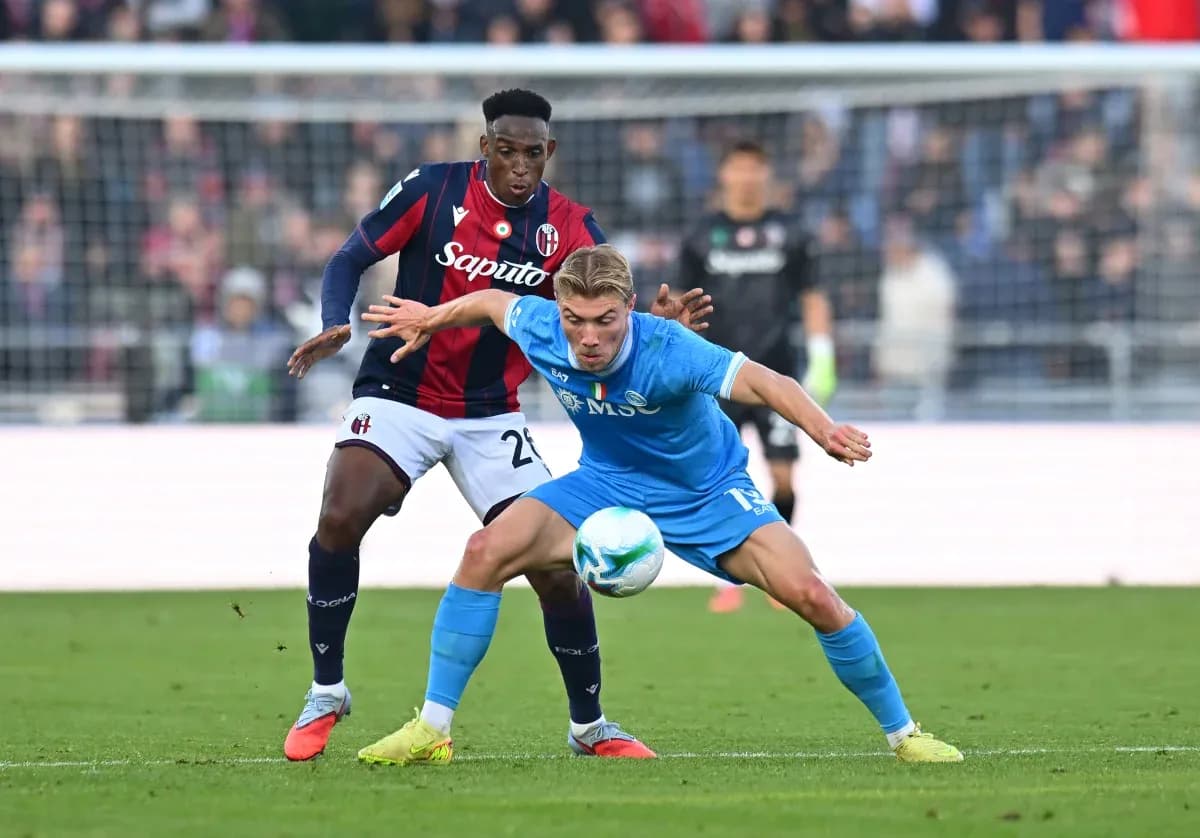
Under the lights of Stadio Diego Armando Maradona, a 3-2 defeat to Bologna turned what looked like a statement night for second‑placed Napoli into a sobering tactical lesson. Following this result, the scoreline reflects more than a wild contest; it exposes the structural tensions in Antonio Conte’s evolving 3-4-2-1 against Vincenzo Italiano’s bold 4-3-3.
I. The Big Picture – Clash of Identities
Napoli came into Matchday 36 as a Champions League-bound machine: 70 points, a goal difference of 18 built on 54 goals scored and 36 conceded overall. At home they had been imposing, with 12 wins from 18, scoring 32 and conceding 18, an average of 1.8 goals for and 1.0 against at Stadio Maradona. Bologna, eighth with 52 points and a goal difference of 2 (45 for, 43 against overall), travelled as one of Serie A’s most dangerous away sides: 9 wins from 18, 29 goals scored and 23 conceded on their travels, averaging 1.6 goals for and 1.3 against away.
Those numbers framed the tactical duel: Napoli’s controlled aggression versus Bologna’s road‑warrior opportunism. The 3-4-2-1 that has become Napoli’s most-used shape (21 league matches) was trusted again, while Bologna, usually a 4-2-3-1 side (27 games), chose a more front‑foot 4-3-3 to stretch Conte’s back three horizontally and pin the wing‑backs deep.
II. Tactical Voids – Absences and Discipline
Napoli’s attacking blueprint was missing some of its brightest colours. David Neres (ankle injury), K. De Bruyne (eye injury) and R. Lukaku (hip injury) were all ruled out. That trio strips Conte of three distinct profiles: the one‑v‑one winger to destabilise blocks, the elite final‑ball architect between lines, and the penalty‑box reference who pins centre‑backs. Their absence forced Napoli to lean heavily on internal solutions: M. Politano’s creativity from the right, S. McTominay’s late surges, and R. Hojlund’s vertical threat.
Bologna were also depleted in their defensive rotation. K. Bonifazi (inactive), N. Cambiaghi (muscle injury), N. Casale (calf injury) and M. Vitik (ankle injury) all missed out, trimming Italiano’s options to adjust his back line and wide rotations mid‑game. Notably, Cambiaghi’s absence removed a high‑intensity presser and dribbler who, despite a red card earlier this season, often sets the pressing tone from the flank.
On the disciplinary front, the season’s trends foreshadowed the emotional temperature. Napoli’s yellow-card curve peaks between 61-75 minutes with 31.91% of their cautions, followed by a late‑game rise at 76-90 minutes (14.89%). Red cards are brutally concentrated: 100.00% of their dismissals arrive in the 76-90 window. Bologna, by contrast, spread their aggression across the second half, with 27.27% of yellows from 61-75 and 25.76% from 76-90, and red cards scattered across multiple ranges, including 16.67% between 16-30 and another 16.67% from 76-90. This was always likely to be a contest that boiled in the final half‑hour, and the 3-2 scoreline fits that volatile profile.
III. Key Matchups – Hunter vs Shield, Engine Room vs Enforcer
The night’s central narrative revolved around R. Hojlund, Napoli’s leading scorer with 10 league goals and 4 assists, and a Bologna defence that had conceded 23 goals away before this fixture. Hojlund’s profile is clear from the data: 42 shots (22 on target), 299 duels with 107 won, 33 dribbles attempted and 50 fouls drawn. He is not just a finisher; he is a constant physical problem. Against a back four of Joao Mario, E. Fauske Helland, J. Lucumi and J. Miranda, his job was to stretch depth, force the centre‑backs to turn, and open the half‑spaces for Napoli’s second line.
Yet Bologna’s “shield” is collective rather than star‑driven. Their away record – 23 goals conceded in 18 matches – suggests a unit comfortable defending medium blocks and surviving pressure. Italiano’s decision to start R. Freuler and T. Pobega as the double pivot in front of the defence gave the back four an extra layer of protection against McTominay’s late runs and Politano’s interior drifts.
In the engine room, the duel between Napoli’s S. Lobotka and McTominay versus Bologna’s Freuler and L. Ferguson defined the rhythm. Lobotka’s metronomic presence underpinned the 3-4-2-1, but McTominay is the true disruptor: 9 goals and 3 assists from midfield, 69 shots (33 on target), 1202 passes at 88% accuracy, 28 tackles and 20 interceptions. He also embodies Napoli’s risk‑reward edge, having already missed a penalty this season. His repeated surges into the box sought to overload Bologna’s central corridor, especially when Giovane and Alisson Santos tucked in behind Hojlund.
Opposite him, Ferguson’s box‑to‑box energy and Freuler’s positional discipline were designed to screen those lanes. When Bologna broke, they had a perfect “hunter” of their own in R. Orsolini. With 9 goals and 1 assist, 64 shots (30 on target) and 67 dribbles attempted (32 successful), Orsolini is Italiano’s chaos agent. His four penalties scored, offset by two misses, underline his centrality to Bologna’s attacking identity but also introduce jeopardy if he steps up from the spot.
IV. Statistical Prognosis – Why Bologna’s Plan Held
Following this result, the numbers that framed the fixture help explain why Bologna were always capable of springing an upset. Napoli’s overall scoring average of 1.5 goals per game (1.8 at home) met a Bologna side used to hostile environments, averaging 1.6 goals scored away. Defensively, Napoli’s 1.0 goals conceded on average both home and away suggests stability, but Bologna’s 1.3 goals conceded away is not catastrophic; it is the profile of a side willing to trade chances if they can punch back.
In xG terms, this had all the hallmarks of a high‑event match: Napoli’s volume shooters (Hojlund, McTominay, Politano) versus a Bologna front three of Orsolini, S. Castro and F. Bernardeschi that could attack the wide channels left by Napoli’s advanced wing‑backs. Without De Bruyne’s control and Lukaku’s penalty‑box gravity, Napoli’s attacks were always likely to be a little more vertical, a little more chaotic – and that played into Bologna’s transitional strengths.
The 3-2 scoreline, with Bologna leading 2-1 at half-time and holding on in the second half, mirrors the season‑long patterns: Napoli can overwhelm but leave spaces, Bologna can suffer but strike hard away from home. Conte’s 3-4-2-1 remains a powerful structure, yet this night in Naples underlined its margins. Against a fearless Bologna, every missed rotation, every mistimed press became an invitation – and Italiano’s side accepted it ruthlessly.