.svg&w=384&q=75 "naujapitch logo")
Morocco Dominates Canada in Round of 16 Clash
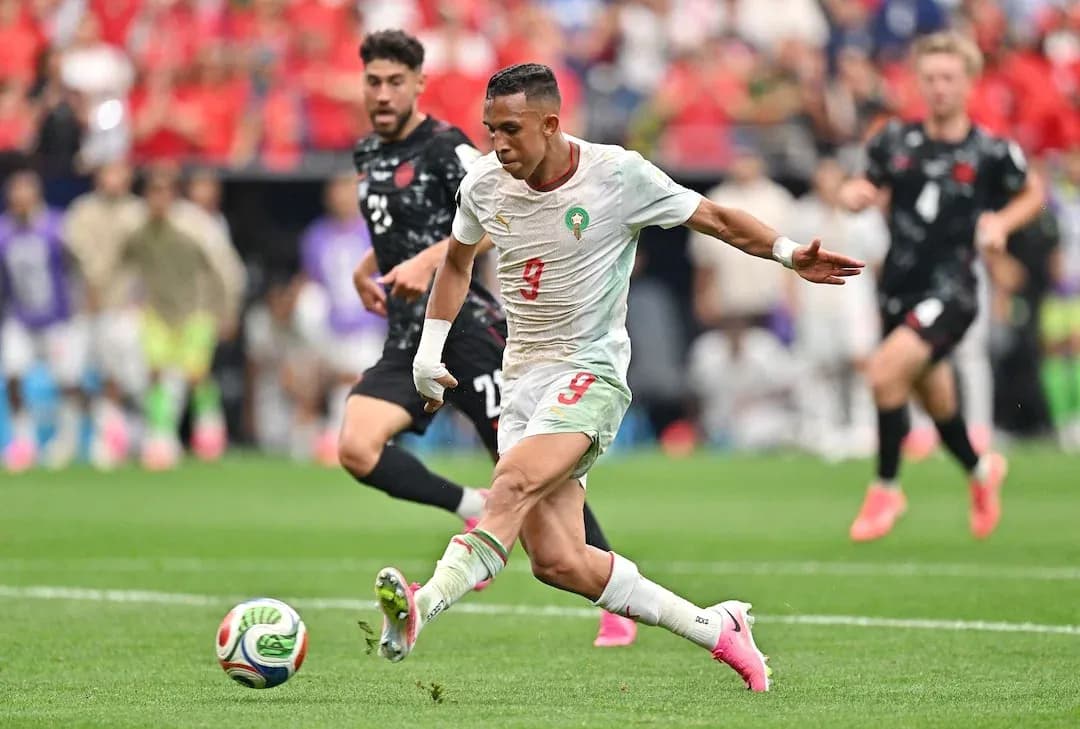
Under the roof of NRG Stadium in Houston, the Round of 16 tie between Canada and Morocco closed with a brutal clarity: a 3–0 Moroccan win, and a lesson in tournament maturity. The World Cup stage had already revealed the outlines of both sides’ identities; this knockout only sharpened them.
Canada arrived as one of the stories of the group phase. In total this campaign they had scored 9 goals in 5 matches, with 7 of those coming at home and an overall attacking average of 1.8 goals per match. At home their 2.3 goals per game underlined how aggressive Jesse Marsch’s blueprint had become: front-foot, vertical, and unapologetically open. But the other side of that coin was visible too. In total this campaign they had conceded 6, with 4 of those at home and an overall average of 1.2 goals against per match. The group-stage table in Group B, where they finished 2nd with a goal difference of 5 (8 scored, 3 conceded), suggested a side that could overwhelm but not always control.
Morocco, by contrast, came in with the quiet confidence of a team that knew how to manage tournament football. In total this campaign they had taken 7 points from Group C, also finishing 2nd, with a goal difference of 3 (6 scored, 3 conceded). Over the broader World Cup run they had been even more ruthless: 11 goals in total across 5 matches, split between 4 at home and 7 on their travels, for an overall scoring rate of 2.2 goals per match. Defensively they were tighter than Canada, conceding just 4 in total, with an overall average of 0.8 goals against per game. They were unbeaten, with 4 wins and 1 draw in total and no losses at all. This was a side that understood how to bend a game to its rhythm.
The lineups told a story of conviction rather than improvisation. Marsch stayed loyal to the 4-4-2 that had defined Canada’s tournament: Maxime Crepeau behind a back four of Alistair Johnston, Moïse Bombito, Luc De Fougerolles and Richie Laryea; a midfield band of Tajon Buchanan, N. Sigur, Stephen Eustaquio and Ali Ahmed; Jonathan David and Tani Oluwaseyi as the twin spearhead. Canada’s season data backed that choice: they had used 4-4-2 in all 5 matches, and their best result, a 6–0 home win, came with this structure at full throttle.
Morocco mirrored that tactical consistency. Mohamed Ouahbi rolled out the now-familiar 4-2-3-1: Bono in goal; a back line of Achraf Hakimi, Issa Diop, R. Halhal and Noussair Mazraoui; a double pivot of A. Bouaddi and N. El Aynaoui; Brahim Díaz, Azzedine Ounahi and Bilal El Khannouss supporting lone forward Ismael Saibari. Across the tournament Morocco had used this shape in all 5 matches, and it had become their platform for controlled aggression.
Injury news subtly reshaped Canada’s options. I. Koné was ruled out with a fracture of the lower leg, depriving Marsch of a midfielder who could have added another progressive carrier between lines. It meant more responsibility on Eustaquio to dictate tempo and on Ahmed to break lines with his running. On the bench, the likes of Cyle Larin, Alphonso Davies, Jonathan Osorio and Nathan-Dylan Saliba offered different attacking and creative profiles, but the starting XI already hinted that Canada would try to run through Morocco rather than around them.
Discipline was always going to be a subplot. Canada’s season card profile showed a spread of yellow cards across the match, with a notable cluster between 31–45 minutes and 46–60 minutes, each accounting for 27.27% of their bookings. De Fougerolles, with 2 yellows in the tournament and also listed among the top red-carded profiles, epitomised the edge in their defending. Larin, another with 2 yellows, added risk higher up the pitch. Morocco, for their part, tended to collect their cautions in the middle phases too: 33.33% of their yellows between 16–30 minutes, 33.33% between 31–45, and 33.33% between 46–60. Issa Diop, with 2 yellows and 4 successful shot blocks, was both enforcer and last line.
The “Hunter vs Shield” duel was always going to centre on the two leading scorers. Jonathan David, with 3 goals in total this World Cup from 12 shots (8 on target), was Canada’s clinical reference point. His 428 minutes and 5 starts underscored his status as non-negotiable. Facing him was a Moroccan defence that, in total this campaign, had conceded just 4 goals, with 2 on their travels and an away average of only 0.5 goals against per game. Diop’s presence, plus the full-back intelligence of Hakimi and Mazraoui, gave Morocco the tools to compress space around David’s preferred zones.
At the other end, Ismael Saibari arrived as Morocco’s cutting edge. In total this World Cup he had 3 goals from 6 shots, with 3 on target, and had featured in all 5 matches, starting each. His role at the tip of the 4-2-3-1 meant constant duels with Bombito and De Fougerolles, both of whom had been heavily involved defensively. De Fougerolles, in particular, had engaged in 55 duels and won 30, a sign of his willingness to step into contact. But Saibari’s mix of movement and physicality, supported by the craft behind him, tilted that confrontation.
The “Engine Room” battle was arguably where Morocco seized control. Eustaquio and Sigur were tasked with building Canada’s game, but they were up against a Moroccan axis anchored by Bouaddi and El Aynaoui, with Ounahi floating into pockets. Statistically, Morocco’s midfield had a technical edge. Brahim Díaz, the tournament’s second-ranked assist provider, had 4 assists, 8 key passes and a 90% pass accuracy across 136 passes. He drifted between lines, forcing Canada’s double pivot to choose between pressing him or protecting the space behind. Hakimi, nominally a right-back but effectively a wide playmaker, added 2 assists and 1 goal, with 15 key passes and another 90% pass accuracy from 343 passes. His overlaps and underlaps stretched Buchanan and Laryea, pulling Canada’s 4-4-2 into uncomfortable diagonals.
On Canada’s side, the creative burden beyond David fell partly on Saliba, who had quietly assembled an outstanding tournament: 1 goal, 2 assists, 4 key passes and 83% pass accuracy from 102 passes in just 182 minutes. His 16 duels won from 28 showed he could compete physically as well. But starting on the bench, his influence would always be reactive rather than structural.
From a statistical prognosis standpoint, Morocco’s superiority in both boxes was decisive. In total this World Cup they had scored 11 and conceded 4, a goal difference of 7, with 2 clean sheets and no match where they failed to score. Canada, for all their attacking verve, had 9 scored and 6 conceded, a goal difference of 3, and had failed to score once at home. Canada’s penalty record was clean but empty — 0 taken, 0 scored, 0 missed — while Morocco’s told a story of high stakes: 5 penalties in total, 3 scored and 2 missed, a 60.00% conversion rate that underlined both their ability to generate high-value chances and a vulnerability from the spot that, on another night, might have mattered.
In Houston, it did not. Morocco’s blend of structure, technical superiority in the engine room, and a sharper defensive record translated into a commanding 3–0 scoreline. Following this result, the numbers that had hinted at the likely balance of power were simply confirmed on the grass: Canada’s adventurous 4-4-2 ran into a Moroccan side that knew exactly how to absorb, manipulate, and then punish at World Cup knockout level.