.svg&w=384&q=75 "naujapitch logo")
Colombia vs Ghana: World Cup Round of 32 Analysis
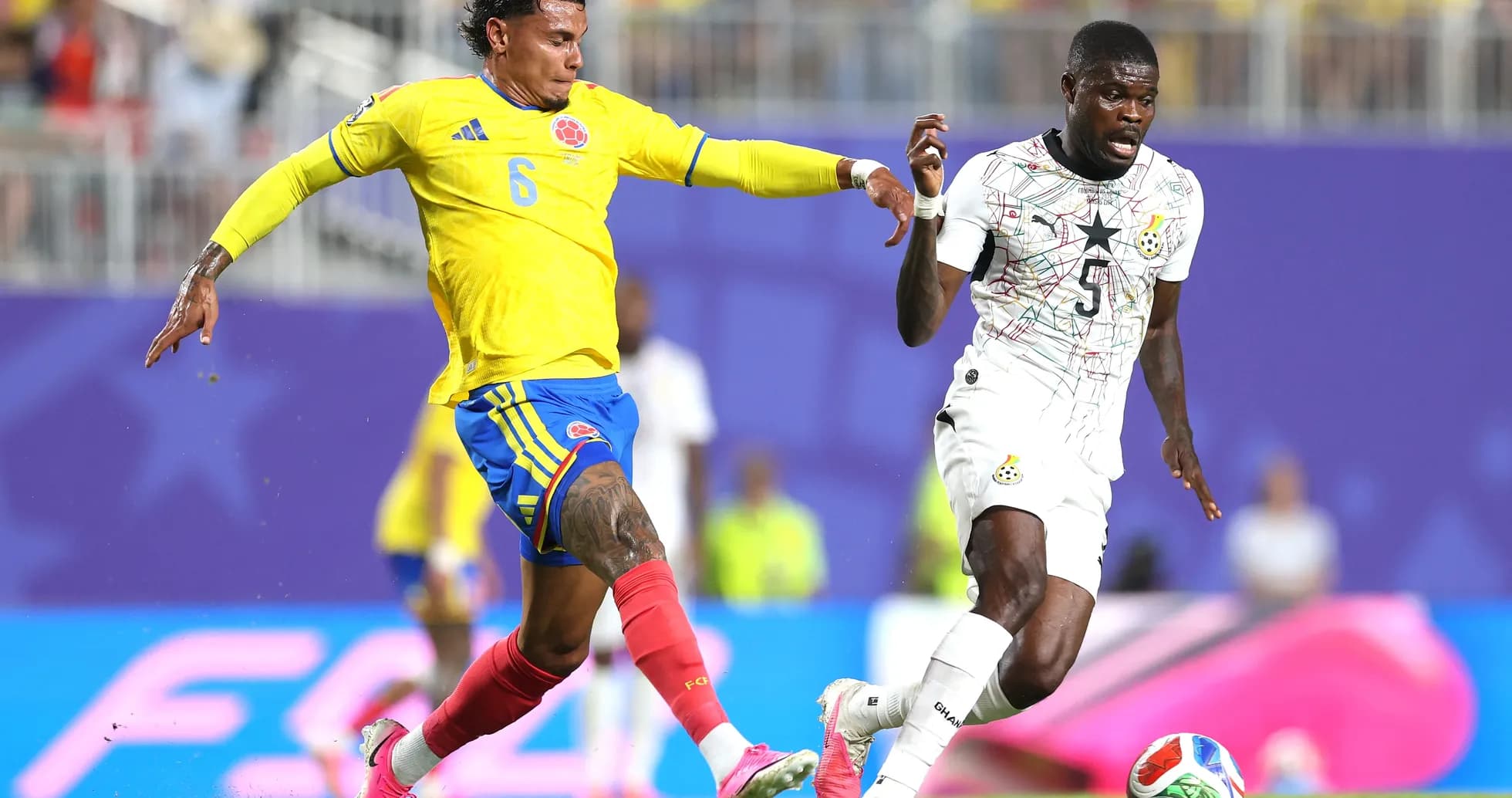
Arrowhead Stadium in Kansas City staged a World Cup Round of 32 tie that felt more like a test of identity than a simple knockout: Colombia 1–0 Ghana, a narrow scoreline that confirmed what the group stage had already hinted. Colombia, top of Group K with 7 points and a goal difference of 3 from 4 goals scored and 1 conceded in 3 matches, arrived as a side built on control and defensive certainty. Ghana, third in Group L with 4 points and a goal difference of 0 from 2 goals scored and 2 conceded, came in as a team still searching for a stable attacking rhythm.
Heading into this game, Colombia’s seasonal profile in the World Cup was clear. Overall they had played 4 matches, winning 3 and drawing 1, with no defeats. At home they had played 3 times, winning 2 and drawing 1, while on their travels they had 1 win from 1. Their attack was efficient rather than explosive: overall they had scored 5 goals, with 2 at home and 3 away. The averages underlined that balance: at home 0.7 goals per game, away 3.0, for an overall average of 1.3. Defensively they were even more impressive, conceding just 1 goal in total, 0 at home and 1 away, which translated into an overall average of 0.3 goals against per match and a perfect 0.0 at home. Three clean sheets overall, all of them at home, told the story of a side that rarely loses structure.
Ghana’s path was more uneven. Overall they had played 4 matches, with 1 win, 1 draw and 2 defeats. At home they had 1 win from 1, while on their travels they had drawn 1 and lost 2. Their attack had struggled: 2 goals in total, split as 1 at home and 1 away, for an overall average of 0.5 goals per game. On their travels they were averaging just 0.3 goals. Defensively they had conceded 3 in total, none at home and 3 away, giving an overall average of 0.8 goals against and 1.0 on their travels. Two clean sheets overall – one at home and one away – suggested that when their block was set, they could be hard to break down, but their failure to score in 2 matches, both away, hinted at a recurring attacking drought.
Tactical Overview
Tactically, this Round of 32 clash was framed by the formations. Nestor Lorenzo’s Colombia stayed loyal to a 4-3-3 that had already been used 4 times in the tournament. C. Vargas anchored a back four of D. Munoz, D. Sanchez, J. Lucumi and J. Mojica. Ahead of them, a midfield trio of G. Puerta, J. Lerma and J. Arias gave Colombia a blend of bite and progression. The front line, on paper one of the most expressive in the competition, saw J. Rodriguez operating between the lines, flanked by J. Cordoba and L. Diaz.
Carlos Queiroz’s Ghana opted for a 4-1-4-1, a structure built to congest the centre and protect the back four. L. Ati Zigi started in goal behind M. Senaya, D. Luckassen, J. Opoku and G. Mensah. T. Partey sat as the single pivot, with a band of four – I. Williams, C. Yirenkyi, K. Sibo and A. Semenyo – tasked with linking to the lone forward, J. Ayew.
Disciplinary Profiles
The disciplinary profiles of both teams shaped the tempo. Colombia’s yellow-card pattern across the tournament showed a clear late-game edge: 33.33% of their cautions had arrived between 0–15 minutes, another 33.33% between 76–90, and 16.67% each in the 46–60 and 91–105 ranges. It painted a picture of a side that starts aggressively and then, as matches tighten, is willing to foul to protect a lead. Ghana’s yellow-card distribution was more spread, but there was a spike between 46–60 minutes at 33.33%, with further 16.67% slices in each of the 16–30, 61–75, 76–90 and 91–105 windows. That suggested a team whose discipline wavered as they chased games after half-time.
Individual Performances
In individual terms, C. Yirenkyi was a central figure in Ghana’s narrative. Across the tournament he had made 4 appearances (3 as a starter), playing 272 minutes and contributing 1 goal from midfield. His 70 completed passes with 1 key pass and 88% accuracy, plus 2 successful blocks and 3 interceptions, made him both creator and disruptor. Yet his 7 fouls committed and 2 yellow cards underlined the risk: Ghana’s most active midfielder also lived on the disciplinary edge. In a knockout tie, that duality was always going to matter.
On the Colombian side, the spine of C. Vargas, D. Sanchez and J. Lucumi was the quiet architecture of their campaign. With 3 clean sheets overall and just 1 goal conceded in 4 matches, their defensive metrics were the bedrock that allowed J. Rodriguez and L. Diaz to take risks higher up the pitch. The 4-3-3, used in all their fixtures, ensured automated movements: full-backs stepping into midfield, J. Lerma screening transitions, and G. Puerta shuttling to cover wide spaces when Diaz and Cordoba drove inside.
Match Dynamics
The “Hunter vs Shield” battle was therefore clearly defined. Colombia’s overall scoring rate of 1.3 goals per match, backed by an away average of 3.0, faced a Ghana back line that, on their travels, conceded 1.0 goal per game. Ghana’s shield was not porous, but it was under constant strain, especially given their difficulty in sustaining attacks: an away scoring average of 0.3 meant long spells without relief for the defence.
In the “Engine Room”, J. Lerma and G. Puerta squared up to T. Partey and C. Yirenkyi. Colombia’s midfield three, compact and staggered, were built to suffocate the Ghanaian pivot, forcing Ghana’s progression wide and isolating J. Ayew. Ghana, in turn, relied on Partey’s positioning and Yirenkyi’s energy to break Colombia’s rhythm and spring counters for I. Williams and A. Semenyo.
Statistical Outlook
Statistically, the prognosis leaned towards Colombia. Their overall goal difference of 4 (5 scored, 1 conceded) heading into the knockout contrasted with Ghana’s -1 in the broader tournament sample (2 scored, 3 conceded). Colombia’s record of never having lost, combined with 3 clean sheets and no penalties missed or taken, suggested a team that did not need spot-kick variance to win. Ghana, with 2 matches in which they failed to score and no penalties taken, lacked alternative routes to goal.
The 1–0 scoreline in Kansas City ultimately fit the numbers. Colombia’s defensive solidity held, Ghana’s away attacking struggles persisted, and the match unfolded along the fault lines the data had drawn. Following this result, Colombia’s identity as a pragmatic, structurally sound contender was reinforced. Ghana departed with the outline of a competitive side – a disciplined block, a tireless C. Yirenkyi, flashes from I. Williams and A. Semenyo – but without the sustained attacking clarity needed to unpick a defence as miserly as Colombia’s on a World Cup knockout night.