.svg&w=384&q=75 "naujapitch logo")
Paraguay vs France: Tactical Analysis of Round of 16 Clash
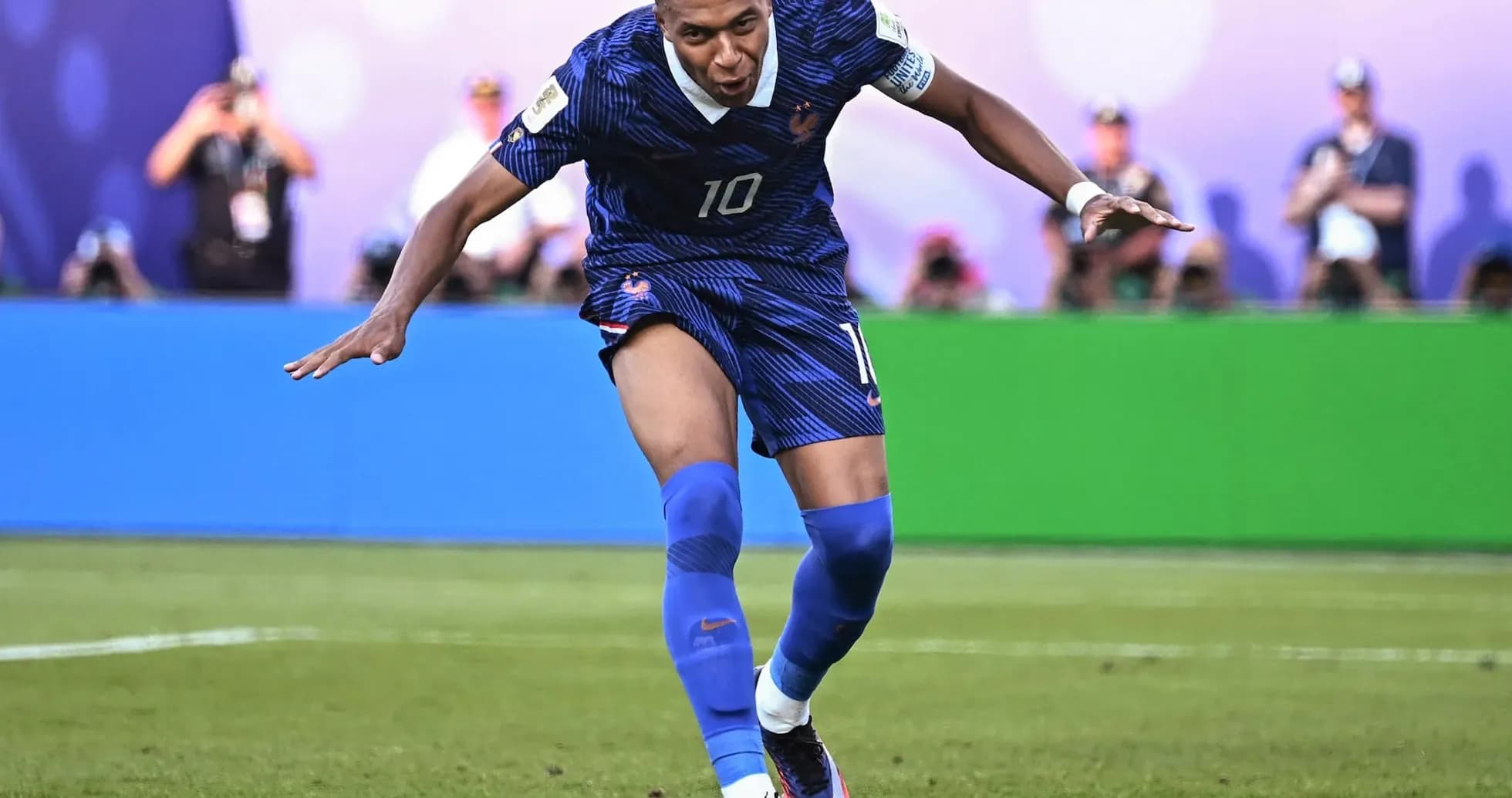
Paraguay’s Round of 16 defeat to France at Lincoln Financial Field unfolded as a classic clash between deep defensive organisation and sustained territorial dominance. Paraguay, in a 5-4-1 under Gustavo Alfaro, accepted extreme defensive density and minimal possession, while Didier Deschamps’ France used a 4-2-3-1 to suffocate the game territorially and finally edge it 1-0 via Kylian Mbappé’s 70th-minute penalty.
France’s structural control was absolute from the outset. With 76% possession and 568 total passes, of which 510 were accurate (90%), they built patiently through William Saliba and Dayot Upamecano, who operated high and wide in the Paraguayan half. Full-backs Jules Koundé and Lucas Digne pushed on to pin Paraguay’s wide midfielders, turning France’s base shape into something closer to a 2-3-5 in settled attack, with Manu Koné and Adrien Rabiot anchoring circulation.
Paraguay’s 5-4-1 was unapologetically low and narrow. The back five—Juan Cáceres, Gustavo Velázquez, Gustavo Gómez, Omar Alderete and Junior Alonso—stayed compact in the width of the box, with Andrés Cubas screening in front. The wingers, Miguel Almirón and Matías Galarza, dropped almost to full-back depth, leaving Julio Enciso isolated up front. The statistical profile underlines the strategy: only 24% possession, 183 total passes (99 accurate, 54%), and just 5 total shots, with 1 shot on goal and 1 effort inside the box. Paraguay essentially traded any attacking rhythm for defensive solidity.
France’s attacking line of Ousmane Dembélé, Michael Olise, Bradley Barcola and Mbappé constantly rotated between lines. Olise drifted into the right half-space to combine with Koundé, while Barcola’s starting position on the left allowed Digne to underlap. Mbappé, as the lone striker, alternated between running channels and dropping to link, forcing Paraguay’s central defenders to make difficult decisions about stepping out of the line. This relentless occupation of advanced zones produced 15 total shots (5 on goal, 4 blocked), reflecting both volume and pressure on the Paraguayan block.
The key tactical hinge came around the hour mark with substitutions. For Paraguay, Omar Alderete (OUT) was replaced by José Canale (IN) on 58', a like-for-like change that preserved the back-five structure but brought fresh legs for defending the box. Three minutes later, Julio Enciso (OUT) made way for Gustavo Caballero (IN), signalling a search for more vertical threat on transitions without altering the 5-4-1 framework. On 71', Alfaro further adjusted: Miguel Almirón (OUT) for Gabriel Ávalos (IN) and Gustavo Gómez (OUT) for Mauricio (IN). Functionally, this nudged Paraguay towards a slightly more direct, two-forward look in some phases, but the team still spent most of the time pinned deep.
France’s key attacking tweak came on 61', when Bradley Barcola (OUT) was replaced by Désiré Doué (IN). Doué’s introduction immediately changed the left side: he attacked inside channels more aggressively, increasing dribble threat between Paraguay’s left centre-back and wing-back. This new dynamism directly preceded the game’s decisive moment. At 68', VAR confirmed a penalty for France, with the event specifically linked to Doué. Two minutes later, Mbappé converted from the spot, rewarding France’s territorial siege and Doué’s impact.
Defensively, France’s control was as notable as their attacking structure. With only 11 fouls conceded and 1 save required from Mike Maignan (France), their rest-defence and counter-press were highly effective. Koné and Rabiot formed a strong shield in front of the centre-backs, preventing Paraguay from turning defensive regains into meaningful counters. The fact that Paraguay produced only 0.15 xG from their 5 shots underscores how rarely they accessed threatening zones; most of their efforts came from distance, reflected in 4 shots from outside the box.
Paraguay’s defensive performance, while ultimately breached, was disciplined and resilient. They conceded 12 corners and faced constant crossing and combination play, yet limited France to 1.36 xG despite 15 attempts. That speaks to the compactness and timing of the back five’s interventions, as well as the work rate of the midfield four in closing central lanes. The blocked shots count—4 for France, 1 for Paraguay—shows how often the Paraguayan block got bodies in front of efforts, even if they were largely defending their own area.
In goal, Orlando Gill (Paraguay) was central to keeping the tie alive as long as it was. He made 4 saves, aligning with France’s 5 shots on target and underlining the volume of on-target pressure he faced. His shot-stopping, combined with the defensive line’s positioning, helped Paraguay outperform their expected concession by a small margin, with 0.37 goals prevented. At the other end, Maignan (France) had a comparatively quiet evening, needing just 1 save; France’s high line and compact midfield screen largely suffocated Paraguayan attacks before they could develop.
Discipline also reflected the game’s pattern. France collected three yellow cards, all in the context of managing transitions or duels high up the pitch: Bradley Barcola (France) at 19' for “Foul”, Manu Koné (France) at 81' for “Foul”, and Michael Olise (France) at 90+7' for “Unsporting behaviour”. Paraguay, by contrast, finished without a single booking despite 13 fouls, a sign of controlled aggression within their low block.
Statistically, the match tells a clear story: France’s 76% possession, heavy passing volume and 1.36 xG against Paraguay’s 0.15 xG justify the narrow 1-0 scoreline. Paraguay’s plan nearly forced extra time, built on deep compactness, committed blocking and a strong performance from Orlando Gill (Paraguay). But Deschamps’ side, aided by the injection of Désiré Doué and the penalty confirmed by VAR, eventually translated their structural dominance into the single goal needed to reach the 1/8 final.