.svg&w=384&q=75 "naujapitch logo")
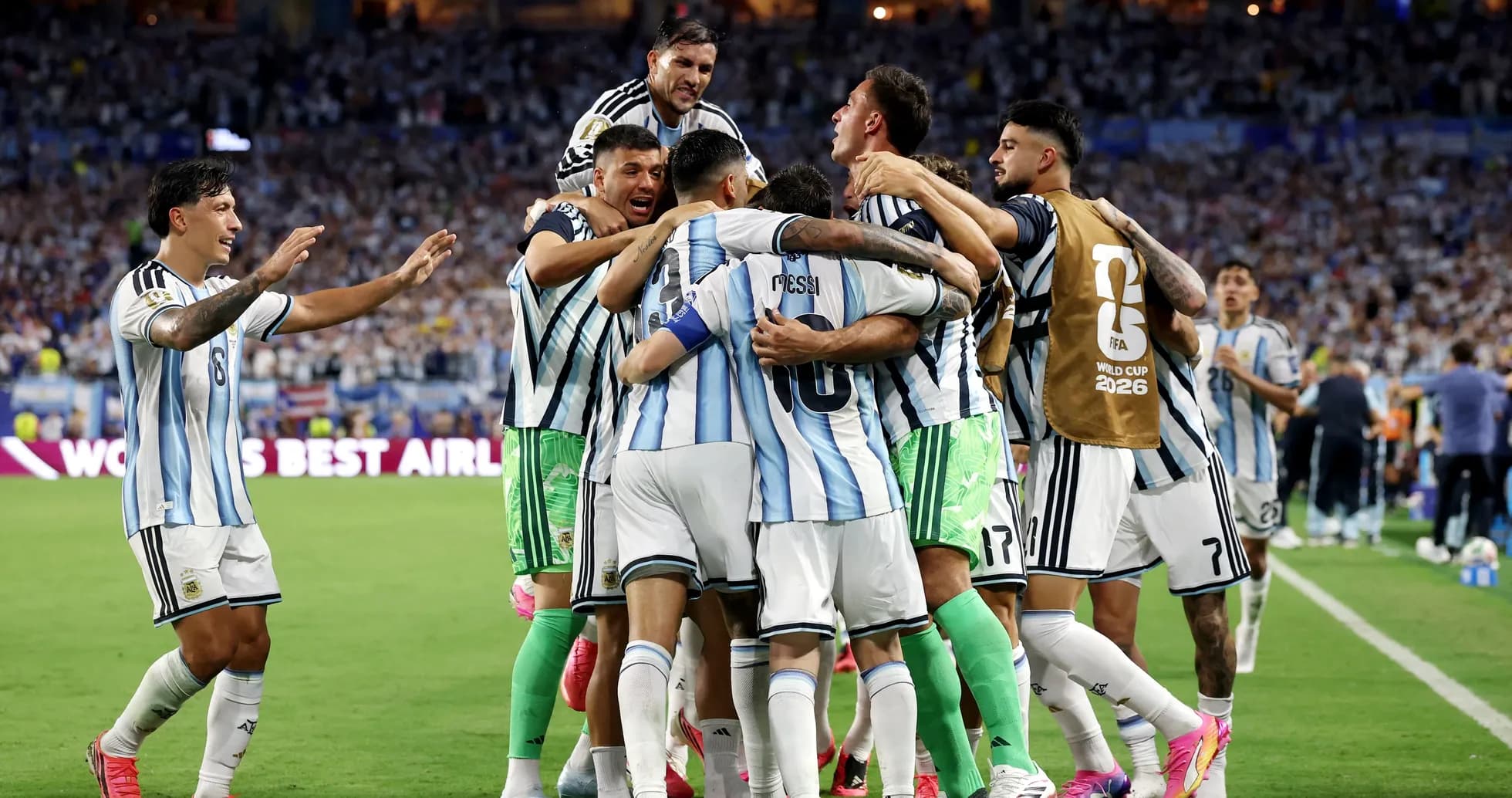
Argentina vs Cape Verde: World Cup Round of 32 Showdown
Under the Miami lights at Hard Rock Stadium, Argentina and Cape Verde Islands carried very different stories into this World Cup Round of 32 tie. Argentina arrived as Group J winners, perfect through 3 matches with 9 points and a goal difference of 7, their campaign defined by control and cutting edge. Cape Verde, second in Group H with 3 points from 3 draws and a neutral goal difference of 0, came as the stubborn survivors of the group phase. Over 120 minutes, Argentina’s 2–1 win after extra time ultimately followed those broader patterns: the favourites probing, the underdogs resisting, and quality finally separating them without the need for penalties.
I. The Big Picture – Seasonal DNA Meets Knockout Tension
Heading into this game, Argentina’s season profile was that of a ruthless, undefeated machine. Overall they had played 4 fixtures, winning all 4. At home they had played 3 times and won all 3; on their travels they had played once and won once. In total this campaign they had scored 11 goals and conceded 3, giving an overall goal difference of 8. At home they had 8 goals for and 2 against (goal difference 6), while away they had 3 for and 1 against (goal difference 2). Their attacking averages were just as intimidating: 2.7 goals per game at home, 3.0 away, 2.8 overall, while conceding only 0.7 at home, 1.0 away, 0.8 in total.
Cape Verde entered with a very different rhythm. In total this campaign they had played 4 fixtures, drawing 3 and losing 1. At home they had played once, drawn once, failed to score and not conceded; on their travels they had played 3 times, drawing 2 and losing 1. Overall they had scored 4 and conceded 5 (goal difference −1). On their travels they had 4 goals for and 5 against (goal difference −1), averaging 1.3 goals scored and 1.7 conceded away, 1.0 scored and 1.3 conceded overall. Their path was about survival, clean sheets (2 in total) and grinding out results rather than imposing themselves.
The 120-minute narrative in Miami mirrored that contrast. Argentina led 1–0 at half-time, were pegged back to 1–1 by full time, then found the extra-time winner for 2–1. It was the first time in this tournament that their perfect control was meaningfully challenged across such a long, tense contest.
II. Tactical Voids and Discipline – Edges in the Margins
Neither side had listed absentees in the data, so both coaches could lean on their preferred structures. Lionel Scaloni doubled down on continuity: Argentina’s most-used shape this tournament, 4-4-2, had already been deployed in all 4 fixtures, and he kept faith with it again. Pedro Leitao Brito did the same for Cape Verde, staying with the 4-1-4-1 that has defined their World Cup run.
Argentina’s disciplinary profile this campaign hinted at a team that can become increasingly combative as games stretch. All of their recorded yellow cards had come late: 33.33% between 76–90 minutes, 33.33% between 91–105, and 33.33% between 106–120. That late accumulation suits knockout football: they are willing to take cards to manage transitions and protect leads when the match becomes stretched.
Cape Verde’s bookings, by contrast, have been front-loaded. In total this campaign 40.00% of their yellow cards came in the opening 0–15 minutes, 20.00% between 16–30, another 20.00% between 61–75, and 20.00% between 91–105. That pattern speaks of a side that often has to foul early to slow superior opponents, then again as fatigue bites. Against a side as technically sharp as Argentina, those early fouls risked conceding dangerous dead-ball situations around the box.
III. Key Matchups – Hunter vs Shield, Engine Room vs Screen
The headline duel was always going to be Lionel Messi against the Cape Verde defensive block. Messi entered this tie as the tournament’s standout attacker: in total this campaign he had scored 7 goals in 4 appearances, starting 3 times and playing 320 minutes, with a rating of 9.28. He had taken 22 shots, 15 of them on target, and created 10 key passes from 141 total passes at 80% accuracy. Even more telling was his penalty record: he had missed 1 penalty in this World Cup, so Argentina’s danger from the spot was not the certainty it might once have been.
Cape Verde’s defensive record on their travels – 5 goals conceded in 3 away games, 1.7 per match – suggested that keeping Messi and Lautaro Martínez quiet over 120 minutes would be a monumental ask. The back four of S. Moreira, R. Lopes, D. Borges and S. Lopes Cabral, screened by K. Lenini in the 4-1-4-1, had to compress space between the lines to deny Messi the half-spaces where he thrives. Their overall clean-sheet tally of 2 showed they can organize and suffer, but the numbers hinted that sustained pressure from an elite attack would eventually tell.
In midfield, the “engine room” duel set Argentina’s technical core of Rodrigo de Paul, Alexis Mac Allister, Enzo Fernandez and Thiago Almada against Cape Verde’s workmanlike band of K. Lenini, R. Mendes, L. Duarte, D. Duarte and J. Cabral. Argentina’s structure in a 4-4-2 is subtly asymmetrical: de Paul and Mac Allister can both tuck in to create overloads centrally, while Almada drifts inside from the flank to act as a quasi-10, feeding Messi between the lines. That fluidity was designed to drag Cape Verde’s single pivot out of position and force their wide midfielders into uncomfortable defensive decisions.
Cape Verde’s counter-threat rested on N. Da Costa up front, supported by late-arriving runs from R. Mendes and the Duartes. With Argentina conceding only 0.8 goals per game in total this campaign, chances were always going to be rare; the plan was to make each transition count.
IV. Statistical Prognosis – Why Argentina Were Always Favoured
From a statistical standpoint, Argentina’s superiority was stark. They entered with 4 wins from 4, scoring 2.8 goals per game overall and conceding 0.8. Cape Verde, still winless, averaged 1.0 goal scored and 1.3 conceded in total, and 1.3 scored with 1.7 conceded on their travels. Even if Cape Verde could drag the game into extra time – which they did – Argentina’s depth and proven late-game edge, visible in both their winning streak and their willingness to absorb late bookings, tilted the odds heavily in their favour.
The missed penalty in Argentina’s campaign profile served as a small note of vulnerability, a reminder that even Messi is not infallible from the spot. But the broader numbers and the structure of this squad always pointed to exactly the kind of outcome that unfolded in Miami: Cape Verde competitive, organized and brave; Argentina, ultimately, too complete across 120 minutes to be denied.