.svg&w=384&q=75 "naujapitch logo")
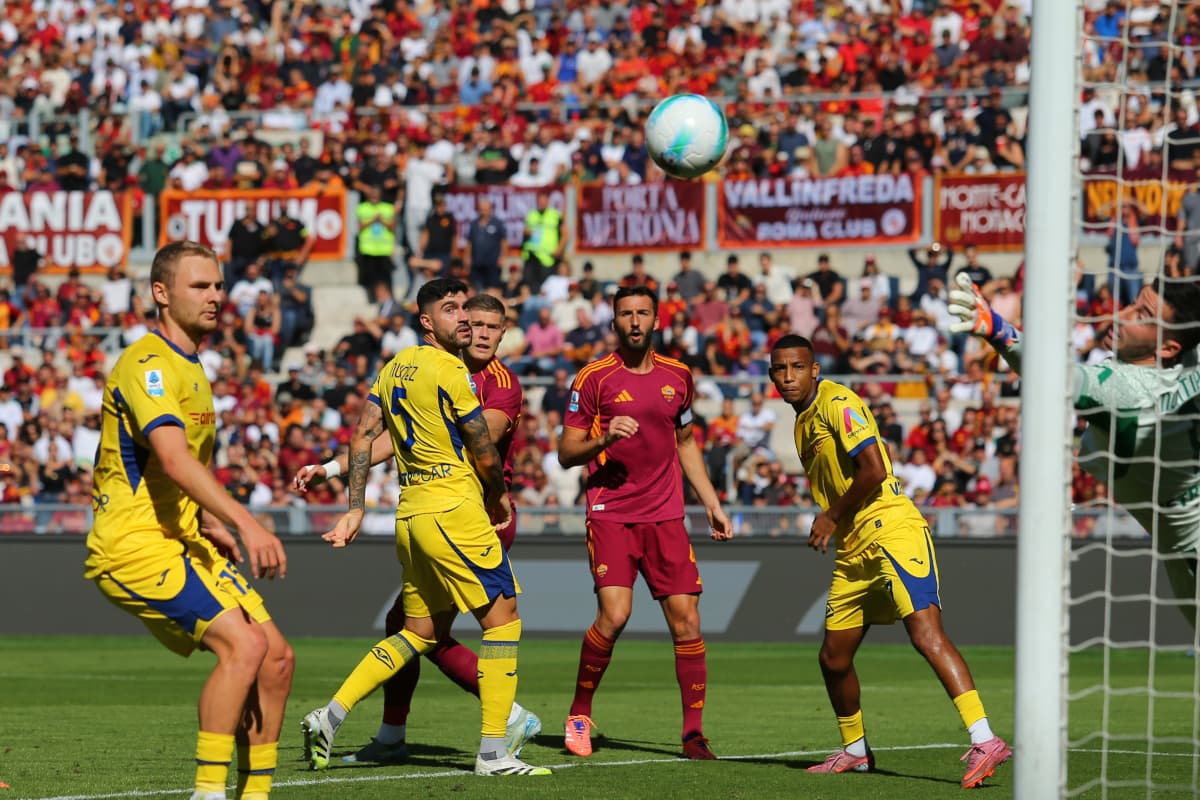
Hellas Verona vs AS Roma: Final Serie A Match Preview
Hellas Verona host AS Roma at Stadio Marcantonio Bentegodi in the final round of Serie A, a game with sharply contrasting stakes: Verona sit 19th with 21 points and a -34 goal difference in the league phase (25 scored, 59 conceded) and are locked in the relegation zone, while Roma arrive 4th on 70 points with a +26 goal difference in the league phase (57 scored, 31 conceded), looking to secure Champions League qualification and potentially climb within the top four positions.
Head-to-Head Tactical Summary
The recent head-to-head record shows a clear Roma edge but with Verona capable of troubling them, especially at Bentegodi. On 28 September 2025 at Stadio Olimpico in Serie A Regular Season - 5, Roma beat Hellas Verona 2-0 (HT 1-0). Earlier in 2025, on 19 April at Stadio Olimpico in Serie A Regular Season - 33, Roma won 1-0 (HT 1-0). The last meeting in Verona was on 3 November 2024 at Stadio Marcantonio Bentegodi, where Hellas Verona edged Roma 3-2 (HT 2-1). In 2024 at Stadio Olimpico (20 January, Serie A Regular Season - 21), Roma won 2-1 against Verona (HT 2-0). The 2023 Bentegodi clash on 26 August (Regular Season - 2) also finished 2-1 to Hellas Verona (HT 2-0). Across these five fixtures, Roma have three home wins (2-0, 1-0, 2-1) at Stadio Olimpico, while Verona have twice taken 2-1 and 3-2 victories at Bentegodi, underlining a pattern of Roma control in Rome and Verona’s ability to open Roma up at home in more open, higher-scoring games.
Global Season Picture
- League Phase Performance: Hellas Verona are 19th with 21 points in the league phase, having won 3, drawn 12 and lost 22 from 37 matches, with 25 goals for and 59 against (goal difference -34). Their home record is particularly weak: 1 win, 5 draws, 12 losses, 12 goals scored and 26 conceded at Bentegodi. Roma are 4th with 70 points in the league phase, from 22 wins, 4 draws and 11 defeats in 37 games, scoring 57 and conceding 31. Away from home they have 9 wins, 1 draw and 8 losses, with 24 goals scored and 21 conceded.
- Season Metrics: The datasets for fixtures and goals in the statistics blocks match the league totals, so these numbers apply in the league phase. Verona’s attack has been blunt, averaging 0.7 goals per game (25 in 37) and failing to score in 19 matches, while conceding 1.6 goals per game (59 in 37). Their defensive structure has been fragile despite a back-three base (3-5-2 used 25 times), and they rely heavily on set pieces and penalties (3/3 converted). Disciplinary output is high, with yellow cards spread heavily between minutes 31-60 and 76-90, pointing to a reactive, often late-tackling side. Roma, by contrast, show a balanced and efficient profile: 57 goals in 37 games (1.5 per match) and only 31 conceded (0.8 per match), with 17 clean sheets and just 7 matches without scoring. Their predominant 3-4-2-1 structure (29 games) underpins a controlled approach, with a strong defensive base at home and a solid, if slightly more open, away profile (1.3 scored and 1.2 conceded per away game). Their card distribution suggests a team that increases intensity after the break, with most yellows between minutes 46-90.
- Form Trajectory: Verona’s recent form string in the league phase is “DLDDL”, reflecting 3 draws and 2 defeats in their last five league games and no wins, consistent with their season-long struggle to turn parity into victories. Roma’s form string “WWWWD” shows a strong late surge: four consecutive wins followed by a draw, indicating momentum and resilience heading into this decisive final round.
Tactical Efficiency
With no explicit Attack/Defense Index values provided in the comparison data, the efficiency picture must be inferred from the in the league phase statistics. Verona’s low scoring rate (0.7 goals per game) combined with a high concession rate (1.6 per game) points to an attack that is anything but clinical and a defense that is consistently under pressure. Their six clean sheets are outweighed by 19 games without scoring, illustrating a side that rarely dominates either box. Roma, meanwhile, couple a productive attack (1.5 goals per game) with an impressively tight defense (0.8 conceded per game) and 17 clean sheets, a profile typical of a top-four side. The contrast in failed-to-score numbers (Verona 19 vs Roma 7) and clean sheets (Verona 6 vs Roma 17) underlines Roma’s superior two-way efficiency. Even though Roma’s away defense is slightly more vulnerable (1.2 conceded per away match), it still compares favorably to Verona’s overall defensive record, suggesting that Roma’s structural and individual quality should translate into a higher probability of controlling chances and xG in this matchup, especially against a Verona side that has often needed penalties or isolated moments to create high-value opportunities.
The Verdict: Seasonal Impact
For Hellas Verona, this match is the last chance to salvage pride rather than safety: sitting 19th with 21 points and a -34 goal difference in the league phase, they are effectively resigned to relegation, and even a win against Roma would be unlikely to change their fate in the table. However, beating a top-four side could provide a psychological platform and tactical reference point for an immediate push in Serie B in 2026, especially validating their more positive home performances against Roma in recent years. For Roma, the stakes are far higher: at 70 points and 4th place in the league phase, anything less than a win risks opening the door for rivals to challenge their Champions League slot, while a victory would consolidate their position and possibly allow them to climb within the top four hierarchy depending on other results. Given their strong recent form (“WWWWD”), superior goal difference and vastly better attacking and defensive metrics, dropping points here would be a significant underperformance and could reshape the narrative of their 2026 campaign from a successful Champions League qualification drive to a missed opportunity. This fixture therefore functions as a pressure test for Roma’s maturity as a top-four side and as a closing statement on Verona’s difficult year, with the result likely to confirm Roma’s status in the Champions League places and Verona’s slide into Serie B.