.svg&w=384&q=75 "naujapitch logo")
Fiorentina and Atalanta End Serie A Season in Tense 1-1 Draw
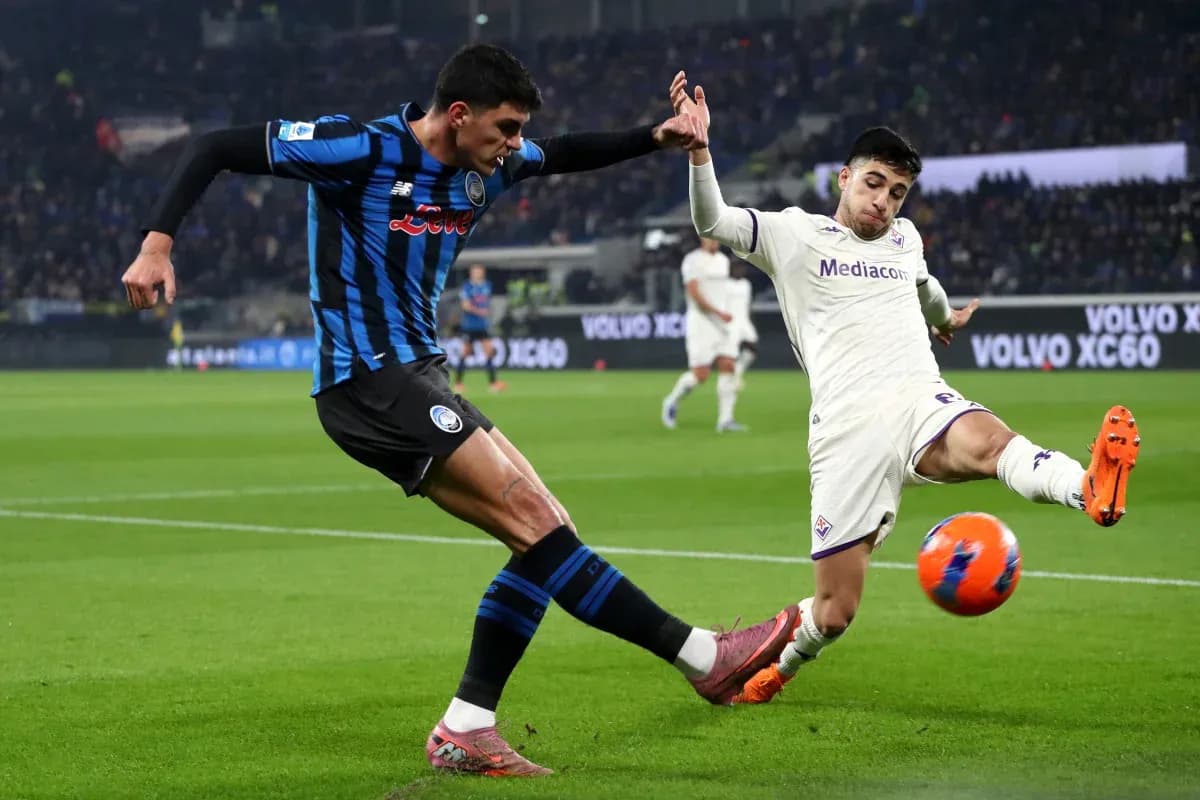
Stadio Artemio Franchi closed its Serie A season under floodlights and tension, with Fiorentina and Atalanta grinding out a 1-1 draw that said as much about their identities as their league positions. Following this result, Fiorentina’s year ends in 15th place on 42 points, their overall goal difference locked at -9 from 41 scored and 50 conceded. Atalanta, by contrast, finish 7th on 59 points, their overall goal difference a healthy +15 after 51 for and 36 against.
I. The Big Picture – Two Systems, Two Realities
On the night, Paolo Vanoli went to his most trusted shape: a 4-3-3 that mirrors Fiorentina’s broader seasonal profile, with that formation used 15 times in the league. O. Christensen anchored the back, protected by a back four of Dodo, P. Comuzzo, D. Rugani and R. Gosens. Ahead of them, the midfield trio of G. Fabbian, R. Mandragora and M. Brescianini offered a blend of legs and left-footed control, while the front line of J. Harrison, R. Piccoli and A. Gudmundsson gave width, work rate and a roaming creator.
Across from them, Raffaele Palladino stayed loyal to Atalanta’s structural DNA: a 3-4-2-1 used 34 times this campaign. M. Sportiello started in goal behind a trio of G. Scalvini, I. Hien and H. Ahanor. The wing-backs, R. Bellanova and Y. Musah, flanked a double pivot of M. De Roon and M. Pasalic, with L. Samardzic and K. Sulemana floating behind central spearhead G. Raspadori.
The match itself mirrored the table. Fiorentina, who overall averaged 1.1 goals for and 1.3 against per game, struck first and then retreated into their familiar tension between control and fragility. Atalanta, whose overall averages sit at 1.3 goals scored and 0.9 conceded, grew into the contest, eventually finding the equaliser and preserving a campaign built on defensive structure and measured risk.
II. Tactical Voids – Absences and Discipline
Both managers had to navigate significant absences that shaped their tactical choices.
For Fiorentina, M. Kean’s calf injury removed a direct, penalty-box option from the bench, pushing Vanoli towards a more associative front three with Piccoli as the central reference. F. Parisi’s knee injury deprived them of a natural attacking left-back, making R. Gosens’ inclusion essential for width and crossing from deeper zones. L. Ranieri’s suspension after a red card forced a reconfiguration at centre-back, with Comuzzo stepping in as the partner to Rugani. The absence of Ranieri, who across the season contributed 34 tackles, 13 successful blocks and 24 interceptions, reduced Fiorentina’s aggression and left-footed balance in the defensive line.
Atalanta were without L. Bernasconi (knee injury) and O. Kossounou (thigh injury). Kossounou’s absence, in particular, removed a powerful, front-foot defender from Palladino’s rotation, making the reliance on Scalvini and Hien even greater against Fiorentina’s fluid front three.
Disciplinary trends hovered over the game. Fiorentina’s season-long yellow-card profile shows a pronounced late-game spike: 25.30% of their yellow cards came between 76-90 minutes, with another 15.66% between 91-105. Their red-card pattern is even starker, with 66.67% of reds arriving in that 76-90 window. Atalanta’s own yellow-card curve also rises late, with 23.33% of their yellows between 76-90 minutes and 21.67% between 61-75, plus red cards clustered at the start (0-15) and again in the 76-90 band. It was no surprise that as the match wore on and the stakes of the final day sharpened, the rhythm fractured into fouls, protests and stoppages.
III. Key Matchups – Hunter vs Shield, Engine Room vs Enforcer
The most intriguing “Hunter vs Shield” dynamic sat slightly off the centre-forward line. Atalanta arrived with a forward unit shaped by the threat of N. Krstović and G. Scamacca, even if both started on the bench. Krstović’s overall tally of 10 goals and 5 assists, with 75 shots and 21 key passes, marks him as a complete attacking outlet. Scamacca, also on 10 league goals with 2 penalties scored and 22 shots on target, offers a more classic penalty-box presence. Their mere availability changed how Fiorentina had to manage depth and rotations in the back line.
Fiorentina’s overall defensive record – 50 goals conceded in 38 games, with an average of 1.1 conceded at home – suggests a unit that can be compact but is prone to lapses. Without Ranieri, the burden shifted to Rugani and Comuzzo to hold the line and win duels early, supported by Dodo and Gosens tucking in when Atalanta’s wide overloads formed. The risk was clear: if Atalanta introduced Krstović or Scamacca from the bench, tired legs in the Fiorentina back four would have to cope with fresh, high-volume shooters.
In the “Engine Room” duel, the contrast was sharp. For Atalanta, M. De Roon remained the enforcer, the positional anchor that allowed Samardzic and Sulemana to drift into half-spaces. De Roon’s role was to suffocate Mandragora’s passing lanes and disrupt Brescianini’s forward surges. On the other side, Mandragora’s left foot and tempo-setting were essential to Fiorentina’s attempts to play through Atalanta’s first line, while Fabbian’s box-to-box running was tasked with tracking late arrivals from Pasalic and the inside forwards.
The creative axis that hovered over the match, even from the bench, was C. De Ketelaere. Across the season he delivered 5 assists and 3 goals, with 63 key passes and 102 attempted dribbles, 51 of them successful. His ability to receive between the lines and drive at back-pedalling defenders would always threaten a Fiorentina side that, overall, failed to score in 11 league matches and often relies on narrow margins.
IV. Statistical Prognosis – Margins, xG and the Late-Game Edge
From a statistical standpoint, the 1-1 felt like the meeting point of two opposing curves. Fiorentina, at home, averaged 1.1 goals scored and 1.1 conceded, and they collected 6 home clean sheets but also failed to score 4 times in Florence. Atalanta, on their travels, averaged 1.4 goals scored and 1.1 conceded, with 6 away clean sheets and only 2 away games without a goal. Any Expected Goals model built on those season-long numbers would likely have shaded the attacking edge towards Atalanta while acknowledging Fiorentina’s capacity to keep things tight at the Franchi.
The late phases were always going to be decisive. Fiorentina’s disciplinary spikes in the 76-90 and 91-105 windows, combined with Atalanta’s own surge of yellows in the same period, pointed to a closing stretch of broken rhythm, set pieces and emotional swings rather than sustained possession. That dynamic tends to flatten xG differences and create chaos chances rather than crafted ones.
Following this result, the narrative is clear. Fiorentina close a fraught season having survived, but with a profile that screams for more punch and fewer lapses. Atalanta, meanwhile, validate their place in the European conversation: structurally consistent, defensively solid, and with enough firepower in reserve – from Krstović’s dual role as scorer and provider to De Ketelaere’s creative gravity – to tilt tight matches. On this final evening in Florence, the numbers and the story converged on parity.