.svg&w=384&q=75 "naujapitch logo")
Bologna vs Inter: A Thrilling 3-3 Finale in Serie A
Stadio Renato Dall’Ara staged a finale worthy of the season it closed. Bologna, eighth in Serie A on 56 points with a goal difference of 3 (49 scored, 46 conceded overall), went punch for punch with champions Inter, who arrived already crowned on 87 points and a towering goal difference of 54 (89 for, 35 against overall). Across 38 matches, Bologna had been far stronger on their travels than at home, while Inter had been ruthless everywhere, but especially in Milan. Yet on this afternoon, the league table flattened into a single, breathless 90-minute story that finished 3-3.
Team Strategies
Vincenzo Italiano’s decision to lean into a 4-3-3, one of Bologna’s less-used structures this season compared to their staple 4-2-3-1, was both necessity and statement. Injuries stripped him of several pillars: Riccardo Orsolini, his 10-goal wide talisman and penalty taker (4 scored, 2 missed in total this campaign), was out with a muscle injury. Defensive options were thinned by the absences of K. Bonifazi and M. Vitik, while N. Casale was also unavailable. N. Cambiaghi, another attacking option, was missing as well. For a side that had failed to score in 11 league games overall, losing Orsolini’s direct threat and set-piece menace could easily have tilted this into a damage-limitation exercise.
Instead, Italiano built a front line around mobility and interchange. F. Bernardeschi started from the right but was given license to drift inside and act as a playmaking winger. J. Rowe on the opposite flank offered direct running, while S. Castro led the line as a central reference point. Behind them, a midfield triangle of L. Ferguson, R. Freuler and T. Pobega was constructed to fight Inter’s numbers rather than mirror them. Freuler anchored, Ferguson had the dual role of shuttler and late runner, and Pobega’s left-sided presence was designed to help J. Miranda deal with Inter’s most creative outlet.
That outlet, of course, was Federico Dimarco. Inter’s 3-5-2 under Cristian Chivu has been an exercise in controlled aggression all season, and the numbers tell the story: heading into this game they averaged 2.6 goals at home and 2.1 away, with 89 in total and 18 clean sheets overall. Dimarco, the league’s top assist provider with 16, has been the system’s left-footed metronome and chaos agent rolled into one. Lining up as the left wing-back in the 3-5-2, he formed the wide vertex of a chain with Carlos Augusto and P. Zielinski, constantly looking to overload Bologna’s right.
Chivu’s midfield was retooled by necessity. H. Calhanoglu, one of Serie A’s standout playmakers with 9 goals, 4 assists and a 90% pass accuracy, missed out through lack of match fitness. That removed Inter’s primary deep conductor and penalty specialist (4 scored, 1 missed this season), forcing a redistribution of creative duties. Nicolò Barella, already on 8 assists and 3 goals, became the de facto tempo-setter from the right half-space, while P. Sucic and Zielinski shared responsibility for progression between the lines.
Up front, Lautaro Martínez, the league’s top scorer with 17 goals and 6 assists, was paired not with his usual foil M. Thuram (rested), but with F. Esposito. It shifted Inter’s attacking dynamic. Without Thuram’s relentless channel running and back-to-goal play, Lautaro had to toggle between poacher and facilitator more often, dropping to combine with Barella and Dimarco and relying on Esposito to threaten the last line.
Defensive Tactics
Defensively, both teams carried clear identities into the match. Bologna’s season-long averages of 1.0 goals scored at home and 1.2 conceded at home painted them as cautious hosts, often more solid than spectacular. Inter, by contrast, had conceded just 35 overall, with only 1.0 goals against on their travels, thanks to a back three marshalled here by S. de Vrij and flanked by Y. Bisseck and Carlos Augusto. With Yann Sommer on the bench and J. Martinez starting, Chivu rotated in goal but kept the structural integrity of the 3-5-2 intact.
The disciplinary backdrop added another layer. Bologna’s yellow-card profile shows a pronounced spike from 61-75 minutes (26.87%) and 76-90 (25.37%) – a late-game surge that hints at fatigue and desperation in closing phases. Inter’s bookings also climb as the clock ticks, with 20.31% of their yellows between 61-75 and a league-high 31.25% in the final quarter of an hour. In a fixture that ultimately produced six goals and constant momentum swings, those tendencies foreshadowed a second half rich in tactical fouls, broken rhythm and emotional edge.
Key Matchups
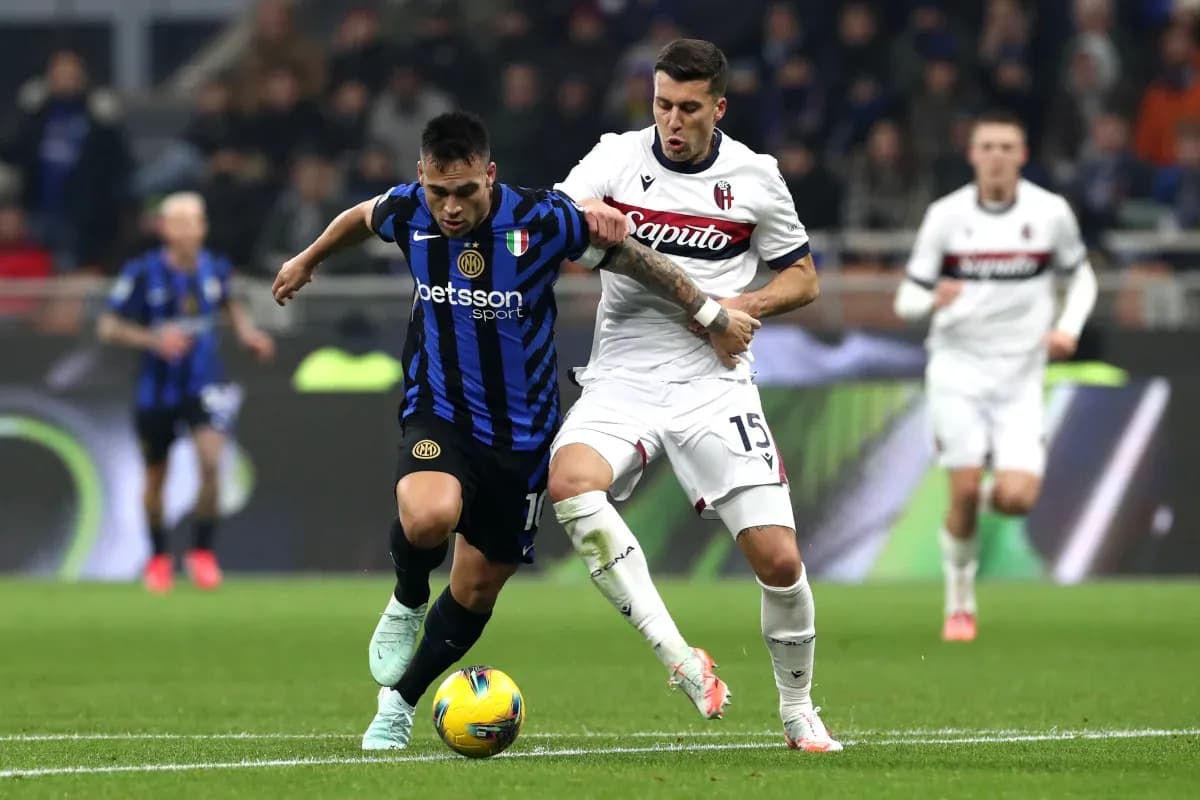
Within that chaos, certain duels defined the narrative. The “Hunter vs Shield” confrontation between Lautaro Martínez and Bologna’s central pairing of E. Fauske Helland and J. Lucumi was a running subplot. Lautaro’s season numbers – 69 shots, 39 on target, 253 duels with 115 won – demanded total concentration. Helland and Lucumi, protected by Freuler, had to manage his movement while also tracking Esposito’s darts and Dimarco’s underlaps. Every time Bologna pushed their full-backs high, they risked leaving those three-on-three transitions that Inter thrive on.
In the “Engine Room”, Barella and Dimarco faced a different kind of resistance. Ferguson’s remit was to disrupt Barella’s rhythm, while Pobega and Miranda tried to narrow the lane for Dimarco’s trademark whipped deliveries. Without Calhanoglu, Inter’s central buildup could be choked if Bologna’s midfield three compressed effectively. When they did, Bologna could spring Rowe and Bernardeschi into the spaces behind Dimarco and Diouf; when they didn’t, Inter’s 3-5-2 morphed into a five-man wave at the edge of the box.
Statistical Outlook
Following this result, the statistical prognosis for both sides crystallises. Inter’s attacking firepower – 2.3 goals per game overall – remains the division’s gold standard, but the three goals conceded in Bologna echo their away average of 1.0 against and underline that high possession and territory do not always translate into control. Bologna, for their part, showed that even without Orsolini’s end product and despite a modest home scoring rate, they can stretch elite defences when their 4-3-3 is played with conviction.
In xG terms, this was the archetype of a high-variance, high-risk encounter: Inter’s structural superiority and shot volume balanced by Bologna’s verticality and willingness to commit numbers forward. The champions leave with their aura intact but reminded of their defensive mortality; Bologna close the season as a side whose numbers hint at mid-table solidity, but whose tactical bravery – especially in games like this – suggests a ceiling higher than eighth.