.svg&w=384&q=75 "naujapitch logo")
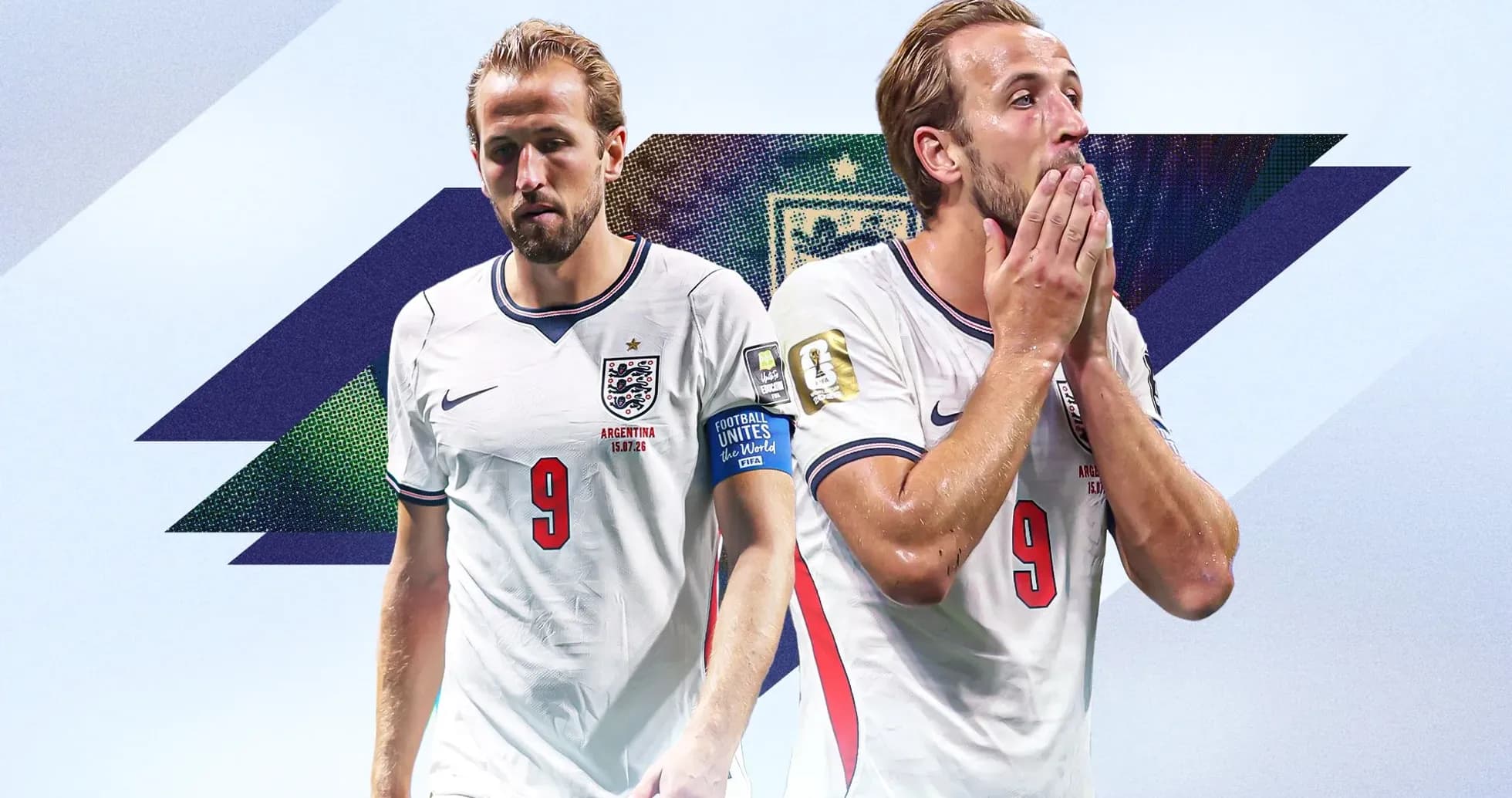
Harry Kane's World Cup Heartbreak: England's Semi-Final Struggles
For an hour in New Jersey, England went punch for punch with the world champions. They did not dominate Argentina, but they did not shrink from them either. When Anthony Gordon swept in the opener on 55 minutes, it felt like the reward for nerve, not a theft. This was England landing first. The expectation was simple: Argentina would respond, and England looked ready to trade again.
They never did.
Once ahead, England retreated. Argentina surged. Lionel Scaloni spoke afterwards of his team “smelling blood in the water”. It was hard to argue. Every minute that followed Gordon’s goal felt like Tuchel tossing more bait into the ocean, his team sinking deeper and deeper towards their own box.
In the middle of it all, Harry Kane drifted through the chaos like a ghost.
His numbers are brutal: 26 touches, nine completed passes, one blocked shot, not a single touch in Argentina’s penalty area. On the surface, it reads like a striker who never turned up. That is not quite the full story.
This was a scrappy, bitty semi-final, and Kane embraced the fight early. He spent most of the first half chasing, grappling, throwing himself into challenges. He contested more duels than Lisandro Martínez and Alexis Mac Allister. At times he hurled his body into tackles with a recklessness that would have made a centre-back proud.
In those opening 45 minutes, with little football to be played and a lot of ground to be covered, that edge had value. England needed a captain willing to muck in. Kane did.
The problem came when the game changed and he didn’t.
Once England scored, the match presented Tuchel with a tactical dilemma he never truly solved. His caution was at least understandable. England had survived a siege at the Azteca against Mexico, a backs-to-the-wall masterclass to cling to a one-goal lead. Kane had gone 89 minutes there, scrapping, clearing, clattering into people. England’s defensive heroism had become the story of their tournament.
On Wednesday, the pattern threatened to repeat itself. Kane again was all sweat and sacrifice. Yet this time, England needed something different from him.
“For one reason or another, we struggled to be on the ball, we struggle to put pressure on the ball and it allowed them to create more momentum and created more attacks for them in our final third,” Kane said afterwards. Honest words. The irony is that he was part of the tactical problem he was describing.
What England desperately lacked was an out ball. Someone to pin one of Argentina’s heavy-legged centre-backs, to make them turn, to give the defence a simple pass up the pitch and a chance to breathe. Kane is almost the complete centre-forward. He links play, finishes off both feet, dominates in the air, leads a press when asked. The one attribute he does not possess is pace.
So he did what he has done for years: dropped deeper, searching for the ball, trying to plug holes and slow the tide. Against a rampant Argentina, it was like trying to stop a flood with a towel. Wave after wave of pressure broke in front of him, and England never escaped.
This was no longer Kane’s game. Tuchel should have recognised it and acted. He didn’t. The captain stayed on, reduced to a spectator in his own penalty area as the semi-final slipped away.
In isolation, it is a harsh way to end a season that had been close to flawless. Kane’s year with Bayern Munich was extraordinary. He shattered the single-season scoring record for a Bundesliga player, hitting 58 goals in all competitions. No one in Europe’s top five leagues matched his domestic haul of 36. He became the fastest Bayern player ever to rack up 100 goal contributions. Bayern cantered to the title by 16 points, even after easing off late in the campaign.
Those numbers fuelled serious Ballon d’Or talk. Robert Lewandowski never hit those heights in Bavaria. Statistically, Kane moved into the orbit of Messi and Ronaldo. On output alone, the case for him to become the first English winner of the award since Michael Owen was compelling.
The problem lay in the competitions that define legacies. Bayern went toe-to-toe with eventual Champions League winners PSG but failed to overturn a first-leg deficit, bowing out 6-5 on aggregate in the semi-finals. The grandest stages, once again, denied him.
That is why this World Cup loomed so large. Kane admitted as much before the tournament. A big month with England and the Ballon d’Or race would tilt in his favour.
“I’d be one of the favorites, definitely,” he said. “Given the trophies I’ve won this season and the number of goals I’ve scored, I’d be in the running. Especially as, should England win the World Cup, one could imagine the trophy going to an English player.”
For five games, he played like a man chasing that prize. Two goals against Croatia. One against Panama. Two more against Congo. An assist at the Azteca. Kane and Jude Bellingham drove England forward; everyone else slotted in around them and did their jobs.
A Golden Boot never hurts when awards are handed out. Heading into the semi-final, Kane trailed Lionel Messi and Kylian Mbappé by two goals. If England were to reach the final, logic dictated he would have to be heavily involved. This was the night for him to strike.
He didn’t. And with that, the Golden Boot has almost certainly gone. Even if he were to score a hat-trick against France in a third-place match he should be nowhere near, it would take a brave soul to back Messi not to score against Spain in the final.
Kane will return to Germany without a World Cup, without a Golden Boot, and almost certainly without the Ballon d’Or that once felt within reach. His window, for now, has closed.
The sadness lies in what this might represent. His move to Bayern felt like a rebirth. In hindsight, he probably stayed at Tottenham a year or two too long. He was magnificent there, a constant presence among the Premier League’s elite, but always surrounded by issues he could not control and investment that came too late. The irony that Spurs have finally started spending heavily this summer will not be lost on him.
His first two seasons in Munich became a loud answer to those who doubted him. Kane could thrive at a superclub. He could carry the weight of expectation. He could still improve. He has spoken often about studying other sports, learning from athletes who have extended their careers by obsessively caring for their bodies. He wants to outlast time. At club level, it looks like he might.
International football is another world entirely. There are no long arcs, no gentle rebuilds, no carefully managed minutes. There is no winter break to recharge, no soft run of fixtures to play yourself into form. England stretched their World Cup camp as far as possible, but it still amounted to less than two months. After a long domestic season, the tournament was a sprint. When the gun went off and the finish line loomed, Kane faltered.
If this proves to be his last shot at a World Cup in his prime, his England legacy becomes a complicated thing. On the one hand, he is almost certainly the best striker the country has ever produced. If he stays fit, he will stroll past 100 goals for his country. Peter Shilton’s 125-cap record is well within reach; Kane is already on 121. He holds the record for most penalties scored at World Cups. He owns a Golden Boot from 2018.
On the other hand, the major tournaments keep scarring the story. He was ineffective at Euro 2024. He missed a pivotal penalty in Qatar in 2022. The 2018 World Cup and Euro 2021 squads were weaker than this one, yet even then, Kane never quite dragged England through a competition in the way his talent suggests he should. When you sit his numbers alongside the other great international scorers – Messi, Ronaldo, Pelé, Maradona, Henry – there is a glaring difference. They can all point to a major trophy. He cannot.
The problem is not just Kane’s. England’s striker succession plan is alarmingly thin. Tuchel brought a 30-year-old Ollie Watkins and a 30-year-old Ivan Toney to this World Cup. Behind them, the cupboard is close to bare. There is no obvious young centre-forward ready to seize the shirt. For all the frustration, Kane will be incredibly difficult to dislodge.
So the likely outcome is stasis. England will roll on towards Euro 2028 with Kane still leading the line. They will probably be competitive. They may even be among the favourites. But by then, he will be 34, his peak surely behind him, and yet there is no clear alternative.
Kane, for his part, has no intention of walking away.
“The national team is my pride and joy,” he said. “It's what I love to do most more than anything. Obviously four years is a long way away, I'm 33 this summer but it never ended with Leo [Messi] there, he's still performing at the highest level. I never want to put a limit on these things.”
That is the hope England must cling to: that their captain can bend time, that his Bayern form can be stretched across one more major tournament, that this semi-final becomes a painful chapter rather than the final act.
Because if this was his best chance to turn greatness into something immortal, and it slipped through his fingers like this, how many more does he realistically have left?