.svg&w=384&q=75 "naujapitch logo")
Argentina Triumphs Over England in World Cup Semi-Final
Under the closed roof of Mercedes-Benz Stadium, this World Cup semi-final felt less like a neutral-site contest and more like a collision of footballing ideologies honed over a month-long campaign. England, group winners from Group L with 7 points and a goal difference of 4 (6 scored, 2 conceded), arrived as a side reshaped under Thomas Tuchel: structured, possession-conscious, but increasingly dependent on individual surges from Jude Bellingham and Harry Kane. Argentina, perfect in Group J with 9 points and a goal difference of 7 (8 scored, 1 conceded), came in as a relentless machine built around the enduring genius of Lionel Messi, whose tournament had already yielded 8 goals and 4 assists.
By the time Argentina’s 2–1 win was sealed, the narrative threads of the entire campaign had converged. This was not just a semi-final; it was the logical climax of two statistical profiles and two tactical blueprints.
I. Shapes and Seasonal DNA
Tuchel doubled down on England’s tournament identity with a 4-2-3-1 that has been his go-to shape, used 6 times this campaign. J. Pickford stood behind a back four of R. James, J. Stones, M. Guehi and D. Spence, a line that has helped England concede only 8 goals overall across 7 fixtures, an average of 1.1 per match (1.3 at home, 1.0 on their travels). In front of them, D. Rice and E. Anderson formed a double pivot, tasked with both protecting central spaces and feeding the trio of M. Rogers, Bellingham and A. Gordon behind Kane.
This England side has been efficient rather than explosive: 14 goals overall at 2.0 per match, split evenly between home and away (7 and 7), with a slight uptick in away productivity at 2.3. Their biggest home win, 4–2, and their only home defeat, 1–2, hint at a team that can be opened up when forced to chase.
Argentina, by contrast, have been relentless front-runners. Seven wins from seven, 19 goals scored overall at 2.7 per match (2.8 at home, 2.5 on their travels) and only 7 conceded at 1.0 per game. Lionel Scaloni’s choice of a 4-1-4-1 in this semi-final was a subtle evolution from his more frequent 4-4-2 and 4-1-3-2: L. Paredes sat as the single pivot, with G. Simeone, E. Fernandez, A. Mac Allister and J. Alvarez forming a fluid band behind Messi.
The structure told you everything: Argentina would compress the middle, trust their attacking five to overload England’s back line, and live with a slightly open rest defence, confident in their ability to simply outscore opponents.
II. Tactical Voids and Disciplinary Shadows
England entered the night with a notable absence. J. Quansah, whose campaign has already featured a red card and 1 yellow, was suspended through a sports court decision. His profile – 117 minutes, strong duels (10 won from 13) and one dismissal – had made him a volatile but impactful rotation option. Without him, Tuchel leaned fully into Stones and Guehi as his central axis, sacrificing the option of a more aggressive, front-foot centre-back to step out on Messi.
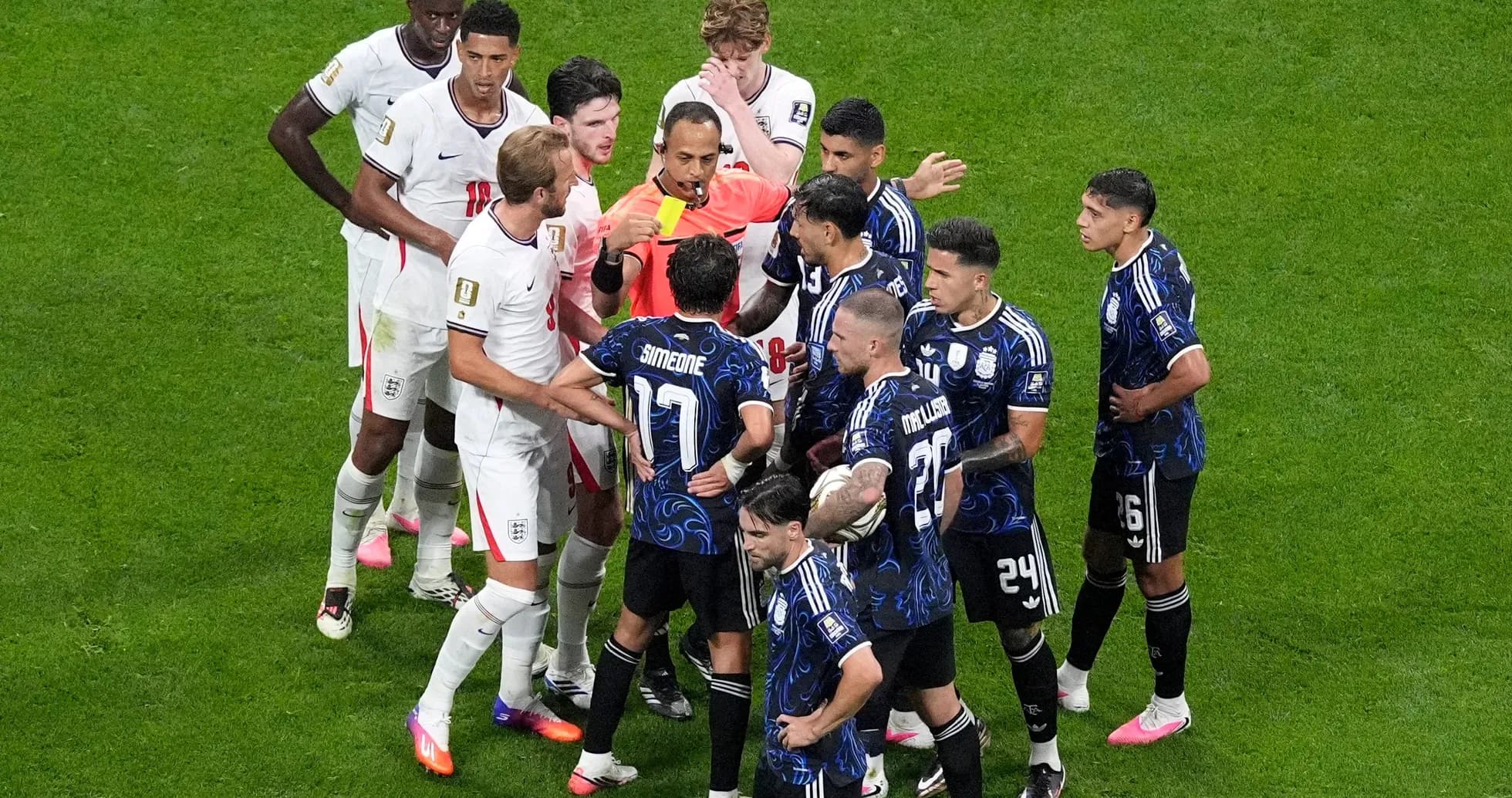
Discipline has been an undercurrent of England’s tournament. Rice, on 2 yellows, embodies that edge. The team’s yellow card timing tells a story of a side that often simmers in the middle phases: 25.00% of their yellows between 31–45 minutes and another 25.00% between 61–75. There is also a flashpoint after half-time – their only red card this World Cup came between 46–60 minutes. Against Argentina’s experienced game management, that volatility was always going to be a risk.
Argentina’s card profile, by contrast, spikes late. Only 11.11% of their yellows arrive in each of the 31–45, 46–60 and 76–90 minute windows, but an extraordinary 44.44% come between 91–105 minutes, with a further 22.22% from 106–120. This is a team that walks the disciplinary tightrope in extra time – but with this semi-final finished in 90, that particular vulnerability never had a chance to surface.
III. Hunter vs Shield, Engine Room vs Enforcer
The marquee duel was always going to be Messi against England’s defensive structure. Messi’s numbers entering this game were absurd: 8 goals, 4 assists, 28 shots (18 on target), 35 dribbles attempted with 24 successful, and 26 key passes from 314 total. He had also missed 2 penalties, a reminder that even his campaign had blemishes, but those failures only sharpened his threat in open play.
England’s “shield” was collective more than individual. Their back line has allowed 8 overall, but with just 2 clean sheets. Stones and Guehi had to step into duels without the safety net of Quansah’s aggression. Rice, meanwhile, carried dual responsibilities: break Argentina’s rhythm and launch England’s own transitions. His 240 passes at 91% accuracy and 15 key passes underline his importance as the first playmaker from deep.
Higher up, the “engine room” battle pitted Bellingham against Paredes and the Argentine interior trio. Bellingham’s 6 goals and 1 assist, plus 21 dribbles attempted (13 successful) and 8 key passes, made him England’s most complete threat between the lines. But Argentina had density in that zone: Paredes anchoring, with Fernandez and Mac Allister ready to swarm, foul and counter.
On the flanks, A. Gordon’s emergence as a creative outlet (1 goal, 3 assists, 6 key passes) offered England a way to isolate N. Molina or N. Tagliafico. Yet Argentina’s capacity to immediately turn any wide turnover into a central break – via Alvarez and Messi – meant every English overload carried a built-in risk.
At the other end, Kane’s profile – 6 goals, 1 assist, 18 shots with 12 on target, and 2 penalties scored from 2 taken – set up the classic “Hunter vs Shield” contest against an Argentina defence that, for all its success, still concedes 1.0 goal per match overall and has kept only 2 clean sheets. C. Romero and L. Martinez had to manage both Kane’s penalty-box craft and his tendency to drop into the same pockets Bellingham wanted to occupy.
IV. Statistical Prognosis and What the 2–1 Tells Us
Heading into this game, the raw numbers leaned slightly toward Argentina. Their attack, at 2.7 goals per match overall, outstripped England’s 2.0, and their defensive record was marginally tighter (1.0 conceded to England’s 1.1). They had also never failed to score, while England had blanked once. Add Messi’s individual output – 8 goals and 4 assists – and the probability landscape tilted Albiceleste.
The final 2–1 scoreline fits that statistical arc. Argentina’s superior attacking ceiling eventually cracked an England side that, for all its structure, has rarely suffocated opponents. England’s own goal, consistent with Argentina’s habit of conceding one per game, underlined that Scaloni’s team is not invulnerable, merely overwhelming.
Following this result, the story of the semi-final reads as the data always hinted it might: England competitive, occasionally brilliant through Bellingham, Gordon and Kane, but outgunned by a side whose offensive volume and individual genius have been unmatched all tournament. Argentina’s journey, built on seven wins from seven and a front line that never stops asking questions, marches on to the 1/2 final; England’s ends here, shaped by a campaign in which their numbers were good – just not quite as ruthless as the team that beat them.