.svg&w=384&q=75 "naujapitch logo")
Germany's Tactical Masterclass: 7-1 Victory Over Curaçao
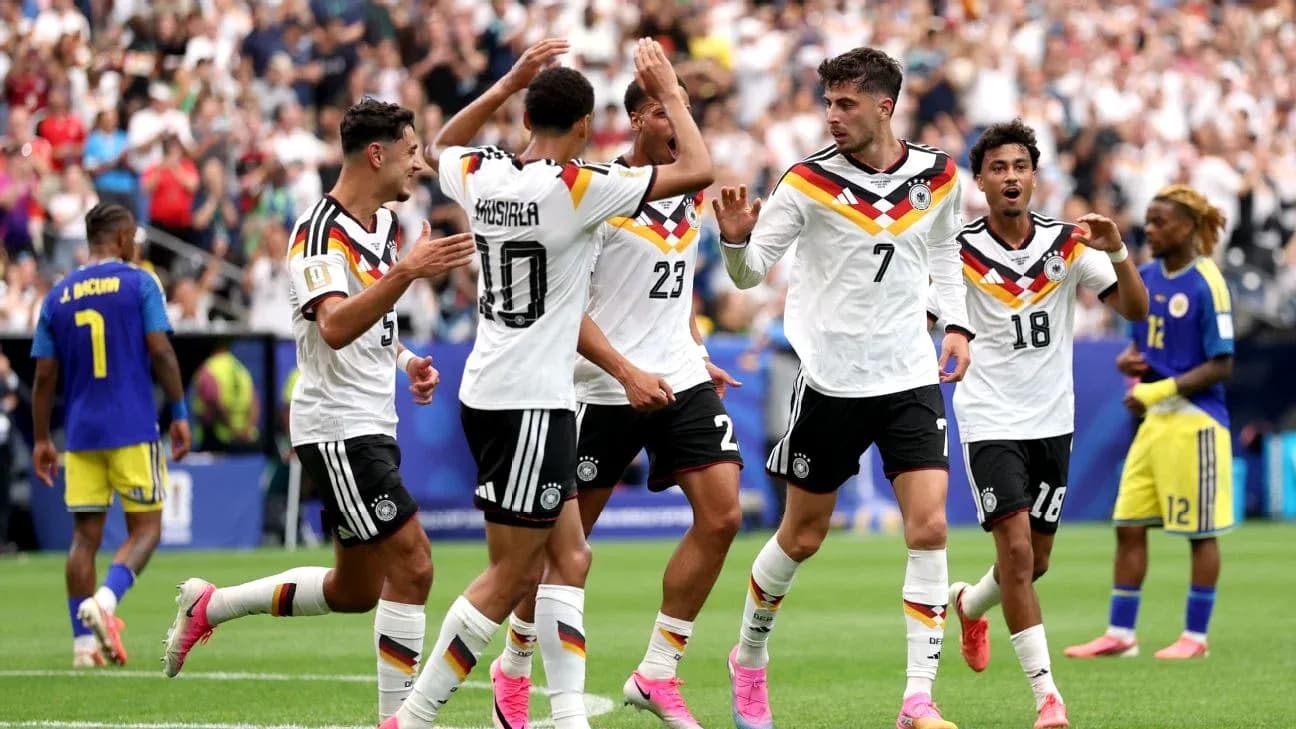
Germany’s 7-1 dismantling of Curaçao at NRG Stadium was a tactical rout built on structural superiority and relentless occupation of the final third. Julian Nagelsmann’s 4-2-3-1 functioned as an aggressive, ball-dominant machine, pinning Dick Advocaat’s 4-3-1-2 deep and stretching it horizontally until the defensive block broke repeatedly. With 65% possession and a 27–8 shot count, Germany controlled both territory and tempo from the opening minutes.
The double pivot of Felix Nmecha and Aleksandar Pavlović gave Germany a stable base, allowing full-backs Joshua Kimmich and Nathaniel Brown to push high and wide. In contrast, Curaçao’s narrow midfield trio and front two were constantly overloaded, unable to close passing lanes between the lines while also tracking the full-backs. The 3-1 half-time score already reflected Germany’s structural dominance; the second half, ending 7-1, simply amplified the same patterns.
In possession, Germany built in a 2-4-4 shape: centre-backs Jonathan Tah and Nico Schlotterbeck plus the double pivot formed the rest defence, while Kimmich and Brown advanced to join Leroy Sané and Florian Wirtz in wide and half-space zones. Jamal Musiala floated centrally behind Kai Havertz, constantly finding pockets between Curaçao’s midfield and defence. The passing figures underline the control: Germany completed 550 of 633 passes (87%), using circulation to patiently move Curaçao’s block before accelerating with vertical combinations.
First Half
The first goal at 6' epitomised the plan. Germany had already established camp in Curaçao’s half; Nmecha arrived from deep, benefiting from Wirtz’s creative positioning to finish Germany’s early pressure. Curaçao’s equaliser at 21', a strike from Livano Comenencia, came against the run of play and highlighted Germany’s only real vulnerability: occasional exposure in transition when both full-backs were advanced. But even that moment did not alter the overall dynamic.
Schlotterbeck’s goal at 38', assisted by Brown, showcased the set-piece and wide-delivery threat created by Germany’s territorial dominance. With eight corner kicks to Curaçao’s one and eight blocked shots, Germany continually forced defending in and around the box. The penalty converted by Havertz at 45+5' was the natural product of sustained pressure and box entries; Curaçao’s back line struggled to manage late runs and rotations, leading to repeated last-ditch interventions.
Second Half
Nagelsmann’s in-game management in the second half maintained intensity rather than protecting the lead. At 47', Musiala’s goal, assisted by Kimmich, came from classic overload dynamics: Kimmich high on the right, combining into the half-space where Musiala could attack a retreating line. Curaçao’s 4-3-1-2 was never able to get proper pressure on the ball in wide zones, leaving the full-backs and attacking midfielders time to pick passes and crosses.
Substitutions did not change Germany’s structure; they refreshed it. At 64', Deniz Undav (IN) came on for Jamal Musiala (OUT), while simultaneously Jeremy Antonisse (IN) came on for Sontje Hansen (OUT) for Curaçao. Undav’s introduction sharpened Germany’s penalty-box presence. Just four minutes later, at 68', Brown’s goal, assisted by Undav, underlined how the new striker attacked space and created lay-off options for overlapping full-backs. Brown’s aggressive high positioning had already been a feature; now it was rewarded.
Germany then rotated their left flank and back line without losing control. At 73', David Raum (IN) came on for Nathaniel Brown (OUT), Antonio Rüdiger (IN) for Jonathan Tah (OUT), and Leon Goretzka (IN) for Felix Nmecha (OUT). Raum replicated Brown’s advanced role, while Rüdiger added security in rest defence. Goretzka’s arrival gave more vertical punch from midfield, but the positional framework remained intact.
The 78' goal, scored by Undav and again assisted by Kimmich, was the product of relentless right-side overloads. Kimmich, now deep into the game but still operating high, repeatedly received in space due to Curaçao’s narrow block and lack of wide pressure. His delivery into central zones allowed Undav to exploit tired defenders. At 83', Waldemar Anton (IN) came on for Joshua Kimmich (OUT), while Gervane Kastaneer (IN) replaced Tahith Chong (OUT) for Curaçao. Germany effectively locked the result while still hunting further goals.
The final strike at 88' – Havertz’s second, assisted by Undav – encapsulated Germany’s vertical superiority. Undav dropped and combined, Havertz attacked the last line, and Curaçao’s centre-backs, already overloaded and fatigued, could not track the movement. By then, Curaçao’s compact 4-3-1-2 had collapsed into a low, reactive block, with minimal ability to progress the ball.
Defensive Performance
Out of possession, Germany were proactive rather than conservative. Their 18 fouls to Curaçao’s 11 show a willingness to counter-press and break transitions early. The high line and aggressive rest defence limited Curaçao to just eight total shots, four inside the box. When Curaçao did break through, Manuel Neuer (Germany) was rarely tested; Germany’s block allowed only two shots on goal, with Neuer making 1 save. At the other end, Eloy Room (Curaçao) faced a barrage: 12 shots on goal, of which he saved 4. The negative goals prevented values for both teams’ keepers reflect how the finishing quality and defensive exposure combined to produce a lopsided scoreline.
Curaçao’s possession of 35% and 336 passes (276 accurate, 82%) suggests they were not completely incapable on the ball, but their structure was unsuited to escaping Germany’s press. With a narrow midfield and front two, their outlets were central, exactly where Germany’s double pivot and centre-backs were strongest. Lacking wide progression and under constant territorial pressure, Curaçao could not convert their limited spells of possession into sustained attacks.
From a statistical verdict, Germany’s xG of 3.91 versus Curaçao’s 0.4 underscores the tactical story: this was not simply clinical finishing, but a systematic creation of high-quality chances. Germany’s 22 shots inside the box, eight blocked efforts, and eight corners reflect near-total dominance in the final third. Curaçao’s four shots inside the box and single corner show how rarely they reached threatening positions.
Overall, Germany’s 4-2-3-1, with advanced full-backs and an elastic attacking midfield line, completely overwhelmed Curaçao’s 4-3-1-2. The match served as a blueprint of controlled, high-possession aggression: structured rest defence, wide overloads, and constant occupation of the box translating directly into a 7-1 scoreline in Houston.