.svg&w=384&q=75 "naujapitch logo")
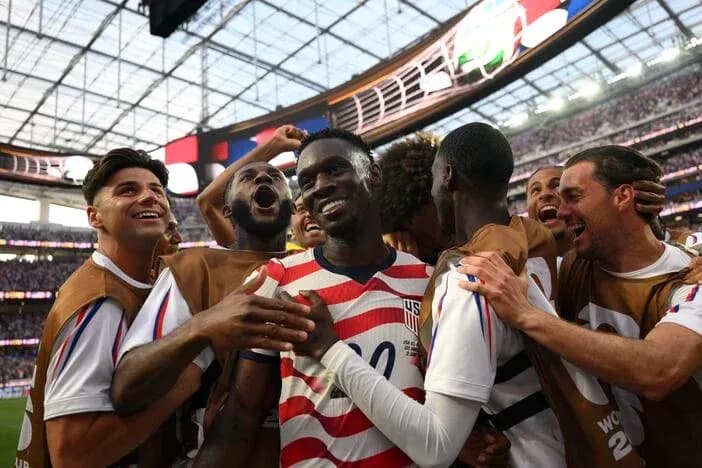
USA Shines in World Cup Opener with Historic Victory
LOS ANGELES — For months, the noise around this World Cup had little to do with football. Politics, soaring ticket prices, immigration snarls, transit headaches across three host nations — Mexico, Canada and the United States — all threatened to drown out the sport.
Then the whistle blew. The tournament started. And the conversation changed.
A U.S. opener for the ages
For a U.S.-based audience, there was only one place to begin: Los Angeles Stadium on Friday night, where the American men delivered what may stand as the most complete World Cup performance in their history.
USA 4, Paraguay 1.
The scoreline alone was historic. Four goals — the most the U.S. men have ever scored in a World Cup match. The manner of it, though, is what will linger.
Folarin Balogun, the striker entrusted with leading the line, justified every ounce of faith. He struck twice, becoming the first U.S. player with a multi-goal game at a World Cup since the inaugural tournament in 1930. Nearly a century of waiting, snapped in one ruthless, confident display.
Behind him, the U.S. controlled the game with a calm authority that has so often deserted them on this stage. Chris Richards, back from the injury that kept him out of both pre-tournament warm-ups, played like he’d never been away. Eighty-three passes attempted. Eighty-three completed. No player has hit that mark in a World Cup match since records began in 1966.
Every build-up seemed to run through him. Every reset, every switch of play, every moment the U.S. needed composure. Richards provided it.
There was one cloud. Christian Pulisic, the team’s star forward and emotional barometer, did not emerge for the second half. A calf issue forced him off at the break, and he walked gingerly to the team bus afterward. His status remains uncertain — a single line on the injury report that could reshape the entire American campaign.
From front to back, though, the U.S. sparkled. They pressed, they combined, they finished. It was bold. It was assured. It was everything this generation has promised.
But it was still only game one.
Group D flips on its head
On Saturday, the Americans got a clear look at the rest of their group. What they saw will sharpen the stakes of the week ahead.
Turkey arrived with the pedigree. A squad stacked with players from Europe’s elite leagues, headlined by Real Madrid’s Arda Güler and Juventus attacker Kenan Yildiz, carried the aura of Group D favorites.
Australia tore that up.
In one of the early shocks of the tournament, the underdog Socceroos beat Turkey 2-0, a result that instantly rewires the group dynamic. Suddenly, Friday’s USA–Australia clash is enormous. If the U.S. win, they seize control of Group D and place one foot firmly in the knockout rounds, likely in a favorable position.
Drop points, and that dominant opener starts to feel more like a missed opportunity than a launchpad.
Scotland’s moment, Brazil and Morocco held
Elsewhere, the World Cup’s early days have already delivered their customary jolts.
Scotland, back at a World Cup for the first time in 28 years, sit top of Group C after beating Haiti. On paper, that result might look routine. In context, it’s anything but.
They share the group with Brazil — five-time world champions — and Morocco, a modern powerhouse and recent World Cup semifinalist. Those two heavyweights met and cancelled each other out in a 1-1 draw, leaving Scotland, improbably, looking down at giants. For now, at least.
That single point between Brazil and Morocco may yet define the group. It also gives Scotland the rarest of gifts on this stage: a little breathing room.
Qatar’s first point, a heavyweight draw
The theme of tight margins continued on Saturday when Qatar and Switzerland finished 1-1. For Qatar, that solitary point carries real weight. This is only their second World Cup; in 2022, as hosts, they lost all three matches. Their first-ever World Cup point, earned away from home and under far less favorable circumstances, marks a quiet but significant step.
On Sunday, Group F produced a more expansive spectacle. The Netherlands and Japan, both billed as heavyweights in the section, traded blows in a 2-2 draw. Neither side blinked. Neither side backed off. Two points dropped or one point gained? That answer will come later in the group.
Curaçao’s 17 minutes of belief
Then there was Curaçao.
Population: 158,000. The smallest country ever to appear at a World Cup. Paired with Germany, a nation whose name is practically shorthand for this tournament.
Germany did what Germany so often do: scored early. Order restored, or so it seemed. But Curaçao hit back, leveling the match and, for 17 glorious minutes, living in a 1-1 world where anything felt possible.
Those minutes will be remembered on the island for a long time, even if the final score will look all too familiar to German fans: 7-1. A famous World Cup scoreline, resurfacing with a very different story attached.
Politics at the door, Iran finally arrives
Not every storyline has been confined to the pitch.
On Monday, Iran face New Zealand at Los Angeles Stadium in a match that almost never felt guaranteed. After the United States and Israel attacked Iran in February, speculation swirled about whether the Iranian team would even participate in this World Cup.
Iran had originally planned to base its training camp in Tucson, Arizona. Instead, citing ongoing hostilities and security concerns, the team shifted to Tijuana, Mexico. The U.S. government has restricted their entry to the country, allowing the squad to cross the border only on the day before each of their three group-stage matches.
They will arrive late, play, then leave. A World Cup campaign conducted on a tightrope.
New Zealand, by contrast, come in with far less geopolitical baggage but with the same prize on offer: a winning start that could define their tournament.
Mbappé, Messi, and the chase for history
Tuesday belongs to the superstars.
France open their World Cup against Senegal in Group I, with Kylian Mbappé again cast as the face of a nation and perhaps of the tournament itself. Every touch he takes will be dissected, every run tracked. Senegal, hardened by years of top-level competition and tournament experience, will not play the supporting role willingly.
On the same day, the defending champions step onto the stage. Argentina and Lionel Messi begin their bid for back-to-back titles against Algeria in Group J. The task is clear and daunting: join the rarest company in World Cup history.
Only two nations have ever defended their crown — Italy in 1938, Brazil in 1962. That is the scale of what Argentina are chasing, and of what Messi, deep into the final chapters of his international career, is trying to add to an already unmatched legacy.
Five weeks of football stretch ahead. Records have already fallen. Underdogs have already bitten. Giants have already stumbled.
The U.S. have fired a warning shot. Now the real question begins: who can sustain this first burst of brilliance, and who will still be standing when the noise, on and off the field, finally dies down?