.svg&w=384&q=75 "naujapitch logo")
Everton's Tactical Collapse in 1-3 Defeat to Sunderland
Everton’s 1-3 home defeat to Sunderland at Hill Dickinson Stadium unfolded as a tactical collapse after a largely controlled first hour. Both sides mirrored each other in a 4-2-3-1, but the visitors adapted better to game-state, used their bench more aggressively, and turned marginal underlying numbers into a decisive late surge.
Everton’s structure under Leighton Baines was clear: Jordan Pickford behind a back four of Jake O’Brien, James Tarkowski, Michael Keane and Vitaliy Mykolenko, with Tim Iroegbunam and James Garner as a double pivot. Ahead of them, M. Rohl, Kiernan Dewsbury-Hall and Iliman Ndiaye supported Beto. The idea was to build with patience (406 passes, 346 accurate, 85%) and progress through central overloads, with Dewsbury-Hall and Rohl drifting inside to form a box with the pivots.
That plan worked in the first half. Everton’s 49% possession was territorially tilted in their favour, reflected in 10 total shots to Sunderland’s 7 and a higher xG of 1.07 to 0.73. They generated 6 shots inside the box, using Beto’s presence to pin the Sunderland centre-backs and allow Rohl and Ndiaye to attack second balls. The opening goal on 43 minutes captured the structure: M. Rohl arrived from the right half-space, fed by Michael Keane, whose step into midfield was enabled by Iroegbunam dropping to cover. It was a classic centre-back progression into the second line, exploiting Sunderland’s reluctance to push a midfielder onto Keane.
Out of possession, Everton tried to defend in a mid-block 4-4-1-1, with Ndiaye often sliding alongside Beto to screen passes into Granit Xhaka and N. Sadiki. The disciplinary data shows the strain this system came under as Sunderland grew: three Everton yellow cards, all for “Foul”, to Sunderland’s clean sheet on the card front. The bookings for Tim Iroegbunam (25'), Jake O’Brien (47') and James Garner (90+6') underline how often Everton’s midfield and right side were forced into late interventions as Sunderland began to find pockets.
Sunderland, in the same 4-2-3-1, were initially more conservative. Regis Le Bris set R. Roefs behind a back four of Lutsharel Geertruida, Nordi Mukiele, Omar Alderete and Reinildo Mandava, with Xhaka and Sadiki shielding. T. Hume, E. Le Fee and N. Angulo supported B. Brobbey. Their 51% possession (430 passes, 365 accurate, 85%) was more about control than penetration in the first half; they took only 7 shots in total, but 5 came inside the box, indicating a focus on quality over volume.
The tactical turning point came after the interval. Sunderland’s equaliser on 59 minutes, B. Brobbey finishing from an E. Le Fee assist, came from a more assertive press and quicker vertical play. As Everton’s double pivot tired, Xhaka and Le Fee started to receive between the lines, pulling Tarkowski and Keane into uncomfortable zones. The goal reflected Sunderland’s willingness to commit Brobbey centrally against an exposed back line once the first line of pressure was bypassed.
Le Bris then used the bench as an attacking weapon. At 60', T. Hume (OUT) was replaced by C. Talbi (IN), adding a more direct threat on the flank. On 77', he executed a triple change: N. Angulo (OUT) for C. Rigg (IN), N. Sadiki (OUT) for H. Diarra (IN), and Brobbey (OUT) for W. Isidor (IN). These moves re-energised the front four, increased running power between the lines, and crucially introduced fresh ball-carriers (Rigg, Diarra) and a new depth runner in Isidor.
Baines’ response was more reactive and ultimately destabilising. At 73', T. George (IN) replaced T. Iroegbunam (OUT) and T. Barry (IN) replaced Beto (OUT), effectively sacrificing some central control for extra attacking width and pace. While this aimed to chase a winner at 1-1, it left Garner increasingly isolated as the single true stabiliser in front of the defence. Later, at 88', S. Coleman (IN) came on for J. O’Brien (OUT) and D. McNeil (IN) for M. Rohl (OUT), but by then Sunderland’s momentum was established and these changes were more about chasing the game than reshaping its logic.
Sunderland’s second goal on 81 minutes, scored by E. Le Fee and assisted by C. Rigg, was emblematic of the tactical swing. Everton’s weakened central structure allowed Rigg to receive and combine in the half-space, with Le Fee arriving late to exploit the gap between the lines. The move highlighted Sunderland’s superior use of their advanced midfielders once the original double pivot of Iroegbunam and Garner had been broken.
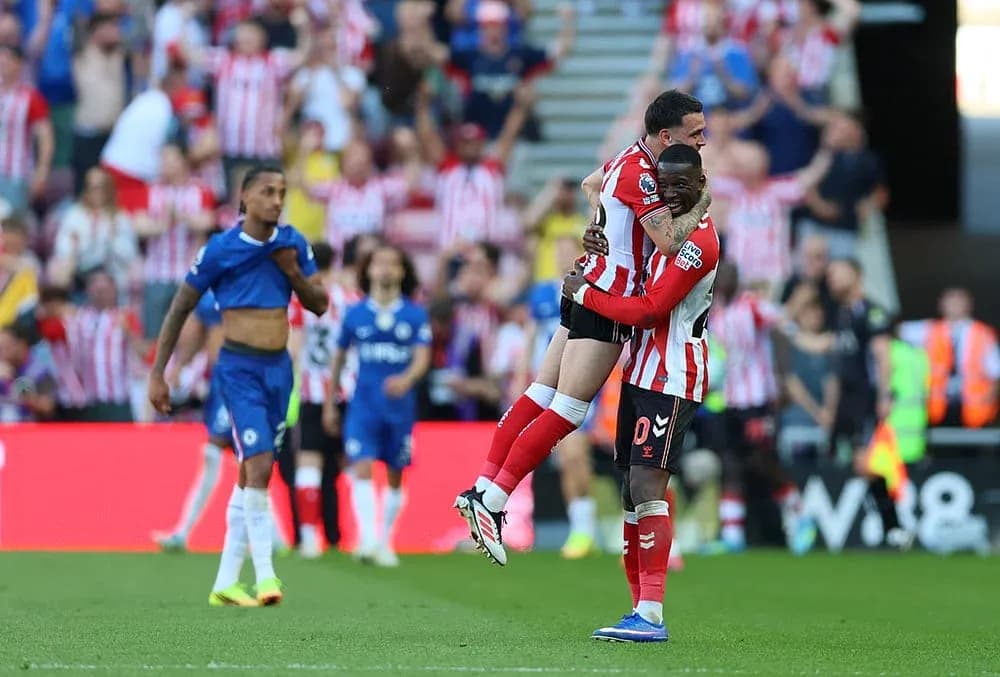
The third goal, W. Isidor scoring at 90' from an H. Diarra assist, punished Everton’s stretched, transition-prone shape as they chased an equaliser. With the home side committing numbers forward and their rest defence compromised, Diarra’s ability to carry and release into space found Isidor attacking the last line, turning a narrow deficit into a comprehensive 1-3 away win.
From a statistical verdict, the game was closer than the score suggests. Everton led in total shots (10 vs 7), shots on goal (4 vs 3), and xG (1.07 vs 0.73), and they forced R. Roefs into 3 saves, compared to 0 for Pickford. Sunderland’s goalkeeper also matched Pickford’s goals prevented at 0.02, indicating that neither keeper dramatically overperformed. The difference lay in game management and tactical adaptation: Sunderland turned a marginal attacking profile into three highly efficient, mostly box-based chances, while Everton’s structural changes eroded their Defensive Index. The higher Everton foul count (14 vs 9) and their three yellow cards, all for “Foul”, underline how the home side increasingly defended on the edge as Sunderland’s fresh legs and reconfigured 4-2-3-1 seized control of the final third.