.svg&w=384&q=75 "naujapitch logo")
Everton vs Sunderland: A Crossroads Fixture in the Premier League
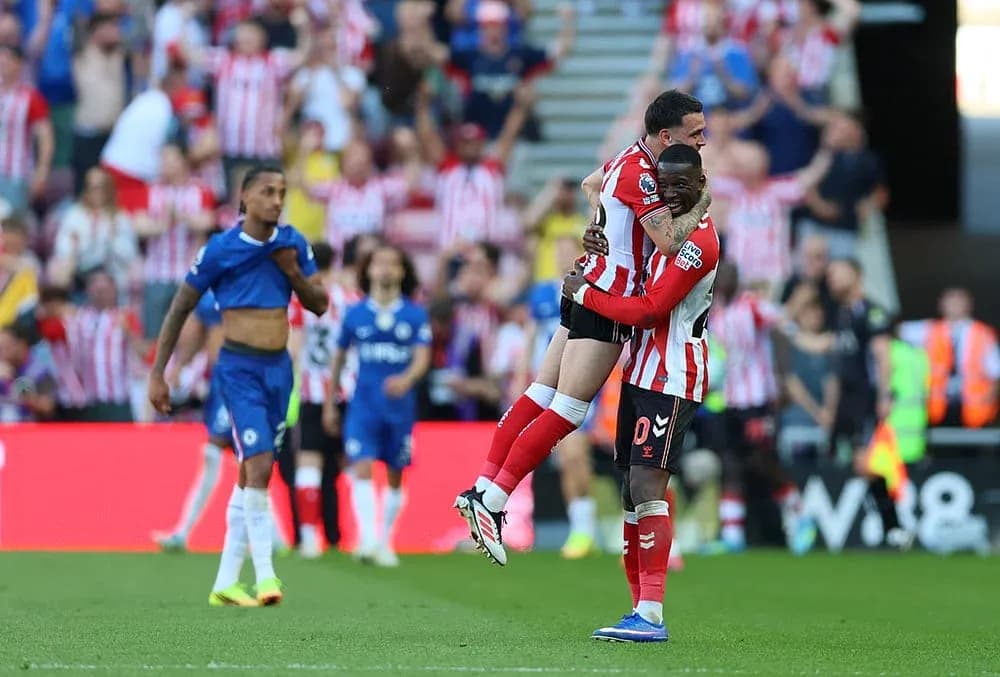
Hill Dickinson Stadium had the feel of a crossroads fixture, and the table confirms it. Following this result, Everton sit 12th on 49 points with a goal difference of -2, Sunderland 9th on 51 with a goal difference of -7. Both have now completed 37 league matches in the 2025 Premier League season, and Sunderland’s 3-1 away win in Liverpool underlines the subtle but decisive differences in their seasonal DNA.
Everton came into this game as a side that mirrors its own numbers: balanced, often on a knife-edge. Overall they average 1.3 goals scored and 1.3 conceded per match, with almost identical profiles at home (1.4 for, 1.4 against). Sunderland, by contrast, are a contradiction: a top-half team with a negative goal difference, scoring 1.1 goals per match overall while conceding 1.3. At home they look solid (1.3 for, 1.1 against); on their travels they become something wilder and more fragile, scoring 0.9 and conceding 1.5. Yet on this particular afternoon, it was that away volatility that turned into cutting edge.
Both coaches mirrored each other on the whiteboard, lining up in 4-2-3-1. Leighton Baines’ Everton were built on a familiar spine: J. Pickford behind a back four of J. O’Brien, J. Tarkowski, M. Keane and V. Mykolenko. Ahead of them, J. Garner and T. Iroegbunam formed the double pivot, with M. Rohl, K. Dewsbury-Hall and I. Ndiaye supporting Beto.
Across from them, Regis Le Bris trusted his most-used shape. Sunderland’s 4-2-3-1 had R. Roefs in goal, a back line of L. Geertruida, N. Mukiele, O. Alderete and R. Mandava, with G. Xhaka and N. Sadiki screening. T. Hume and E. Le Fée flanked N. Angulo behind lone forward B. Brobbey.
The absentees told their own tactical stories. Everton were without J. Branthwaite, I. Gueye and J. Grealish – three players who would all have had a strong claim to start. Branthwaite’s hamstring injury removed a left-sided pillar, placing greater responsibility on Keane and Mykolenko in build-up and in duels. Gueye’s absence stripped Baines of his most natural ball-winner in the six space, pushing Iroegbunam into a role that demanded maturity against Sunderland’s rotating tens. Grealish’s foot injury deprived Everton of a proven ball-carrier and chance creator between the lines; his season return of 2 goals and 6 assists in 20 appearances had been a rare injection of final-third craft.
Sunderland’s list of missing players was equally significant. D. Ballard, out due to suspension after a red card, removed a physically dominant centre-back who had contributed 2 goals and 24 successful blocks across the season. The injuries to S. Moore, R. Mundle and B. Traore cut into depth and flexibility, particularly in wide and rotational roles. Yet Le Bris compensated with a settled axis: Mukiele and Alderete as the central pairing, Mandava at left-back despite his own disciplinary history – 1 red card and 7 yellows – and the experienced Xhaka as the metronome.
Discipline and card risk were always going to shape the tone. Heading into this game, Everton’s yellow-card profile skewed towards the second half: 20.83% of their yellows arrived between 46-60 minutes and another 20.83% between 76-90, with a further 16.67% in the 91-105 window. Their reds had an unmistakable late-game tilt too, with 50.00% shown between 76-90. Sunderland’s bookings also peaked after the break, with 23.38% of their yellows between 46-60 and 18.18% between 61-75. In a match that finished 3-1 to the visitors, that shared tendency for second-half cards hinted at a contest that would grow increasingly stretched and emotional as Everton chased and Sunderland countered.
No individual embodied Everton’s edge-of-control identity more than J. Garner. Officially listed as a defender in the seasonal data but operating here as a deep midfielder, he arrived at this fixture as the league’s top yellow-card collector with 12 bookings, yet also as one of its most productive creators: 7 assists, 52 key passes and 1,738 completed passes at 87% accuracy. His duel volume – 329 contests, 200 won – and 116 tackles underline a player who lives permanently on the fault line between control and chaos. In this 4-2-3-1, Garner’s responsibility was double-edged: progress the ball under pressure and put out fires whenever Sunderland broke through Iroegbunam.
On the other side, Sunderland’s “engine room” was a double act. E. Le Fée entered the day with 5 goals and 6 assists, 49 key passes and 3 penalties scored from 4 taken – that single miss a reminder that even their set-piece specialists are not flawless. Alongside him, Xhaka had quietly assembled 6 assists, 1,753 passes at 83% accuracy, and a defensive line of 50 tackles, 20 successful blocks and 29 interceptions. Together they formed the heartbeat of Le Bris’ plan: Le Fée drifting into pockets between Everton’s lines, Xhaka anchoring transitions and dictating tempo.
If Garner was Everton’s hunter in midfield, Sunderland’s primary shield – and occasional weapon – out wide was T. Hume. He arrived as one of the league’s most carded defenders with 9 yellows, but also with 64 tackles, 12 successful blocks and 25 interceptions. His duel count (324, with 172 won) framed him as the natural counter to Everton’s left-sided creativity from Mykolenko and Ndiaye, and to any rotations involving Dewsbury-Hall drifting into the half-space.
In pure statistical terms, Everton’s home profile suggested a tight contest. Heading into this game, they had scored 26 and conceded 27 at Hill Dickinson Stadium, with 6 home wins and 6 clean sheets overall. Sunderland’s away numbers – 17 scored, 28 conceded, 5 wins in 19 – painted them as vulnerable travellers. Yet their biggest away win of 1-3 hinted at a capacity to explode on the break if given space, exactly the pattern that a 1-3 scoreline ultimately reflects.
From an xG and defensive solidity standpoint, the pre-match indicators tilted marginally towards Everton controlling territory but not necessarily the scoreboard. Their habit of conceding as often as they score, combined with Sunderland’s late-card and late-pressure profile, made a chaotic second half more likely than a controlled home procession. Sunderland’s flexibility – having used five different formations over the season – contrasted with Everton’s near-exclusive reliance on 4-2-3-1, giving Le Bris more levers to pull once the game state shifted.
Following this result, the narrative is clear. Everton’s structural consistency and individual quality in players like Garner and Dewsbury-Hall have not yet translated into scoreboard control, especially when key absentees strip away depth. Sunderland, meanwhile, continue to defy their negative goal difference with timely, surgical away performances, built on the rhythm of Le Fée and Xhaka and the edge of defenders like Hume and Mandava. The numbers suggested a contest balanced on fine margins; the 3-1 scoreline underlines that Sunderland, on this day, were far more ruthless in exploiting them.