.svg&w=384&q=75 "naujapitch logo")
Declan Rice: England's Key Player Facing Injury Concerns
Aaron Cresswell calls Declan Rice “a freak of nature”. Watching England’s vice‑captain stagger through his 63rd game of the season, it no longer sounds like a throwaway line. It feels like a warning.
Since the start of 2020‑21, Rice has played 360 matches for club and country. West Ham’s European marathons, England’s tournament runs, Arsenal’s Premier League and Champions League pushes – he has carried the load for all of them. The temptation with a player like that is simple: keep picking him and hope the engine never blows.
On Wednesday in Yokohama, it spluttered.
A rare off‑day in the chaos
England beat Croatia 4-2 in a wild World Cup opener, but Rice was a shadow of his usual self. The midfield was stretched, the structure wrong, and the space between Rice and Elliot Anderson yawning wide during a deeply uneasy first half.
Rice dropped too deep. Luka Modric dragged him around. England’s screen in front of the defence looked full of holes. For a player whose game is built on control, interceptions and clean distribution, this was unfamiliar territory.
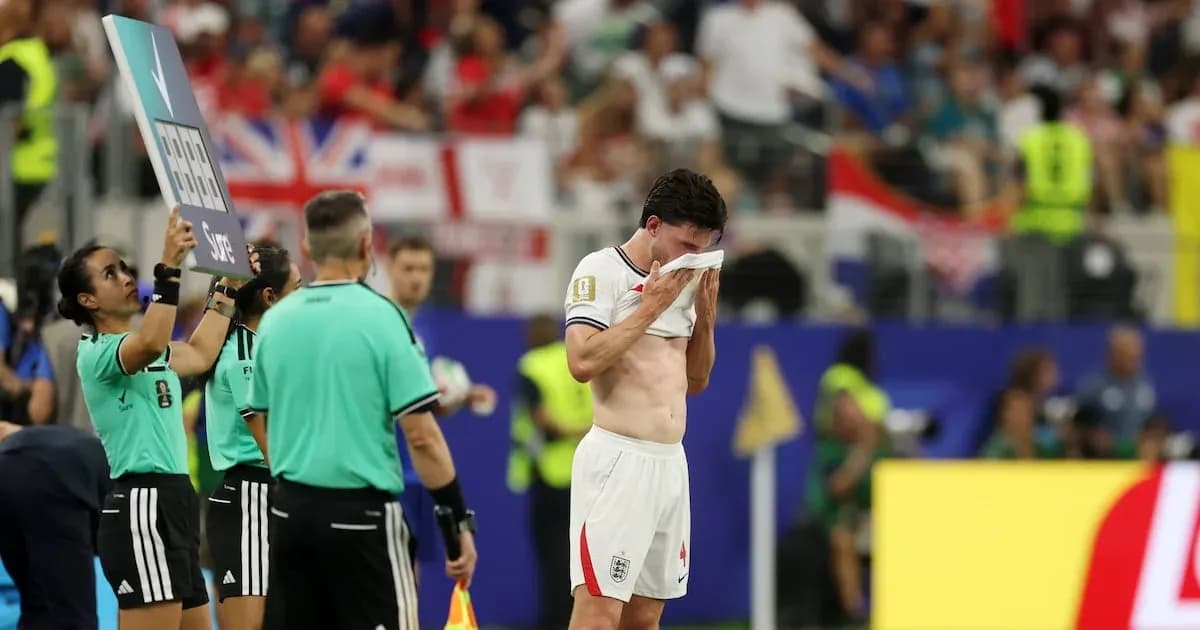
Thomas Tuchel tried to smooth it over afterwards. He spoke of “some unusual ball losses” from Rice, a diplomatic way of saying his midfield anchor was miles off his normal level. The bigger concern came in the 72nd minute, with England clinging to a 3-2 lead, when Rice signalled that he could not continue.
Rice does not come off in those situations. Not when there are tackles to be made and counterattacks to be stopped. Yet here he was, feeling discomfort in his lower back and upper hamstring, asking to be withdrawn when England needed him to slam the door.
Tuchel called it precautionary. Rice insisted he will be ready for Ghana on Tuesday. England will want to believe him. They cannot afford not to.
No like‑for‑like safety net
Strip Rice out of this team and the whole plan starts to wobble. For six years, England have rarely looked convincing without him. There is no direct replacement in this squad, no other midfielder with the same mix of ball‑winning, physicality, discipline and set‑piece delivery.
Kobbie Mainoo is a joy in possession, brave and incisive, but he does not yet have Rice’s frame or defensive presence. Jordan Henderson offers experience and leadership, but at 36 he was overlooked when England wanted to keep the tempo high against Croatia. Tuchel clearly sees him as a situational option now, not the heartbeat of a pressing game.
When Rice limped off, Tuchel’s first move was to pull Jude Bellingham back. On paper, it made sense. In practice, it almost cost England. Bellingham’s instincts drag him towards the ball and towards goal; the space behind him opened up, and Croatia sensed weakness. The experiment lasted eight minutes.
That short, frantic spell may prove important. It pushed Tuchel towards a different solution – one that has been hiding in plain sight.
Reece James, the emergency 6
Djed Spence came on for Bellingham. Reece James stepped away from right back and into midfield, into a role he has grown increasingly comfortable with at Chelsea over the last 18 months.
Suddenly England looked more secure.
James is not new to this. He played in midfield during a loan at Wigan in 2018-19 and, under Enzo Maresca at Chelsea, was pushed permanently into central areas. It was a move that raised eyebrows at first, not least from Tuchel himself, who had always viewed James as an elite right back.
Maresca persisted. He trusted James’s reading of the game, his strength in duels, his ability to punch passes through the lines. The payoff was clear enough when Chelsea beat Paris Saint‑Germain in last year’s Club World Cup final with James patrolling the middle.
It did not stop there. James was outstanding alongside Moisés Caicedo in Chelsea’s 3-0 dismantling of Barcelona last November, then dominated Rice when Arsenal visited Stamford Bridge five days later. That performance did not go unnoticed.
“Reece James can play in the 6 because he does on a high level for Chelsea,” Tuchel said when he named his World Cup squad, using that as part of his justification for leaving Adam Wharton and Alex Scott at home. He has built this group around versatility. Now he may be forced to cash in on that idea.
If Rice’s minutes must be managed, James is the most convincing stand‑in. He can tackle, he can pass, he can marshal a press. He understands the position.
But there is a catch.
A solution with its own risk
James’s fitness record is a permanent asterisk. Hamstring problems have stalked his career, the latest in March ruling him out for almost two months. Chelsea have learned to handle him carefully. England must do the same.
Tino Livramento’s calf injury, which forced Tuchel to call up Trevoh Chalobah instead, has already thinned the options at right back. James is the first choice in that role. He cannot start every game and then be asked to soak up extra minutes as a midfield firefighter if Rice is struggling.
Tuchel has tried to protect his squad. England flew early to Florida for a pre‑tournament camp in the sun, the schedule shaped around conditioning and recovery. Even that had its complication: Rice joined late after playing in the Champions League final for Arsenal. He just kept going, as he always does.
Now the bill may be arriving.
Tuchel does have structural tweaks up his sleeve. If James steps into midfield, Spence, Ezri Konsa or Jarell Quansah can slot in at right back. Konsa could tuck in as a third centre back alongside John Stones and Marc Guéhi, with Nico O’Reilly surging forward from left back to give England width and thrust on the opposite flank.
On the tactics board, it works. On the pitch, it all depends on whether James’s body holds and whether Rice can keep defying the numbers.
The cost of carrying everything
If England reach the World Cup final and Rice is not given a rest, he will finish the season on 70 appearances for club and country. Seventy. For a midfielder who covers every blade of grass, who is asked to be both shield and launchpad, the demands are extreme.
England’s reliance on him has been total. He is the default option, the constant, the safety blanket. When the game tilts and the pressure rises, managers look for him. Team‑mates look for him. He rarely says no.
But as he walked off against Croatia, clutching his back and hamstring, England were forced to confront a question they have dodged for years.
What happens if the freak of nature finally hits his limit?