.svg&w=384&q=75 "naujapitch logo")
Cristiano Ronaldo and Portugal's World Cup Dilemma
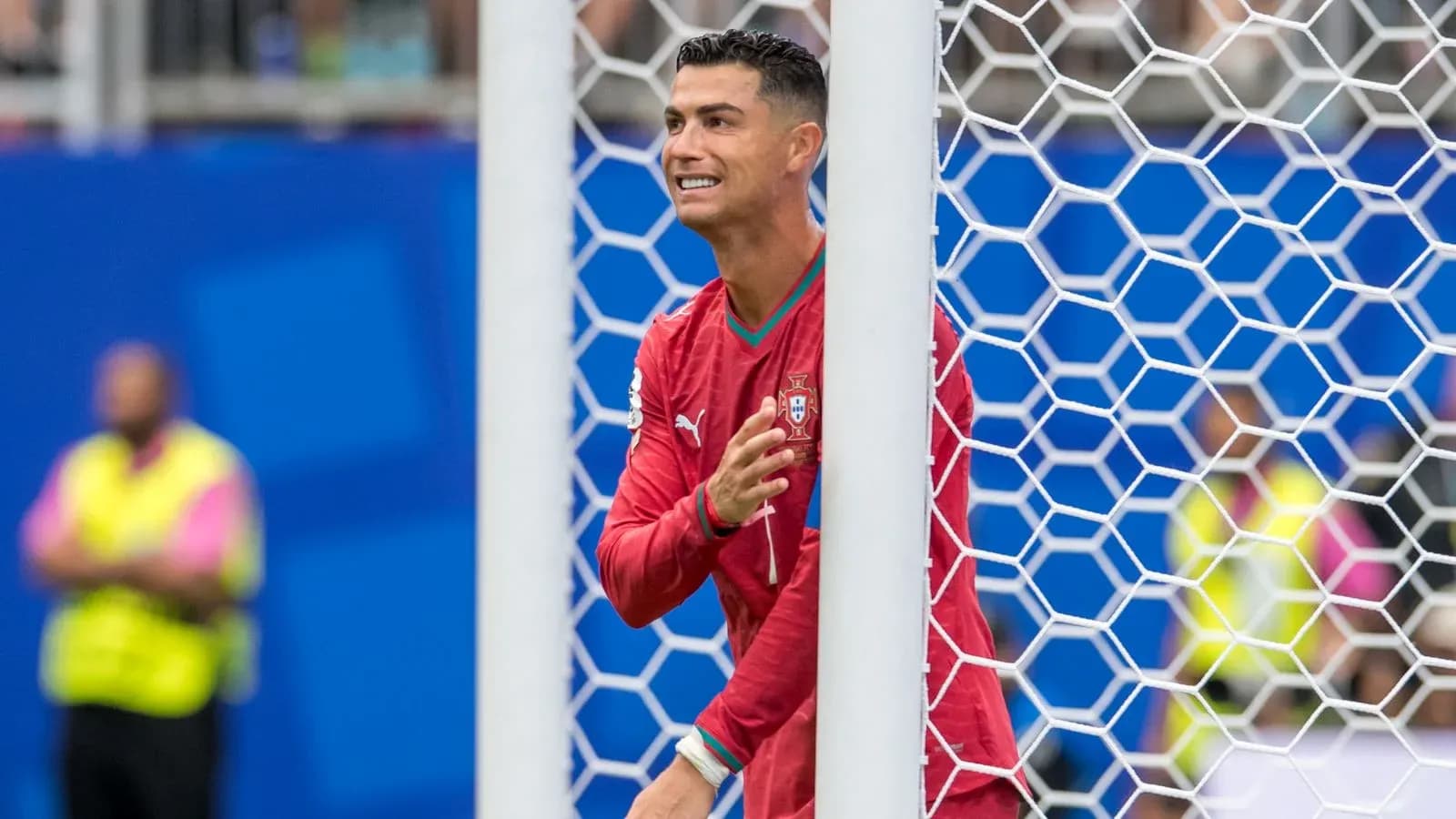
Cristiano Ronaldo walked out in Houston chasing ghosts and numbers.
A record-extending sixth World Cup.
Age 41.
Captain’s armband on.
The night before, the new royalty of the game had already made their mark. Kylian Mbappe scored twice. Erling Haaland found the net. Lionel Messi, the old rival who has shadowed every step of his career, produced a hat-trick.
Ronaldo’s response?
Twenty-nine touches.
One shot on target.
No goals.
Portugal laboured to a draw against DR Congo, and as so often happens, the story circled back to one man. His goalless run in major international tournaments now stretches to 10 matches. Messi, across his last 10, has nine. The contrast is brutal.
In Houston, Ronaldo had fewer touches than almost everyone in Portugal’s starting XI. Only Bernardo Silva, withdrawn at half-time, saw less of the ball. For a player who once bent entire games around his will, the numbers now paint a very different picture.
Martinez stands by his man
Roberto Martinez did not flinch. If anything, he doubled down.
"It makes no sense to get the best goalscorer in world football out in a game that you need goals," he insisted afterwards. To Martinez, Ronaldo’s value is not just in the finish, but in the gravity he carries. The way he attracts defenders. The space he supposedly opens up for others. The experience in the box that can’t be quantified by a heatmap.
"And every player has a responsibility or a piece of quality on the pitch. And clearly when you look for goals, you need to have Cristiano."
It is a bold defence when you consider what Martinez has at his disposal. Bernardo Silva, Bruno Fernandes, Pedro Neto, Vitinha, Joao Neves, Joao Cancelo, Nuno Mendes. A creative core that most international coaches would build a decade around. Some of the best in the world in their roles, all stationed behind a striker who no longer moves as he once did, no longer finishes as he once did, no longer influences games as he once did.
So are they failing him? Or is he now failing them?
Are Portugal really starving Ronaldo of service?
Look at the numbers, and the picture is complicated.
Across each of their last 10 competitive international matches, Ronaldo, Messi, Mbappe and Harry Kane have all been under the same kind of pressure: deliver, or carry the criticism. Among that group, only Kane has taken fewer shots than Ronaldo. Kane has 30 efforts in that stretch; Ronaldo sits just above him.
Expected goals offers another lens. Ronaldo’s xG over those 10 games is 5.36. Kane’s is 7.15. Mbappe’s climbs to 8.76. Data for Messi isn’t available in this sample, but the pattern is clear enough: the quality of chances falling Ronaldo’s way is lower.
That leads straight back to Martinez’s argument. Is the service good enough? Is the structure right?
With Ronaldo on the pitch in those 10 matches, Portugal’s total xG sits at 12.76. England, with Kane, generated 16.39. France, with Mbappe, surged to 21.99. Per 90 minutes, that breaks down to 1.32 for Portugal, 1.34 for England and a hefty 1.72 for France.
Go another layer down and the gap widens. Ronaldo’s xG from chances created by team-mates in this barren run stands at 2.55. Kane’s equivalent is 3.2. Mbappe’s is a towering 5.78.
So yes, even with all that talent around him, Ronaldo is not being served with the same volume or quality of chances as the other elite forwards. For long stretches, he is feeding on scraps. The numbers back that up.
But they also expose another uncomfortable truth.
When the chances do come, he’s not the same finisher
The easy argument from the creative unit behind him would be simple: we may not be creating as much as France or England, but we’ve created enough. A prime Ronaldo would have cashed in by now.
The evidence supports them.
Ronaldo’s post-shot xG – which measures how good his attempts are after he strikes the ball – is damning. While Kane and Mbappe have outperformed their chances, with Kane at +2.05 and Mbappe at +2.25, Ronaldo is at -2.8.
In plain terms, he has scored nearly three goals fewer than expected from the shots he has taken. For a man once regarded as the game’s deadliest finisher, that is not a blip. It is a clear decline.
The eye test matches the data. The instincts are half a second slower. The angles he used to find have narrowed. The ruthless certainty that once followed every run into the box has faded into hesitation.
And when he isn’t scoring, Ronaldo no longer compensates in other areas.
A legend standing still in a moving game
Against DR Congo, his touch map told its own story. Sparse involvement. Small pockets of activity. Most of it clustered in isolated positions on the left, where Neto and Mendes should have been stretching the game, not working around their centre-forward.
Ronaldo has never been Kane, dropping deep to knit play together. He has never been Messi, drifting into midfield to dictate tempo. That was never the deal. The bargain was simple: build around him, and he will win you games.
Now, though, his limited movement and rigid positioning are starting to choke Portugal’s attacking structure. He does not roam enough to drag defenders out of zones. He does not link play enough to justify his minimal involvement. When the goals dry up, the rest of his game does not fill the void.
Martinez cannot tear up his entire creative unit to accommodate one man, even if that man is Cristiano Ronaldo. Yet he also refuses to remove him from the firing line, clinging to the belief that one chance, one moment, will reset the narrative.
That tension sits at the heart of Portugal’s World Cup campaign.
The golden generation’s gamble
This is supposed to be a golden era for Portuguese football. A squad brimming with Champions League regulars, technicians and match-winners. Depth in almost every line. On paper, a team built to go deep into tournaments.
But every system choice, every attacking pattern, still bends around a 41-year-old whose numbers are sliding and whose presence, once liberating, now feels like a tactical constraint.
At some point, the conversation that everyone has been dodging will have to happen. Not in the abstract, not about “respect” or “legacy”, but about what gives Portugal the best chance of winning knockout games right now.
Martinez has nailed his colours to the mast. He believes that chance still includes Cristiano Ronaldo.
If he is wrong, this generation may not be remembered for what it won, but for what it sacrificed to keep a legend on the pitch.