.svg&w=384&q=75 "naujapitch logo")
Cremonese's Tactical Domination Over Pisa in Serie A
Cremonese’s 3-0 win over Pisa at Stadio Giovanni Zini was a textbook example of how structure, tempo control and game-state management can completely suffocate an opponent. In a Serie A Round 36 fixture, Marco Giampaolo’s 4-4-2 dominated both territory and possession, exploiting Pisa’s indiscipline and numerical inferiority to convert a 1-0 half-time lead into a commanding full-time scoreline of 3-0.
Executive Summary
From the opening whistle, Cremonese imposed a high-possession, positionally disciplined 4-4-2 against Pisa’s 3-5-2. With 77% of the ball and a 10–0 shot count, the hosts turned structural superiority into total control. Pisa’s defensive line collapsed under pressure and, crucially, under its own disciplinary failures: two red cards and four yellows left Oscar Hiljemark’s side defending in survival mode. Goals from J. Vardy (31'), F. Bonazzoli (51') and substitute D. Okereke (86') reflected not just attacking efficiency but a complete territorial lock on the game.
Scoring Sequence & Disciplinary Log
Discipline log (chronological, exact reasons):
- 16' Rosen Bozhinov (Pisa) — Foul
- 23' Rosen Bozhinov (Pisa) — Foul
- 23' Rosen Bozhinov (Pisa) — Foul (Red Card)
- 49' Arturo Calabresi (Pisa) — Foul
- 57' Felipe Loyola (Pisa) — Foul (Red Card)
- 89' Malthe Højholt (Pisa) — Foul
Totals: Cremonese: 0, Pisa: 4 yellow cards, 2 red cards, Total cards: 6.
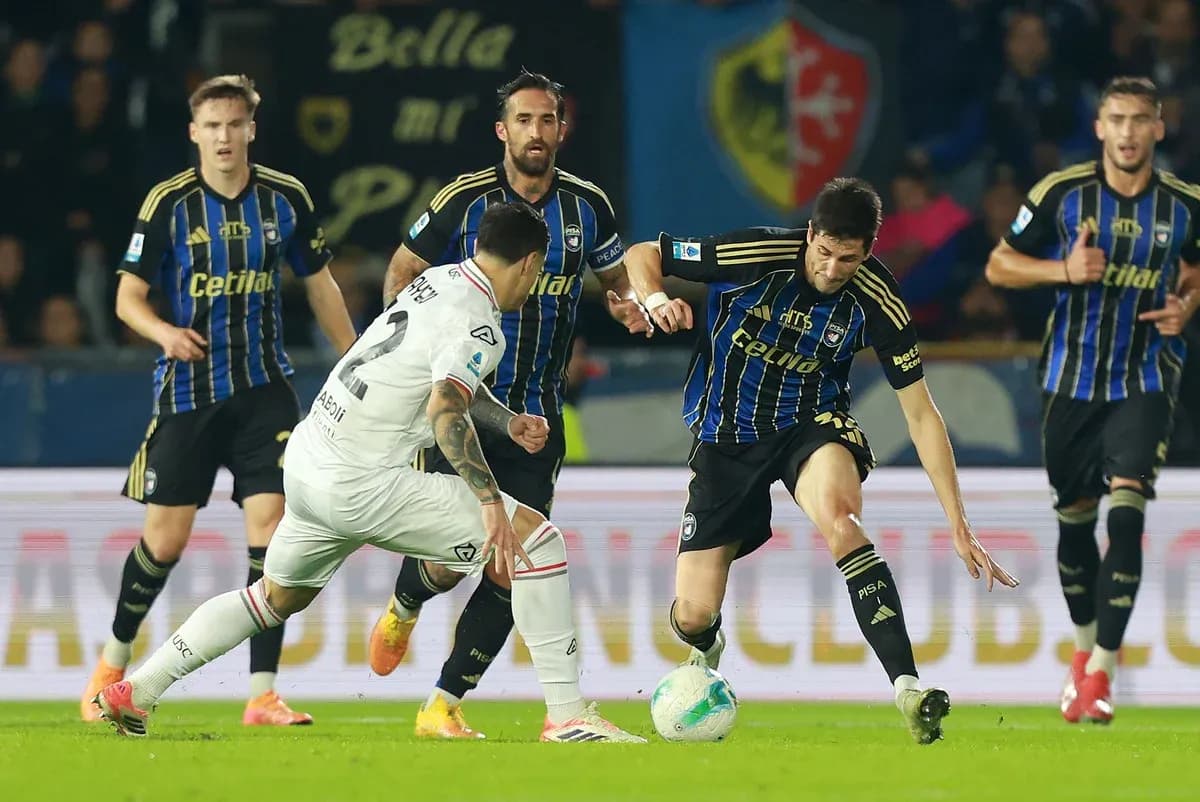
The tactical narrative begins with Pisa’s right-sided centre-back Rosen Bozhinov. Booked on 16' for a Foul, he never adjusted to Cremonese’s repeated targeting of the right half-space. A second Foul at 23' brought a second yellow and immediate red, forcing Pisa to abandon their original 3-5-2 balance and drop into a de facto 4-4-1/5-3-1 hybrid, with wide midfielders deeper and forwards isolated.
Cremonese capitalised quickly. On 31', J. Vardy struck the opener for the home side, punishing Pisa’s disorganised back line. The 1-0 half-time score reflected Cremonese’s control but also Pisa’s inability to progress the ball with a man down and zero shots attempted.
After the break, Pisa tried to stabilise through Arturo Calabresi, but his yellow card on 49' for a Foul underlined the strain on the reconfigured defence. Two minutes later, the pressure told: on 51', F. Bonazzoli finished a move created by J. Vandeputte, doubling the lead to 2-0 and effectively locking Cremonese into a low-risk, high-control game-state.
The match tipped from difficult to impossible for Pisa on 57', when midfielder Felipe Loyola was sent off directly for a Foul. Down to nine men, Pisa’s 3-5-2 shape disintegrated into a deep, narrow block with almost no counter-attacking threat. Late on, at 86', substitute D. Okereke added a third, assisted by A. Zerbin, exploiting the exhausted and numerically depleted defence. The final disciplinary note came at 89', with Malthe Højholt booked for a Foul, emblematic of Pisa’s reactive, last-ditch defending.
Tactical Breakdown & Personnel
Giampaolo’s 4-4-2 was built on structural superiority rather than volume shooting: Cremonese produced 10 total shots (6 on goal) but, more importantly, controlled every phase of play. The back four of G. Pezzella, S. Luperto, M. Bianchetti and F. Terracciano operated high and compact, effectively compressing Pisa into their own third. With Pisa attempting 0 shots and earning just 1 corner, Cremonese’s rest-defence and counter-pressing were so well-timed that E. Audero registered 0 saves; Pisa never reached finishing zones.
In midfield, the double pivot of A. Grassi and Y. Maleh, flanked by T. Barbieri and J. Vandeputte, created a box around Pisa’s central trio. Cremonese’s 735 passes, 684 accurate (93%), illustrate a possession game focused on circulation and patient probing. The wide midfielders held chalk-on-boots positions, stretching Pisa’s wing-backs and forcing the outer centre-backs into repeated 1v1 duels. It was this repeated exposure on the right that led to Bozhinov’s two Fouls and eventual dismissal.
Up front, J. Vardy and F. Bonazzoli offered complementary movements: Vardy attacking depth and channels, Bonazzoli dropping between the lines. The first goal at 31' came from exploiting Pisa’s transitional disarray after the red card, with Vardy finding space against a reconfigured but uncoordinated back line. The second, on 51', was more emblematic of the game’s tactical trend: Vandeputte’s assist from a wide-left position followed sustained possession, pulling Pisa’s remaining defenders across and opening central finishing lanes for Bonazzoli.
Giampaolo’s substitutions were game-state driven. At 59', M. Thorsby (IN) came on for Y. Maleh (OUT), adding physicality and aerial presence in midfield with the game already tilted. A. Zerbin (IN) for G. Pezzella (OUT) at the same minute allowed Cremonese to push even more aggressively down the flank against a Pisa side reduced to ten, then nine. Later, A. Sanabria (IN) replaced J. Vardy (OUT) at 72' and D. Okereke (IN) came on for J. Vandeputte (OUT), adding fresh legs and direct running against a collapsing block; Okereke’s 86' goal from Zerbin’s assist was the direct payoff of those changes. Finally, F. Folino (IN) for S. Luperto (OUT) at 85' was a low-risk rotation with the result secured.
For Pisa, Oscar Hiljemark’s initial 3-5-2 with A. Semper in goal and a back three of S. Canestrelli, A. Caracciolo and Rosen Bozhinov was designed for compactness and counters through M. Leris and I. Toure wide, with S. Moreo and F. Stojilkovic up front. The early red forced a structural collapse: A. Calabresi (IN) for S. Moreo (OUT) and S. Angori (IN) for M. Leris (OUT) at 37' were emergency moves to restore a functional back line and wing-back coverage. Later substitutions — M. Højholt (IN) for I. Vural (OUT) and H. Meister (IN) for F. Stojilkovic (OUT) at 65', then G. Piccinini (IN) for E. Akinsanmiro (OUT) at 72' — were largely damage limitation, adding legs in midfield and attack but unable to change the fundamental dynamic: Pisa had 218 passes, 161 accurate (74%), but almost all in deep, non-threatening zones.
Semper’s 2 saves underline that, despite the 3 goals conceded, Cremonese were selective rather than wasteful in chance creation. Pisa’s defensive index is defined more by discipline than structure: 12 fouls, 4 yellows, 2 reds, and an xG of 0 point to a side that spent almost the entire match without a viable attacking plan and increasingly resorted to Fouls to slow Cremonese’s circulation.
The Statistical Verdict
The raw numbers confirm the tactical story. Cremonese’s 77% possession, 10–0 shot dominance and 7–1 corner advantage reflect an almost uninterrupted grip on territory and tempo. Their xG of 1.15 versus 3 actual goals suggests clinical finishing and effective exploitation of numerical superiority rather than sheer volume of chances. Pisa, with 0 xG and 0 shots, never built a coherent attacking sequence into the final third.
Passing metrics highlight the gulf in overall form: Cremonese’s 735 passes, 684 accurate (93%), indicate a high-functioning possession side comfortable recycling the ball under minimal pressure. Pisa’s 218 passes, 161 accurate (74%), show a team pinned back, forced into longer or rushed passes, and unable to establish stable possession.
Defensively, the contrast in discipline is stark. Cremonese finished without a single card, maintaining structural and emotional control. Pisa’s 4 yellow cards and 2 red cards — all explicitly for Foul — destroyed their defensive index from within, repeatedly forcing Hiljemark to reshuffle and ultimately leaving his side to defend vast spaces with nine men. The 3-0 scoreline, read through the lens of structure, possession and discipline, is not just deserved; it is the logical outcome of Cremonese’s tactical superiority and Pisa’s self-inflicted collapse.