.svg&w=384&q=75 "naujapitch logo")
Australia vs Egypt: World Cup Round of 32 Showdown
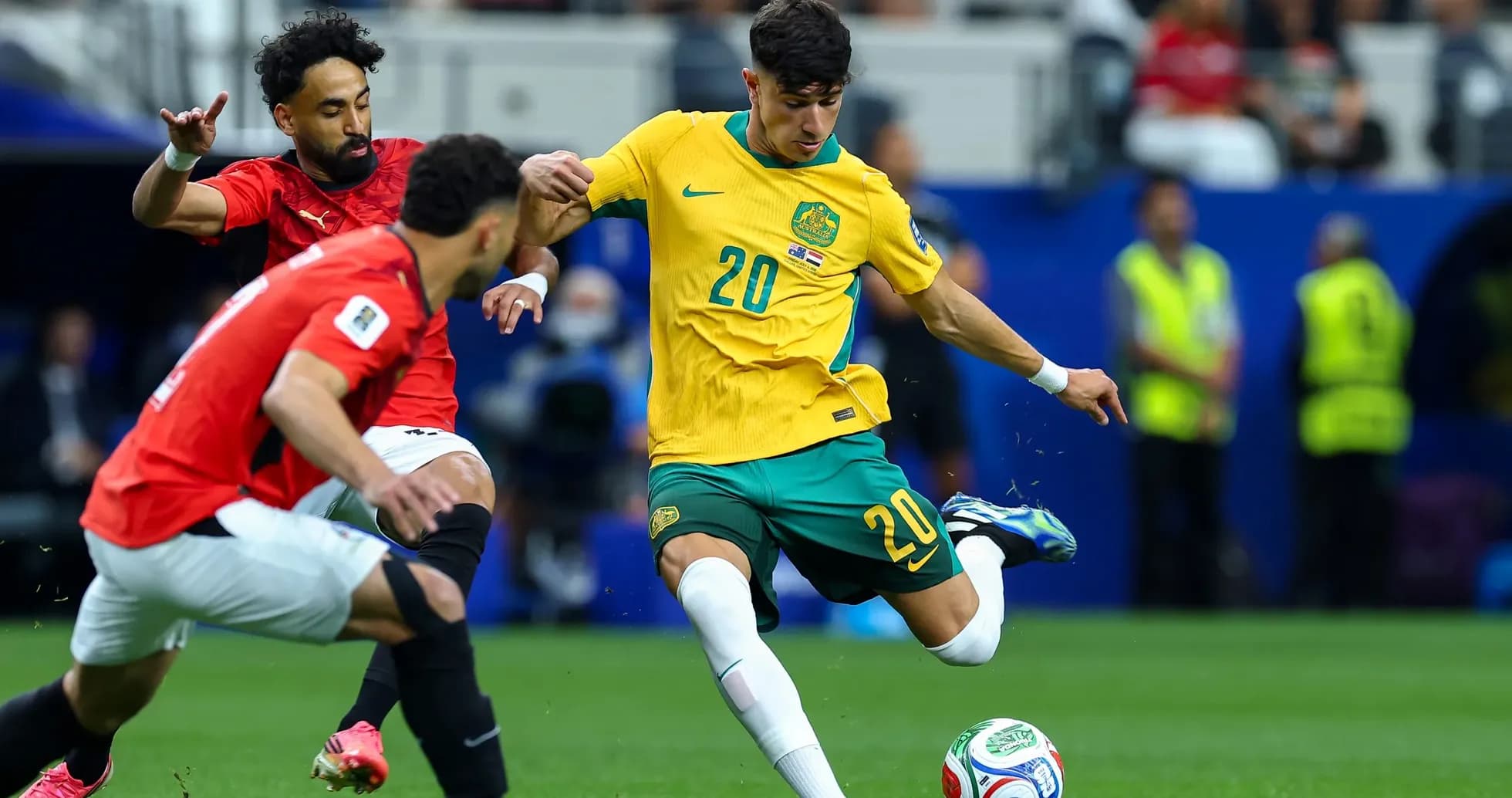
The World Cup’s Round of 32 in Dallas ended not with a late winner but with the slow-burn cruelty of penalties. After 120 minutes at AT&T Stadium, Australia and Egypt were still locked at 1–1, before Egypt held their nerve from the spot to prevail 4–2 in the shootout. It was a match that felt like a clash of footballing identities: Australia’s structural discipline and set-pattern pressing against Egypt’s more polished attacking core built around Mohamed Salah.
Heading into this game, the broader seasonal picture already hinted at contrasting profiles. Overall, Australia had played 4 World Cup matches, winning 1, drawing 2 and losing 1. They had scored 3 goals in total and conceded 3, giving them a goal difference of 0. At home venues in this tournament, they had scored 3 and conceded 1, with averages of 1.5 goals for and 0.5 against. On their travels they had yet to score, averaging 0.0 goals for and 1.0 against. Egypt, by contrast, arrived unbeaten overall: 1 win and 3 draws from 4 games, with 6 goals for and 4 against for a goal difference of 2. At home they had scored 1 and conceded 1; away from home they had 5 goals for and 3 against, averaging 1.7 goals scored and 1.0 conceded.
I. The Big Picture: Shapes, Stakes, and Seasonal DNA
Australia’s selection under Tony Popovic leaned into a three-at-the-back structure that has become a second skin this tournament. The 3-4-2-1 here was not an experiment; they had already used back-five and back-three variants, with two matches in a 5-4-1 and two in a 3-4-2-1. In Dallas, P. Beach started in goal behind a trio of A. Circati, H. Souttar and L. Herrington. The wing lanes belonged to J. Bos and A. Behich, with J. Irvine and A. O’Neill as the double pivot. Ahead of them, C. Volpato and C. Metcalfe supported the lone striker N. Irankunda.
Egypt, ranked second in Group G, arrived with a different kind of continuity: four games, four unbeaten, and a clear tilt towards front-foot football. Hossam Hassan set his side up in a 4-4-2 on the night, a slight departure from their more common 4-2-3-1 but still recognisably Egyptian in its emphasis on width and Salah’s gravity. O. Shobeir was in goal, shielded by a back four of M. Hany, Y. Ibrahim, R. Rabia and K. Hafez. The midfield band of four—E. Ashour, H. Fathy, M. Attia and O. Marmoush—had to knit defence and attack, with Salah and M. Ziko forming a flexible front two.
Australia’s group-stage path had been rugged rather than fluent. Overall they had averaged 0.8 goals scored and 0.8 conceded per game, a statistical reflection of tight margins. Their biggest win at home was 2–0; their heaviest defeat away was 2–0. Two clean sheets overall, split evenly between home and away venues, showed that when their block is set, they are hard to break. But they had also failed to score in 2 of 4 matches overall, both on their travels—an ominous sign against an Egypt side that had never drawn a blank this tournament.
Egypt’s seasonal profile was that of a team comfortable in chaos. Overall they averaged 1.5 goals scored and 1.0 conceded per game. They had not kept a single clean sheet but had also failed to score in 0 of their 4 matches, always finding a way to create. Their standout away win, 3–1, underlined the threat they carry when they can counter into space.
II. Tactical Voids: Absences and Discipline
Both coaches had to navigate significant absences that reshaped their tactical options.
For Australia, M. Leckie and J. Italiano were ruled out—Leckie with a hamstring injury and Italiano with ankle problems. Leckie’s absence was particularly felt in the forward rotation: without his experience and channel running, more creative burden fell on Volpato and Metcalfe to connect with Irankunda, while the bench leaned on younger or less battle-hardened forwards like M. Toure, T. Yengi and N. Velupillay.
Egypt’s list was longer and more structurally disruptive. Hossam Abdelmaguid was suspended through a sports court ruling, while Mohanad Lasheen, one of the tournament’s leading yellow-card collectors, was also missing through suspension. Add to that injuries to Ahmed Abou El Fotouh, Mohamed Abdelmonem and Mohanad Lasheen’s disciplinary absence, and Hassan was forced to reconfigure his defensive and midfield spine. Abdelmonem’s ankle problems and Abou El Fotouh’s hamstring issue removed two experienced defensive pieces; Lasheen’s absence stripped energy and ball-winning from midfield.
Discipline trends also framed the risk profile. Australia’s yellow-card distribution overall showed a pronounced late-game spike: 40.00% of their cautions arrived between 76–90 minutes, with 20.00% each in the 16–30, 31–45 and 46–60 ranges. That pattern hinted at a team that often ends matches under pressure, scrambling to hold leads or salvage draws. Egypt’s bookings were more evenly spread but still told a story: 12.50% of yellows in the opening 15 minutes, 25.00% between 16–30, another 25.00% between 31–45, then a lull before a late flare-up—25.00% between 91–105 and 12.50% from 106–120. In other words, they start aggressively and can become ragged again in extra time.
III. Key Matchups: Hunter vs Shield, and the Engine Room
The headline duel was always going to be Mohamed Salah against Australia’s back three. Salah came into this fixture as one of the World Cup’s leading creative forces: 4 appearances, all starts, 338 minutes, with 1 goal and 2 assists. He had taken 6 shots, 4 on target, created 16 key passes from 113 total passes, and completed 6 of 13 dribbles. His duels record—37 contested, 19 won—underlined how often he is at the heart of Egypt’s attacking confrontations. Even more telling was his discipline: no yellow or red cards, a player who stays on the pitch and keeps asking questions.
Against him stood a defensive unit anchored by H. Souttar and flanked by A. Circati and L. Herrington, with Bos and Behich tracking back from the flanks. Australia’s overall defensive record—3 goals conceded in 4 games, 0.5 goals conceded on average at home—suggested a unit that thrives when it can compress space in its own third. But Egypt’s away scoring rate of 1.7 goals per game overall, plus their refusal to fail to score in any match, meant the “shield” was always under stress.
Within Egypt’s back line, Yasser Ibrahim was a key figure. Over the tournament he had made 4 appearances (3 starts), playing 376 minutes. His passing accuracy of 91% from 236 passes pointed to a calm distributor at the back. Defensively, he had 7 tackles, 3 successful blocks and 2 interceptions, plus 52 duels contested and 22 won. But he also carried disciplinary risk: 2 yellow cards overall, and 5 fouls committed. In a match where Australia’s wide players like Bos and Behich would test the channels, Ibrahim’s timing in stepping out and his ability to block—he had already blocked 3 shots in the tournament—were crucial.
In midfield, the engine-room clash pitted Australia’s double pivot of Irvine and O’Neill against Egypt’s central trio of Fathy, Attia and Ashour. With Lasheen absent, Egypt lost a midfielder who had made 13 tackles, 4 blocks and 4 interceptions across the tournament, as well as 21 duels won from 37. That forced more responsibility onto Fathy and Attia to break up play and protect the back four, potentially reducing their ability to support transitions.
IV. Statistical Prognosis and Tactical Arc
On paper, the statistical balance tilted slightly towards Egypt. Overall they scored more (6 to Australia’s 3), conceded only one more (4 to 3), and had a positive goal difference of 2 versus Australia’s 0. They had never lost in 4 games, whereas Australia had already tasted defeat once overall. Egypt also had no record of failing to score, while Australia had drawn blanks in 2 of 4 matches overall—both away from home venues.
Yet Australia’s home-venue defensive solidity, with just 1 goal conceded in 2 matches and 1 clean sheet, suggested that in a neutral-site knockout environment they could drag the game into the attritional zone they prefer. Their late yellow-card surge between 76–90 minutes overall hinted at a strategy of hanging on, even if it meant taking bookings to break rhythm.
Egypt’s own disciplinary curve, with bookings clustered early and then again in extra time, mirrored the match narrative: an aggressive start, a period of control, then tension as legs tired and decisions grew riskier. In that context, Salah’s composure and Egypt’s broader attacking variety—Marmoush drifting inside from the flank, Ziko offering runs beyond—gave them the marginal edge in chance creation.
The penalty shootout, which Egypt won 4–2 after a 1–1 draw over 120 minutes, felt like the logical extension of those underlying numbers. Australia’s campaign had been defined by fine margins and low-scoring contests; Egypt’s by their ability to find a goal in every game and survive without ever fully shutting opponents out. In Dallas, the shield held long enough to reach spot-kicks, but the hunter’s nerve from twelve yards ultimately decided who walked away from the Round of 32 and who stayed behind under the Texas lights.